Quantum Sensor Breakthrough for Invisible Universe Exploration

QuantumPhysics AtomInterferometry DarkMatter GravitationalWaves ImperialCollegeLondon ScientificBreakthrough

Zusammenfassung

Mindmap Titelbild
KI Generiertes Titelbild

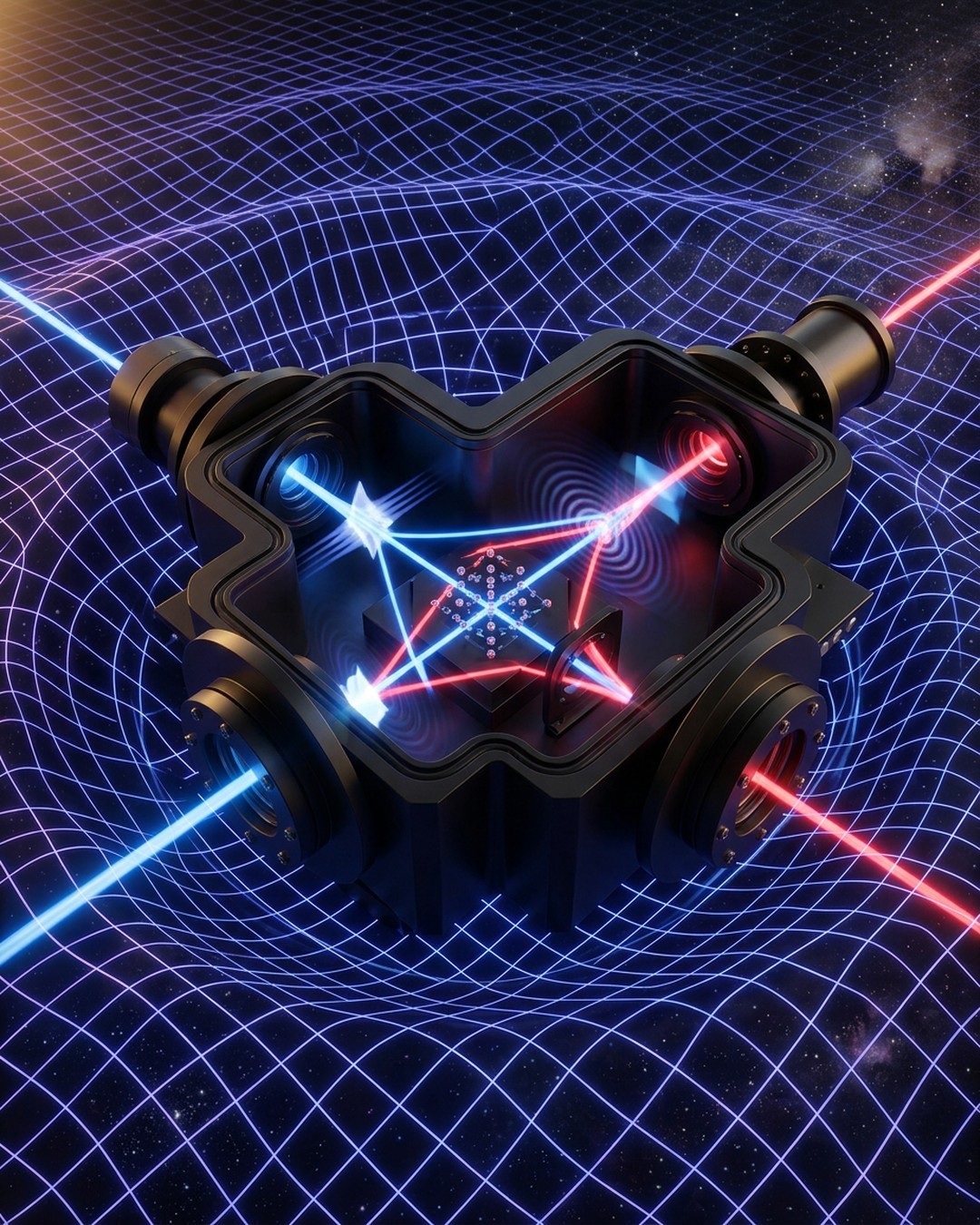
Researchers at Imperial College London have successfully demonstrated a prototype quantum sensor capable of isolating faint signals from overwhelming experimental noise. By utilizing two long baseline atom interferometers and a shared ultrastable clock laser, the team proved that differential measurement techniques can effectively cancel out phase noise, a critical hurdle in detecting gravitational waves and dark matter. This breakthrough, published in Nature on June 17, 2026, validates the core methodology required for next-generation large-scale quantum observatories. The research team, part of the Atom Interferometer Observatory and Network (AION) collaboration, emphasizes that this technology is essential for probing regions of the universe previously inaccessible to current detectors. By comparing the behavior of two ultracold strontium-87 atom clouds, the system successfully recovered signals that were otherwise masked by noise, reaching the fundamental limits defined by quantum physics. This approach provides a scalable blueprint for future international facilities like those proposed at CERN and Fermilab. The study addresses the primary technical challenge of phase noise in high-precision quantum sensing. By intentionally introducing excessive noise into their tabletop prototype, the researchers confirmed that the differential method allows for the detection of oscillating signals, such as those potentially generated by dark matter fields or ancient gravitational waves. This validation marks a significant milestone in the transition from theoretical quantum sensing concepts to practical, large-scale experimental applications. This development offers a strategic pathway for future fundamental physics research, enabling the exploration of intermediate-mass black holes and other invisible cosmic phenomena. For the scientific community, this confirms that atom interferometry is a viable, high-resolution tool for long-term cosmological observation, with immediate implications for the design of upcoming global quantum sensing networks.

Schlüsselpunkte

01

🔹 Breakthrough in Quantum Noise Cancellation

Researchers at Imperial College London demonstrated a differential measurement technique using two long baseline atom interferometers. By comparing two clouds of ultracold strontium-87 atoms measured with a single ultrastable clock laser, the team successfully canceled out significant phase noise, allowing for the detection of faint signals that were previously obscured.

02

🔸 Significance for Fundamental Physics

The ability to isolate signals from noise is critical for detecting gravitational waves and dark matter. This technology enables scientists to probe previously inaccessible regions of the universe, such as intermediate-mass black holes, which played a pivotal role in galaxy formation millions of years ago.

03

⭐ Experimental Methodology and Validation

The team used a tabletop prototype to simulate conditions expected in large-scale detectors. They intentionally added excessive phase noise to the system to stress-test the differential method. The results showed that while individual measurements were unusable, the comparison between the two interferometers successfully recovered the underlying signal, reaching the fundamental quantum limit.

04

📊 The AION Collaboration and Future Scaling

The work is part of the Atom Interferometer Observatory and Network (AION) collaboration, which aims to scale these sensors for international facilities. Proposed projects include the Atom Interferometry CERN Experiment (AICE) and partnerships with the MAGIS project at Fermilab, potentially creating some of the largest quantum experiments ever built.

05

💡 Technical Specifications and Materials

The experiment utilized ultracold strontium-87 atoms cooled to near absolute zero using blue and red laser systems. The precision of the clock laser is vital, as it must maintain stability to the fifteenth decimal point to ensure the accuracy of the quantum state splitting and recombination process.

Möchten Sie Ihre eigene Mindmap erstellen?

Melden Sie sich bei Neumap AI an und beginnen Sie mit der Erstellung Ihrer eigenen Mindmaps!

Loslegen