The Brain Can Reason Without Language, MIT Study Finds

scitechdaily neuroscience mit cognitive-science language mri

Zusammenfassung

Mindmap Titelbild
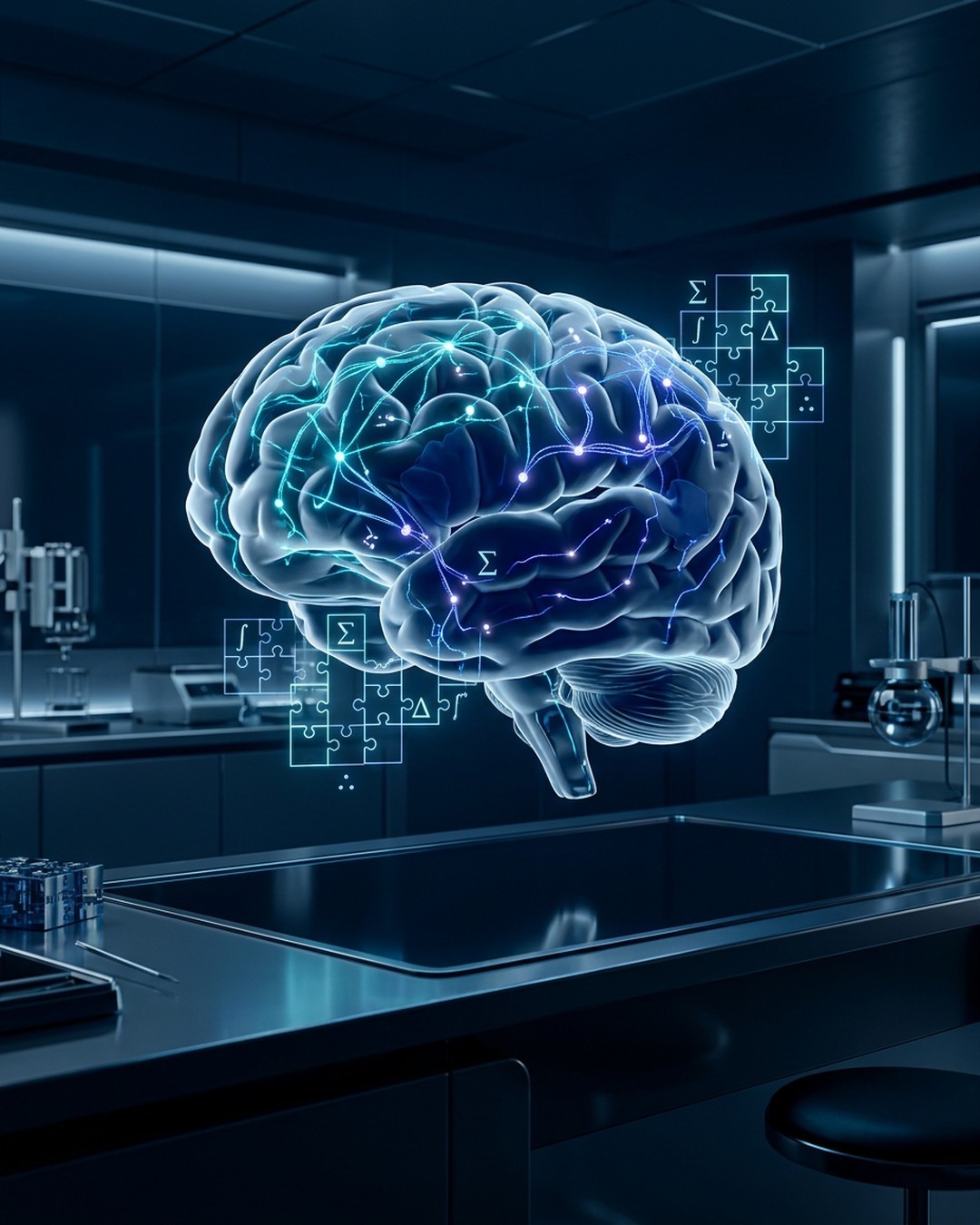
KI Generiertes Titelbild

A study published on July 22, 2026, in PNAS by cognitive neuroscientists at MIT's McGovern Institute for Brain Research, led by associate professor Evelina Fedorenko and postdoc Hope Kean, reveals that logical reasoning does not rely on the brain regions responsible for language processing. The research tested stroke patients with severe aphasia and healthy participants undergoing functional MRI scans, demonstrating that individuals with profound language impairments can still successfully solve complex logic puzzles and abstract reasoning tasks. The authors challenge the long-standing philosophical and cognitive assumption that language serves as the necessary foundation or machinery of thought. By utilizing non-verbal puzzles involving number sequences and geometric designs, the study highlights that abstract thinking and rule induction possess independent cognitive mechanisms that operate entirely separately from linguistic systems in the human brain. The core findings indicate that while language is frequently used to communicate instructions or articulate logical conclusions, the actual mental execution of formal reasoning occurs outside the brain's language network. Furthermore, functional brain imaging confirmed that language regions remain inactive during inductive reasoning tasks, shifting our understanding of how complex problem-solving and cognitive architecture are organized. These insights carry significant practical implications for clinical evaluations, suggesting that communication difficulties in conditions like aphasia, stuttering, or foreign language barriers do not equate to a lack of intelligence or reasoning capability. Additionally, comparing human cognitive separation of language and logic with artificial intelligence models like ChatGPT provides a new benchmark for designing future AI systems that attempt to mimic human reasoning.

Schlüsselpunkte

01

🔹 Core Finding on Language and Logic Independence

Published on July 22, 2026, in PNAS, a study led by Evelina Fedorenko and Hope Kean at MIT's McGovern Institute for Brain Research demonstrates that logical reasoning does not rely on brain regions involved in language processing. Participants with severe aphasia caused by strokes successfully solved complex logic puzzles without language.

02

🔸 Experimental Methodology with Aphasia Patients

Conducted in collaboration with Rosemary Varley from University College London, researchers tested two stroke patients with severe language impairments using non-verbal tasks. Patients analyzed number lists to find hidden rules and completed geometric matrix puzzles, performing as well as control groups and communicating rules via gestures.

03

⭐ Functional Brain Imaging Results

Functional MRI scans of neurotypical participants performing logic games and syllogistic if-then statements showed that neither inductive nor deductive reasoning activated the brain's language system. Inductive reasoning activated the multiple demand network, revealing a clear neurological separation between language and logic.

04

📊 Clinical Implications for Aphasia and Intelligence

The research establishes that severe language loss does not equate to diminished intelligence. Clinicians are reminded that communication disorders, such as aphasia or developmental language conditions like stuttering, do not accurately reflect an individual's abstract logical capacity, problem-solving skills, or overall cognitive competence.

05

💡 Implications for Artificial Intelligence Development

Large language models like ChatGPT and Claude rely purely on text generation to imitate human reasoning. Comparing these AI systems with the human brain, where language and abstract logic operate via separate neural pathways, helps researchers understand current limitations and design more advanced future AI architectures.

Möchten Sie Ihre eigene Mindmap erstellen?

Melden Sie sich bei Neumap AI an und beginnen Sie mit der Erstellung Ihrer eigenen Mindmaps!

Loslegen