Supercharged Natural Killer Cells Against Solid Tumors

scitechdaily stanford-medicine cancer-immunotherapy natural-killer-cells solid-tumors

Zusammenfassung

Mindmap Titelbild
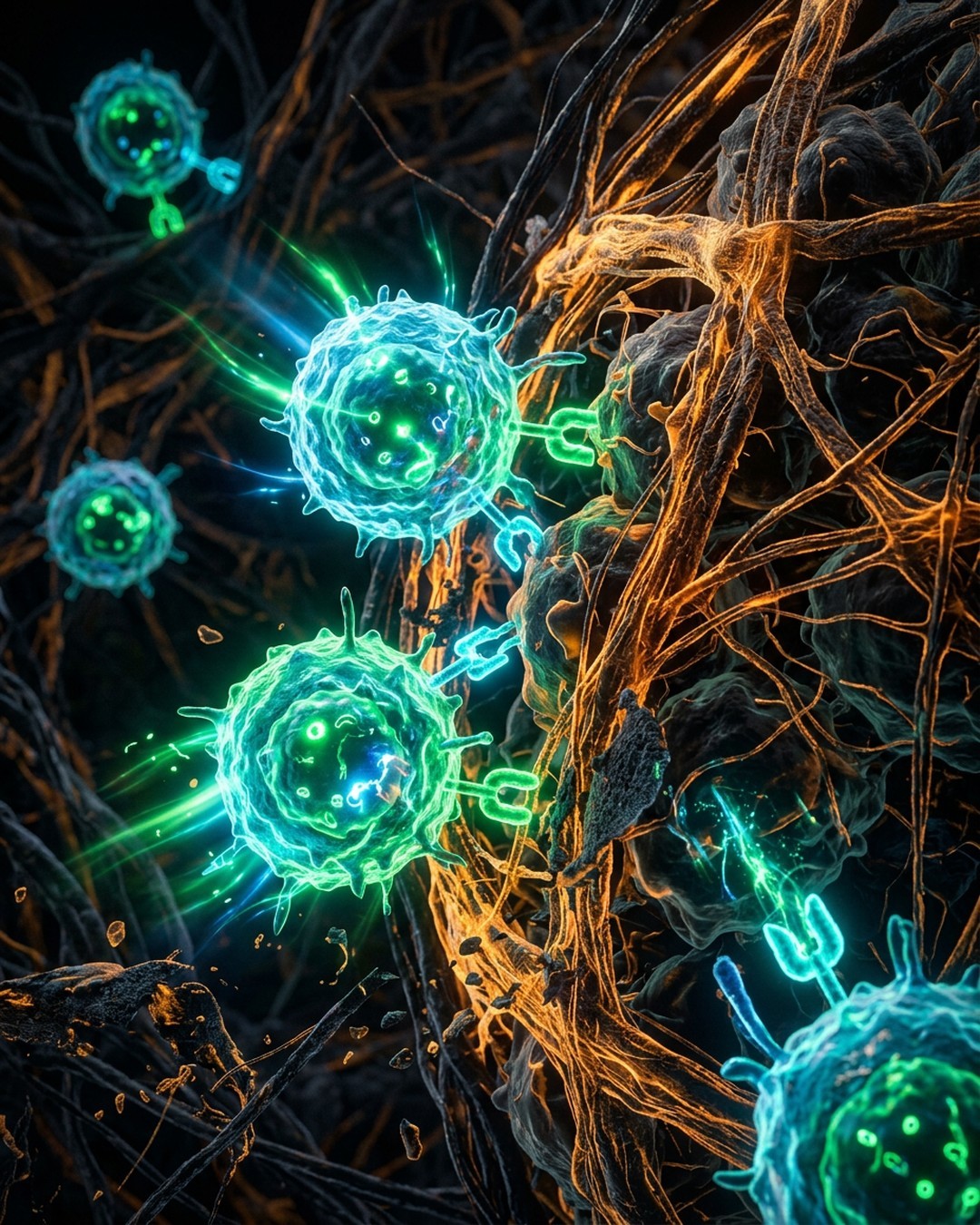
KI Generiertes Titelbild

Researchers at Stanford Medicine published a groundbreaking study on August 22, 2026, detailing a method to supercharge natural killer (NK) cells to successfully infiltrate and attack solid tumors. Solid tumors traditionally act as fortified strongholds that block immune cells while releasing immunosuppressive signals. By exposing blood-derived human NK cells to brief bursts of active transforming growth factor beta (TGF-beta) through direct contact with human epithelial tumor cells, the team generated specialized cytotoxic tissue-resident NK cells defined by the surface markers CD39, CD49a, and CD103. Led by senior author John Sunwoo, MD, alongside co-lead authors Nina Horowitz, Imran Mohammad, and June Ho Shin, the research team demonstrated that these enhanced NK cells significantly slowed the growth of solid tumors, such as human melanoma and head and neck squamous cell carcinoma, in mouse models. The study further revealed that combining these supercharged NK cells with the monoclonal antibody treatment cetuximab produced a synergistic effect, drastically suppressing tumor growth over a 30-day period without causing apparent adverse health effects in the subjects. A major strategic advantage of these enhanced natural killer cells is that they do not trigger a host immune rejection response when transferred between individuals. This characteristic opens the possibility of manufacturing the therapy in large batches, cryopreserving the doses, and providing them as an off-the-shelf treatment rather than requiring custom manufacturing from each individual patient's own biological samples. One single donor source can yield approximately twenty therapeutic doses within roughly two weeks. The practical application of these findings culminates in an upcoming Phase I clinical trial slated to begin by the end of 2026, pending Food and Drug Administration approval. This trial will test the combination therapy of enhanced natural killer cells and cetuximab in patients suffering from advanced squamous cell carcinoma. Medical professionals and researchers can utilize these insights to advance accessible, off-the-shelf immunotherapies targeting treatment-resistant solid tumors.

Schlüsselpunkte

01

🔹 Breakthrough in Solid Tumor Immunotherapy

【📌 Key Finding】Stanford Medicine researchers discovered a method to transform conventional blood-derived natural killer (NK) cells into specialized tissue-resident NK cells that successfully penetrate and destroy solid tumors. 【🔸 Impact Factors】Solid tumors normally act as fortified strongholds that keep immune cells out while emitting signals to blunt attacks, a barrier this new cellular modification successfully breaches. 【⭐ Data Support】Published on August 22, 2026, in Science Translational Medicine (DOI: 10.1126/scitranslmed.adw5567), with preclinical trials demonstrating significant tumor growth reduction in mice over a 30-day period.

02

🔸 The Goldilocks TGF-beta Recipe

【📌 Key Finding】Generating effective cancer-killing tissue-resident NK cells requires a precise, brief exposure to transforming growth factor beta (TGF-beta) delivered via direct contact with human epithelial tumor cells. 【🔸 Impact Factors】Constant or excessive TGF-beta exposure creates inhibited and dysfunctional tissue-resident NK cells that fail to kill, whereas a carefully controlled, brief signal produces potent killers. 【⭐ Data Support】The resulting supercharged cells express specific surface proteins including CD39, CD49a, and CD103, alongside elevated levels of cell-killing molecules like perforin and granzyme A.

03

⭐ Synergy With Monoclonal Antibody Treatment

【📌 Key Finding】Combining the enhanced tissue-resident NK cells with cetuximab, an FDA-approved monoclonal antibody treatment, yielded dramatically superior tumor suppression compared to either therapy used alone. 【🔸 Impact Factors】Cetuximab marks specific tumor cells for destruction, allowing the supercharged NK cells to target and eliminate malignant cells more efficiently in models of melanoma and head and neck squamous cell carcinoma. 【⭐ Data Support】Mice receiving the combination treatment remained healthy through day 30, whereas control subjects experienced severe disease progression.

04

📊 Scalable Off-the-Shelf Manufacturing Potential

【📌 Key Finding】Because natural killer cells do not trigger cross-patient immune rejection reactions, the therapy can be manufactured at scale and stored for immediate clinical use. 【🔸 Impact Factors】This eliminates the lengthy and expensive requirement to custom-manufacture immunotherapies from each individual patient's own cells, drastically improving clinical accessibility and turnaround time. 【⭐ Data Support】A single donor sample can yield approximately twenty cryopreserved therapeutic doses within a production window of roughly two weeks.

05

💡 Upcoming Clinical Trials and Future Outlook

【📌 Key Finding】Principal investigator John Sunwoo and his collaborators are preparing a Phase I clinical trial to evaluate the combination therapy in humans. 【🔸 Impact Factors】Pending Food and Drug Administration approval, the trial will test the enhanced NK cells combined with cetuximab on patients suffering from advanced squamous cell carcinoma by the end of 2026. 【⭐ Data Support】Research funding was provided by National Institutes of Health grants R35DE030054, K22CA282364, and R25DC020174, alongside the Tai Tsun Wu Research Fund and Stanford Bio-X Fellowship.

Möchten Sie Ihre eigene Mindmap erstellen?

Melden Sie sich bei Neumap AI an und beginnen Sie mit der Erstellung Ihrer eigenen Mindmaps!

Loslegen