SPIFFI Microscope Technology in Live Cell Imaging

scitechdaily cell-biology microscopy biophysics epfl

Zusammenfassung

Mindmap Titelbild
KI Generiertes Titelbild

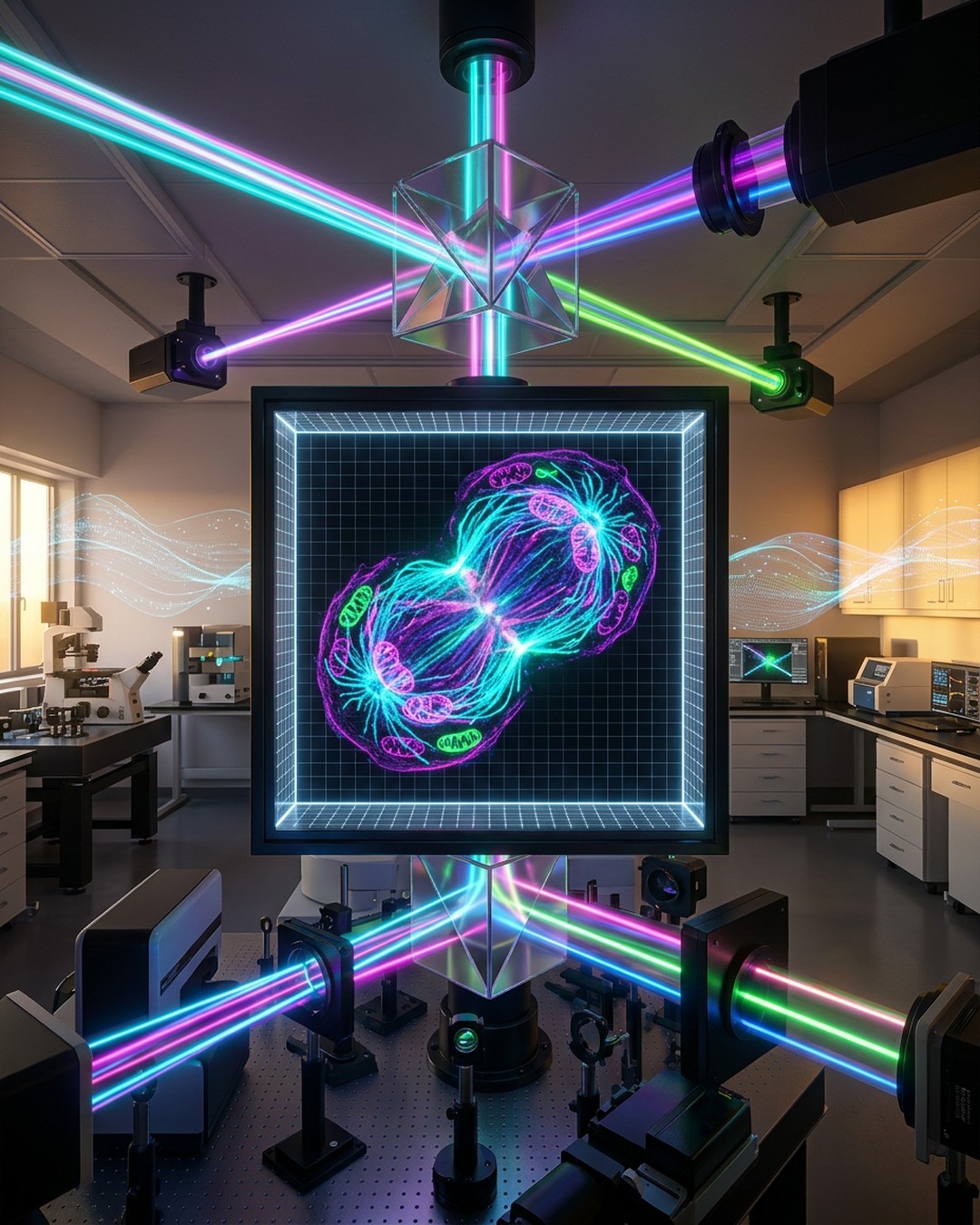
Researchers at the École Polytechnique Fédérale de Lausanne (EPFL) have developed a novel imaging technique called Spatial Polarization-Induced Fluorescence Fluctuation Imaging (SPIFFI), published in Nature Methods on August 31, 2026. Traditional super-resolution microscopy requires hundreds or thousands of sequential images, causing motion blur when observing dynamic living cells. The SPIFFI technique overcomes this limitation by capturing microscopic details in a single camera exposure using polarization properties of fluorescent light. By separating emitted light into four polarization-sensitive channels simultaneously, the system resolves fine structures down to 160 to 170 nanometers, and up to 80 nanometers when combined with post-processing fluctuation methods. This breakthrough enables scientists to observe rapid cellular dynamics, such as moving mitochondria and microtubules, as well as cellular fusion and splitting events in real time. Because every individual frame is super-resolved, researchers can now seamlessly produce high-resolution videos of live cellular processes without sacrificing spatial detail. The technology integrates easily into existing fluorescence microscopes, opening new avenues for research in cell biology, neuroscience, biophysics, and drug discovery where observing rapid structural changes inside living organisms is critical.

Schlüsselpunkte

01

🔹 SPIFFI Technology Overview

Developed by Aleksandra Radenovic and her team at EPFL's Laboratory of Nanoscale Biology (LBEN), Spatial Polarization-Induced Fluorescence Fluctuation Imaging (SPIFFI) captures high-resolution cellular images in a single camera exposure, eliminating motion blur caused by multi-frame accumulation.

02

🔸 Resolution and Performance Metrics

SPIFFI achieves a twofold improvement in image resolution, distinguishing structures as small as 160 to 170 nanometers directly, and reaching approximately 80 nanometers when integrated with existing fluctuation-based post-processing methods.

03

⭐ Polarization-Based Imaging Mechanism

Instead of accumulating temporal information across hundreds of frames, SPIFFI separates emitted fluorescent light into four distinct channels, each sensitive to a specific polarization component, thereby extracting spatial orientation and fine structural details instantly.

04

📊 Applications in Live Cell Dynamics

The technology successfully images rapid cellular processes including moving mitochondria, reorganizing microtubules, and cellular structures undergoing fusion and splitting, which were previously difficult to resolve with traditional multi-exposure super-resolution techniques.

05

💡 Super-Resolution Video Generation

Because every single camera exposure yields a super-resolved frame, researchers can combine successive frames to produce true super-resolution videos of live cells without compromising spatial resolution through multi-frame reconstruction.

Möchten Sie Ihre eigene Mindmap erstellen?

Melden Sie sich bei Neumap AI an und beginnen Sie mit der Erstellung Ihrer eigenen Mindmaps!

Loslegen