Earth's Hidden Climate Thermostat Over 60 Million Years

scitechdaily climate-change marine-geology paleoclimatology sea-level syracuse-university

Zusammenfassung

Mindmap Titelbild
KI Generiertes Titelbild

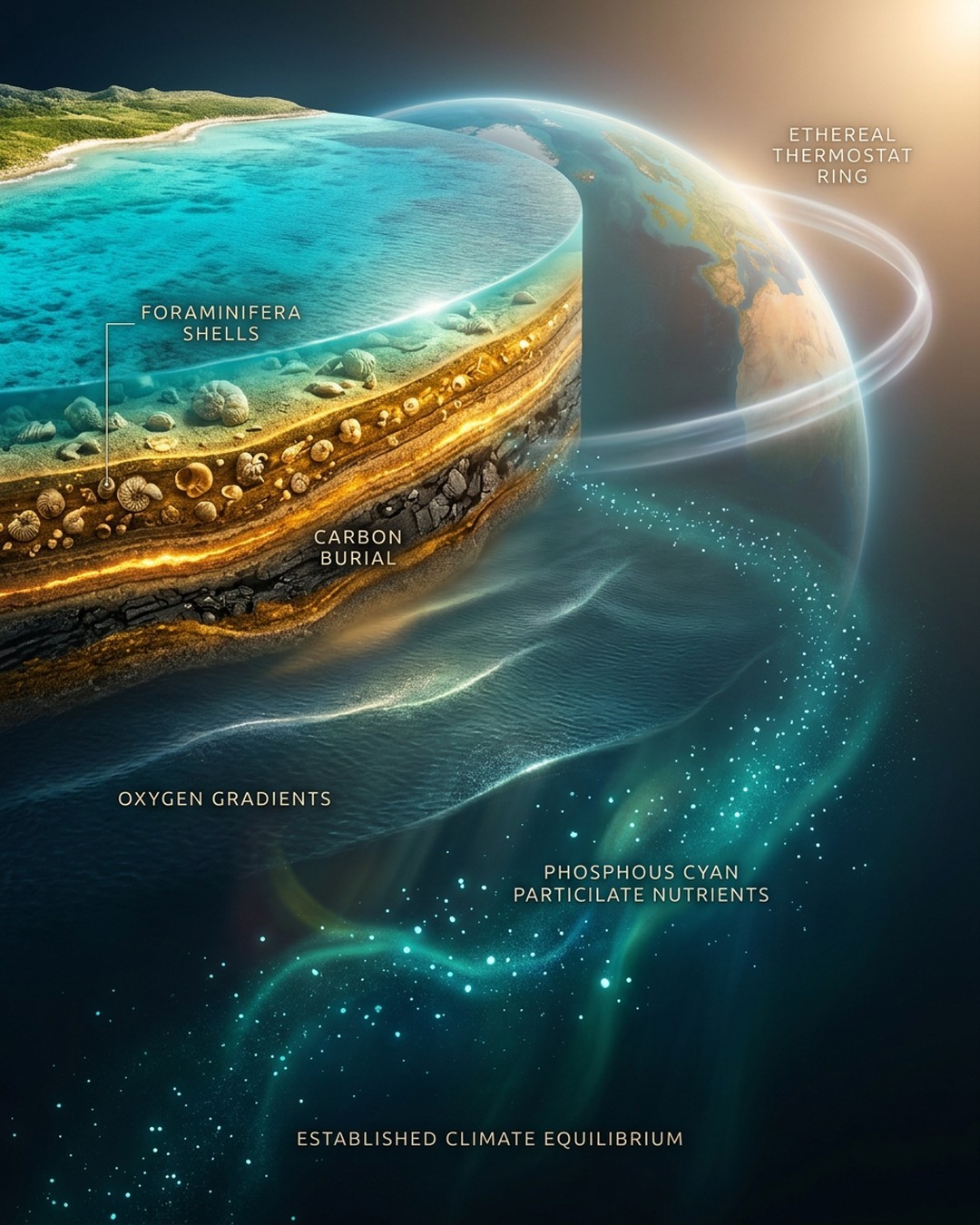
Recent geological research published on July 25, 2026, reveals that Earth's climate has been stabilized for over 60 million years by a hidden feedback mechanism linking sea level, ocean oxygen, phosphate availability, and carbon burial in marine sediments. The authors, including Zunli Lu from Syracuse University and lead author Ros Rickaby from the University of Oxford, demonstrate that temperature fluctuations altered polar ice sheets and sea levels, which consequently controlled the nutrient supply of phosphate required by marine organisms to grow. When sea levels stood at an optimal sweet spot of 10 to 40 meters above present heights, oxygen minimum zones aligned with organic-rich shelf sediments, initiating a reinforcing cycle that maximized organic carbon burial, lowered atmospheric carbon dioxide, and cooled the planet. This mechanism explains how Earth avoided extreme temperature fluctuations over vast geological timescales, providing crucial insights into ancient paleoclimatology and the complex interactions governing global climate resilience.

Schlüsselpunkte

01

🔹 【📌 Core Research Finding】Earth's 60-Million-Year Climate Thermostat

Published on July 25, 2026, in Proceedings of the National Academy of Sciences, research coauthored by Zunli Lu of Syracuse University and lead author Ros Rickaby of the University of Oxford shows that Earth's climate has been stabilized for over 60 million years by a natural feedback mechanism linking sea level, ocean oxygen, phosphate availability, and organic carbon burial.

02

🔸 【📌 Phosphate and Sea Level Link】Nutrient Availability Controls Carbon Burial

【📌 Nutrient Supply】Phosphate acts as a critical nutrient for marine organism growth. 【🔸 Continental Shelves】High sea levels flood continental shelves, trapping phosphate in shallow sediments and reducing organic carbon burial, which leaves open waters oxygenated and increases atmospheric carbon dioxide. 【⭐ Falling Sea Levels】Falling sea levels contract continental shelves, releasing more phosphate into open water, stimulating marine productivity, and consuming dissolved oxygen.

03

⭐ 【📌 The Sea Level Sweet Spot】Optimal Range for Maximum Carbon Sequestration

【📌 Optimal Elevation】The strongest carbon burial occurred when sea level stood between 10 and 40 meters above its present height. 【🔸 Oxygen Minimum Zones】Within this specific range, oxygen minimum zones aligned with organic-rich shelf sediments, creating a reinforcing cycle that buried carbon beneath the seafloor and reduced greenhouse warming for millions of years.

04

📊 【📌 Eocene Epoch Case Study】High Seas Weakening Earth's Carbon Sink

【📌 Eocene Conditions】Spanning approximately 56 to 34 million years ago, the Eocene epoch experienced extremely high sea levels that flooded continental shelves and trapped phosphate in shallow sediments. 【⭐ Reduced Burial】Because the carbon burial feedback mechanism became largely inactive, carbon dioxide accumulated unabated in the atmosphere, keeping Earth consistently warm.

05

💡 【📌 Advanced Analytical Methods】Iodine-to-Calcium Proxy and Mass Spectrometry

【📌 Scientific Technique】Researchers analyzed preserved chemical compositions of foraminifera microscopic marine organisms found in seafloor sediments. 【⭐ Laboratory Testing】Zunli Lu's laboratory at Syracuse University performed iodine-to-calcium measurements using a mass spectrometer funded by the National Science Foundation to determine ancient ocean oxygen levels.

Möchten Sie Ihre eigene Mindmap erstellen?

Melden Sie sich bei Neumap AI an und beginnen Sie mit der Erstellung Ihrer eigenen Mindmaps!

Loslegen