Dinosaurs Ate Fruit Earlier Than Thought

scitechdaily dinosaurs paleontology evolution fossils

Zusammenfassung

Mindmap Titelbild
KI Generiertes Titelbild

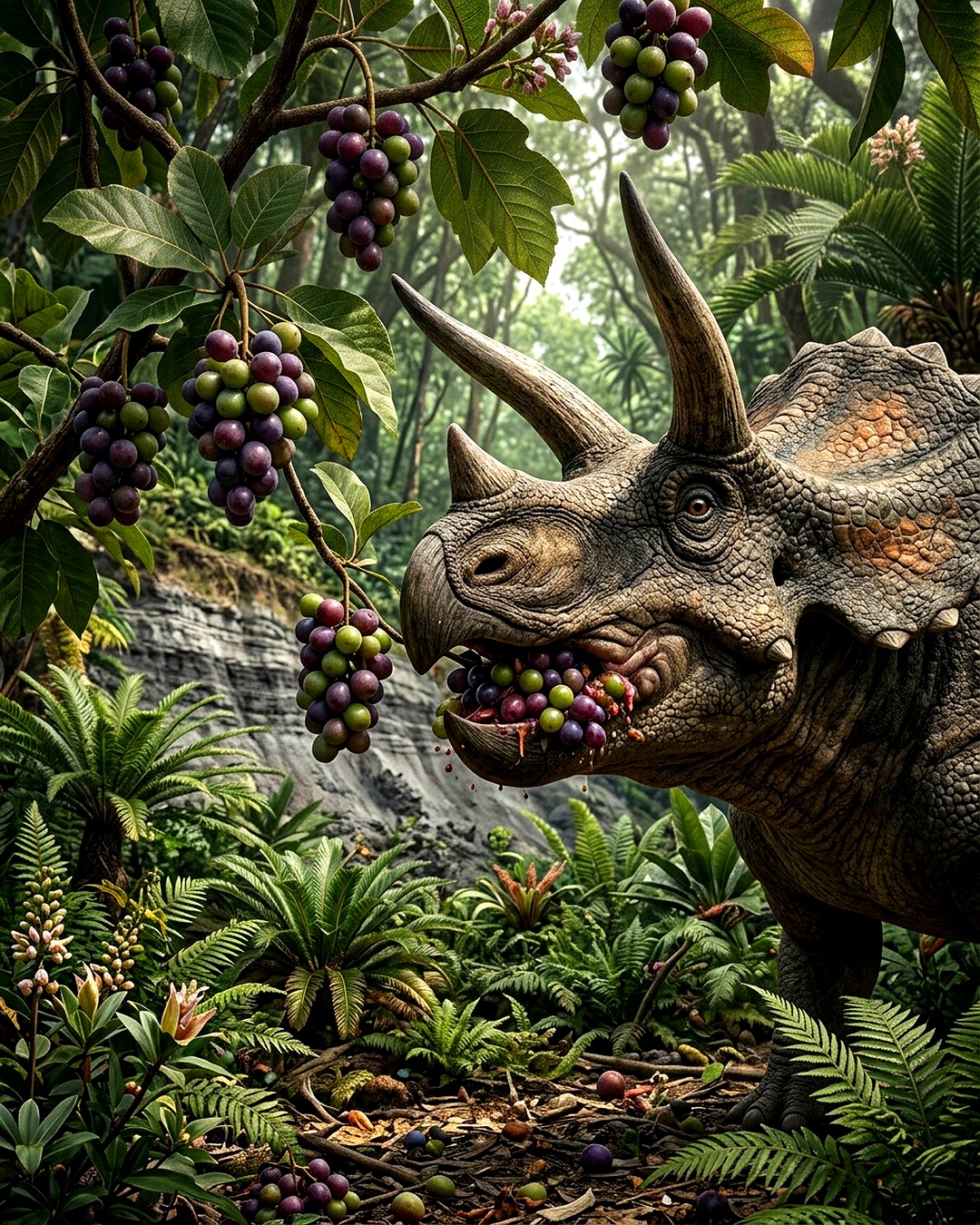
Recent paleontological research published in the journal Science on November 9, 2026, reveals that non-avian dinosaurs and other prehistoric creatures may have consumed significantly more large, fleshy fruit than previously believed. Researchers analyzing a remarkably preserved 74-million-year-old fossil forest in New Mexico, often dubbed a botanical Pompeii, discovered ancient flowering plant reproductive structures and seeds roughly the size of modern grapes. The primary author, James Saulsbury from the University of Kansas Biodiversity Institute and Natural History Museum, along with his co-authors, challenges the longstanding evolutionary theory that large fruits and complex seed dispersal mechanisms exclusively evolved after the Cretaceous-Paleogene extinction event 66 million years ago. This discovery shifts our timeline of angiosperm reproductive ecology. The study demonstrates that modern-looking forest structures and diverse reproductive strategies were actively developing much earlier in the Cretaceous period than previously thought. The presence of grape-sized fruits indicates that large dinosaurs, alongside early mammals, actively participated in zoochory, serving as crucial agents for seed dispersal long before the asteroid impact. Researchers recommend re-evaluating co-evolutionary dynamics between prehistoric megafauna and ancient flora. By examining seed morphotypes from exceptional deposits like the New Mexico volcanic ash tuff, scientists gain a clearer window into ancient ecosystems, proving that plant-animal mutualisms in forest canopies were far more advanced during the Mesozoic era.

Schlüsselpunkte

01

🔹 Discovery of Ancient Grape-Sized Fruit Fossils

【📌 Key Finding】Researchers uncovered exceptionally preserved fossilized seeds and fruits from a 74-million-year-old forest near Truth or Consequences, New Mexico. 【🔸 Impact Factors】The discovered fruits reach sizes comparable to modern grapes, which is remarkably large for flowering plants of the Cretaceous period. 【⭐ Data Support】Published in the journal Science on June 25, 2026, the study analyzed hundreds of plant reproductive structures categorized into distinct morphotypes.

02

🔸 Challenge to Post-Extinction Evolution Theories

【📌 Key Finding】The findings directly challenge the longstanding paradigm that complex seed dispersal strategies and large fleshy fruits only evolved after the asteroid impact 66 million years ago. 【🔸 Impact Factors】Flowering plant reproductive ecology was already undergoing significant diversification during the late Cretaceous rather than waiting for mammalian expansion post-extinction. 【⭐ Data Support】Co-authored by researchers including James Saulsbury, Dori L. Contreras, and Cindy V. Looy under DOI 10.1126/science.adw9457.

03

⭐ Dinosaur Role in Prehistoric Seed Dispersal

【📌 Key Finding】Large dinosaurs likely played a major ecological role in consuming and dispersing the seeds of these large-fruited angiosperms. 【🔸 Impact Factors】Before this discovery, scientists assumed early flowering plants relied primarily on wind or non-animal mechanisms for reproduction. 【⭐ Data Support】The presence of diverse, large fruits in dense Cretaceous forest canopies indicates that both early mammals and large dinosaurs acted as active seed dispersal agents.

04

📊 The Botanical Pompeii of New Mexico

【📌 Key Finding】The research site preserves an ancient forest buried beneath a thick layer of volcanic ash tuff stretching over one kilometer. 【🔸 Impact Factors】The remarkable preservation provides an accurate snapshot of spatial arrangements and plant communities from approximately 74 million years ago. 【⭐ Data Support】Located near New Mexico, the site allowed scientists to collect and classify hundreds of plant fossils without severe preservation bias.

05

💡 Implications for Modern Forest Ecology

【📌 Key Finding】Modern-looking forest structures and moist, densely packed environments evolved millions of years earlier than previously documented. 【🔸 Impact Factors】Understanding the deep-time origins of fruit-bearing plants helps scientists map how terrestrial ecosystems adapted through historical mass extinction events. 【⭐ Data Support】The study highlights how angiosperms successfully diversified and established complex ecological niches alongside Mesozoic megafauna.

Möchten Sie Ihre eigene Mindmap erstellen?

Melden Sie sich bei Neumap AI an und beginnen Sie mit der Erstellung Ihrer eigenen Mindmaps!

Loslegen