AI Tissue Clocks Reveal Non-Uniform Organ Aging

scitechdaily aging artificial-intelligence biomarkers molecular-biology pathology nature-medicine

Zusammenfassung

Mindmap Titelbild
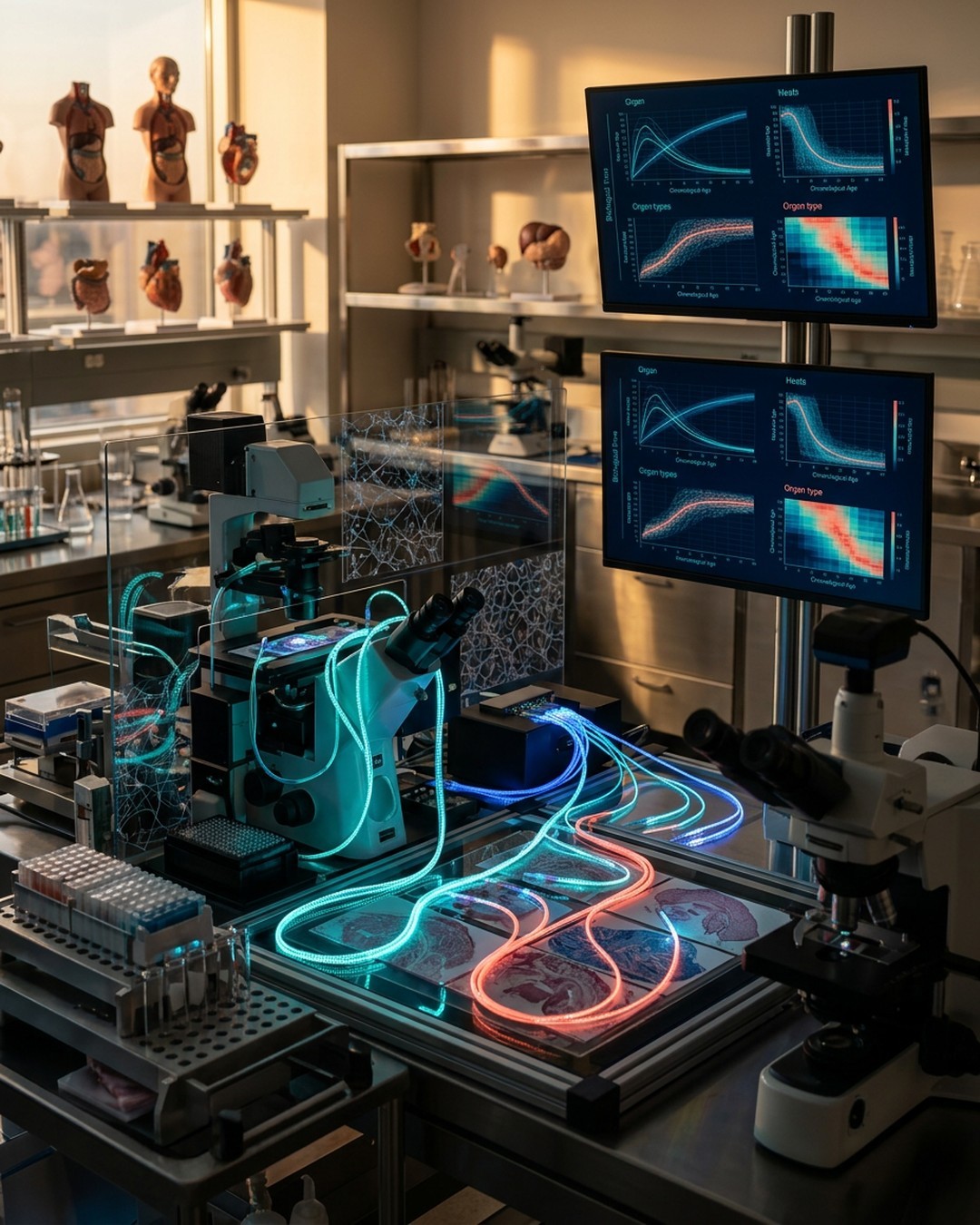
KI Generiertes Titelbild

A groundbreaking August 2026 study published in Nature Medicine reveals that human internal organs age at vastly different speeds, and artificial intelligence can detect these disparate timelines through microscopic tissue architecture. Researchers from the CeMM Research Center for Molecular Medicine and the Ludwig Boltzmann Institute for Network Medicine analyzed over 25,000 images across 40 tissue types from 983 individuals in the Genotype-Tissue Expression Project, successfully creating predictive tissue clocks with an average prediction error of just 4.9 years. The study demonstrates that tissue architecture preserves a detailed hidden record of biological aging, outperforming traditional DNA-based aging markers in capturing tissue-specific pathology. Organs such as the lungs, kidneys, pancreas, and adrenal glands exhibit signs of accelerated aging between the ages of 20 and 40, while the uterus shows a pronounced shift around menopause, proving that aging is not a uniform systemic process. Researchers successfully translated these microscopic structural patterns into routine blood-based gene expression predictors, enabling the detection of organ-specific aging signatures associated with complex medical conditions like Alzheimer's disease, Crohn's disease, diabetes, cystic fibrosis, and stroke. These findings pave the way for minimally invasive diagnostics that can track organ health, monitor disease progression, and evaluate biological versus chronological age through simple routine blood draws, significantly enhancing preventive healthcare and targeted therapeutic strategies.

Schlüsselpunkte

01

🔹 AI Tissue Clocks Discovery

【📌 Key Finding】Researchers at CeMM and LBI-NetMed developed AI-based tissue clocks to estimate biological age from microscopic tissue architecture. 【🔸 Scope】The study analyzed 25,712 images representing approximately 480 million individual image tiles across 40 tissue types from 983 individuals using Genotype-Tissue Expression Project data. 【⭐ Performance】The tissue clocks achieved an average prediction error of 4.9 years, outperforming traditional DNA methylation and gene expression aging estimators in capturing tissue-specific pathology.

02

🔸 Non-Uniform Organ Aging Timelines

【📌 Key Finding】Human organs do not age at the same rate, following distinct trajectories depending on the specific tissue type. 【🔸 Timeline Variations】Lungs, kidneys, pancreas, and adrenal glands display accelerated aging signals as early as ages 20 to 40, whereas the uterus undergoes a dramatic structural shift around menopause. 【⭐ Disease Correlation】Kidney failure accelerates aging signals across multiple tissues, while diabetes specifically drives rapid aging changes within the pancreas.

03

⭐ Blood-Based Organ Aging Predictors

【📌 Conceptual Leap】Researchers matched blood-based gene expression profiles with histology-measured tissue age gaps to build predictors of organ-specific biological age from routine blood draws. 【🔸 Clinical Associations】The blood predictors successfully identified accelerated aging linked to major diseases: brain aging in Alzheimer's disease patients and gastrointestinal tract aging in Crohn's disease patients. 【⭐ Additional Conditions】The method also detected aging patterns associated with cystic fibrosis, vasculitis, diabetes, and stroke.

04

📊 Biological vs Chronological Age Indicators

【📌 Core Indicators】Estimated biological ages strongly correlate with established aging hallmarks, including shortened telomeres, visible tissue pathology, and accumulated chronic diseases. 【🔸 Individual Variation】The AI models successfully identified individuals whose organ structures showed advanced structural remodeling earlier than expected for their chronological age. 【⭐ Architectural Remodeling】Deep learning successfully captures aging as physical architectural remodeling rather than mere molecular drift.

05

💡 Future Diagnostic and Clinical Implications

【📌 Clinical Application】Tissue-specific aging signatures offer a robust framework for developing minimally invasive tests to monitor organ health and disease progression. 【🔸 Data Integration】The study successfully bridges pathology, gene expression, and clinical metadata on a massive scale using computer vision models. 【⭐ Author Attribution】Key researchers leading the published August 2026 Nature Medicine study include André Rendeiro, Ernesto Abila, Iva Buljan, and Yimin Zheng.

Möchten Sie Ihre eigene Mindmap erstellen?

Melden Sie sich bei Neumap AI an und beginnen Sie mit der Erstellung Ihrer eigenen Mindmaps!

Loslegen