First Discovery of Diplodocus in Europe

paleontology dinosaurs diplodocus jurassic-period scientific-discovery

Zusammenfassung

Mindmap Titelbild
KI Generiertes Titelbild

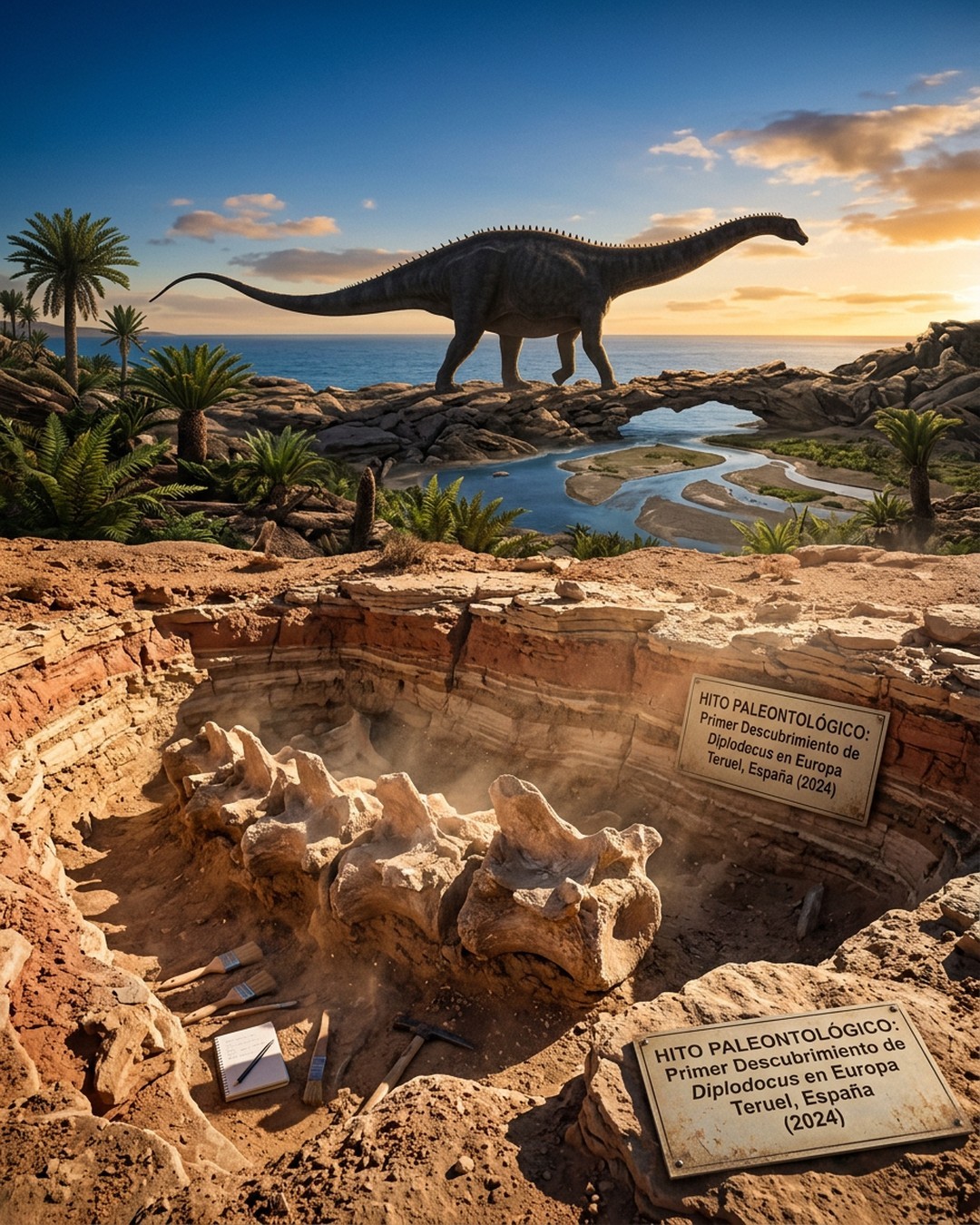
Paleontologists have identified the first evidence of Diplodocus outside North America by discovering 14 exceptionally well-preserved caudal vertebrae and chevron bones at the La Tejería fossil site in El Castellar, Teruel, Spain. This 150-million-year-old specimen, dating to the Late Jurassic Period, measures approximately 25 meters or 82 feet in length and provides critical insights into prehistoric biogeography. The discovery offers the strongest paleontological evidence to date for episodes of dispersal and faunal exchange between North America and Europe across the proto-Atlantic Ocean. Falling sea levels during this time likely exposed temporary land connections that allowed these giant sauropods to migrate across continents. Researchers utilized advanced evolutionary analyses, including maximum parsimony and Bayesian inference methods, to confirm the anatomical similarities with North American species such as Diplodocus hallorum. The find enhances our understanding of Iberian Mesozoic ecosystems and highlights Teruel as a major reference location for diverse European sauropod dinosaurs. Scientists and the general public can examine the fossilized remains directly at the Museo Aragonés de Paleontología at Dinópolis in Teruel, Spain. This specimen supports ongoing research into ancient continental migration routes and expands the known geographic distribution of iconic dinosaur genera.

Schlüsselpunkte

01

🔹 Discovery of Diplodocus in Spain

Paleontologists at the Fundación Conjunto Paleontológico de Teruel-Dinópolis identified the first evidence of Diplodocus outside North America at the La Tejería fossil site in El Castellar, Teruel. The excavation yielded 14 exceptionally well-preserved caudal vertebrae and several chevron bones dating back approximately 150 million years to the Late Jurassic Period.

02

🔸 Evidence of Intercontinental Dispersal

The fossil specimen provides robust paleontological evidence of faunal exchange between North America and Europe across the proto-Atlantic Ocean. Researchers suggest that falling sea levels during the Late Jurassic Period exposed temporary land bridges, enabling giant sauropods to disperse across continents.

03

⭐ Anatomical and Evolutionary Analysis

Identification of the dinosaur relied on a unique combination of features, including large internal air cavities, deep grooves on the tail bones, and forked chevron bones with medial fossae. Maximum parsimony and Bayesian inference methods verified its classification within the genus Diplodocus, closely related to Diplodocus hallorum.

04

📊 Physical Scale and Comparison

Co-author Dr. Alberto Cobos noted that the Spanish Diplodocus reached approximately 25 meters or 82 feet in length, matching the size of its North American relatives. It joins other distinct Spanish Jurassic sauropods such as Turiasaurus and Losillasaurus, establishing Teruel as a premier location for dinosaur biodiversity research.

05

💡 Public Accessibility and Research Value

The excavated fossils are permanently housed in the dinosaur hall of the Museo Aragonés de Paleontología at Dinópolis in Teruel, Spain. The specimen remains accessible for both advanced scientific research and public education, granting visitors the opportunity to view the bones that expanded the known range of Diplodocus.

Möchten Sie Ihre eigene Mindmap erstellen?

Melden Sie sich bei Neumap AI an und beginnen Sie mit der Erstellung Ihrer eigenen Mindmaps!

Loslegen