Challenging Century-Old Crystal Nucleation Theory

scitechdaily physics materials-science nanotechnology ucla crystals

Zusammenfassung

Mindmap Titelbild
KI Generiertes Titelbild

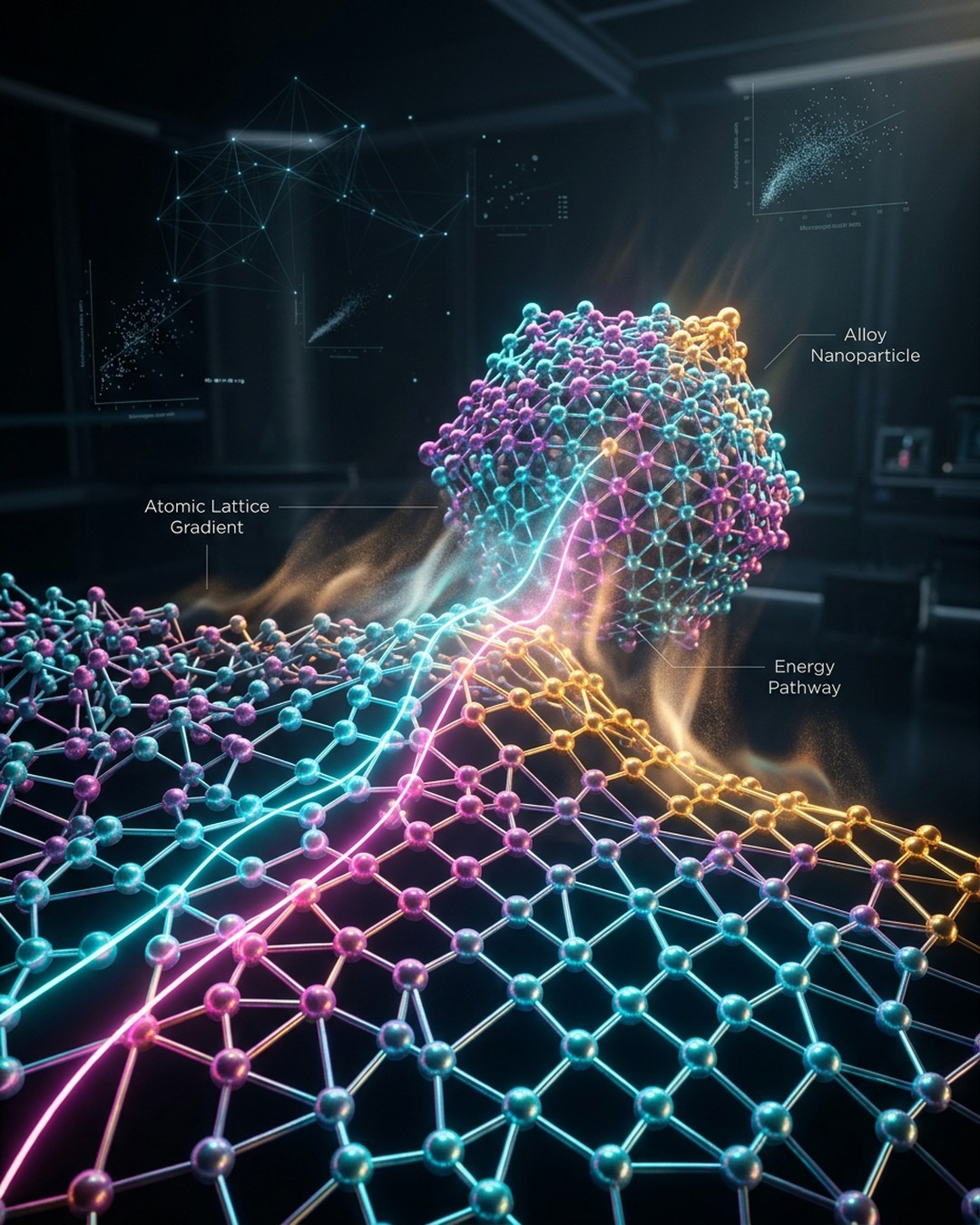
Scientists led by UCLA researchers have published a study in Nature Materials challenging classical nucleation theory, which has governed the understanding of phase transitions like freezing and condensation for nearly a century. By utilizing atomic electron tomography to examine more than 8,000 crystal nuclei in high- and medium-entropy alloy nanoparticles, the team discovered that crystal boundaries are gradual gradients rather than sharp, uniform edges. The researchers developed the gradient nucleation pathways model to explain how crystal cores exhibit high crystallinity while becoming progressively disordered toward their outer boundaries. This discovery suggests that nature overcomes energy barriers through multiple intermediate states rather than a single sharp energy threshold, offering profound implications for materials design, manufacturing, and industrial applications. Published on September 3, 2026, the study demonstrates that rapid cooling from over 3,000 degrees Fahrenheit successfully trapped nuclei at various developmental stages for three-dimensional atomic-scale inspection. The findings indicate that classical nucleation theory represents a special case of this broader gradient model, fundamentally shifting how physicists understand atomic organization during phase changes. This revised theoretical framework provides actionable insights for designing advanced materials with enhanced strength, flexibility, and catalytic efficiency. Researchers across physics, chemistry, pharmaceuticals, and electronics can apply these findings to optimize manufacturing processes and better control microstructural development in engineered systems.

Schlüsselpunkte

01

🔹 Challenge to Classical Nucleation Theory

Published on September 3, 2026, in Nature Materials, UCLA-led researchers challenged the century-old classical nucleation theory by capturing three-dimensional atomic maps of crystal formation, revealing that transition zones between ordered crystals and disordered surroundings are gradual rather than abrupt.

02

🔸 Discovery of Atomic-Scale Gradients

Using atomic electron tomography on high- and medium-entropy alloy nanoparticles containing over 8,000 individual nuclei ranging from under 10 to over 1,000 atoms, the team observed that every nucleus possesses a highly crystalline core that progressively loses order toward its outer boundary.

03

⭐ Gradient Nucleation Pathways Model

Researchers formulated the gradient nucleation pathways model to expand upon classical nucleation theory, proving that the classical model is merely a special case while demonstrating that nature overcomes energy barriers more efficiently through multiple intermediate states.

04

📊 Experimental Rapid Cooling Methodology

To capture rapid phase transitions occurring within fractions of a second, nanoparticles were heated and supercooled from over 3,000 degrees Fahrenheit to room temperature within a few hundredths of a second, effectively suspending crystal nuclei at various developmental stages for detailed 3D statistical analysis.

05

💡 Implications for Advanced Material Design

The findings show that nearby crystals often align in identical orientations prior to merging, providing critical insights that can help engineers design stronger, more flexible alloys and more durable catalysts across physics, semiconductor manufacturing, and chemical industries.

Möchten Sie Ihre eigene Mindmap erstellen?

Melden Sie sich bei Neumap AI an und beginnen Sie mit der Erstellung Ihrer eigenen Mindmaps!

Loslegen