Electrons Slow to a Crawl in Fe5GeTe2 Magnetic Material

scitechdaily physics quantum-materials magnetism 2d-materials

Zusammenfassung

Mindmap Titelbild
KI Generiertes Titelbild

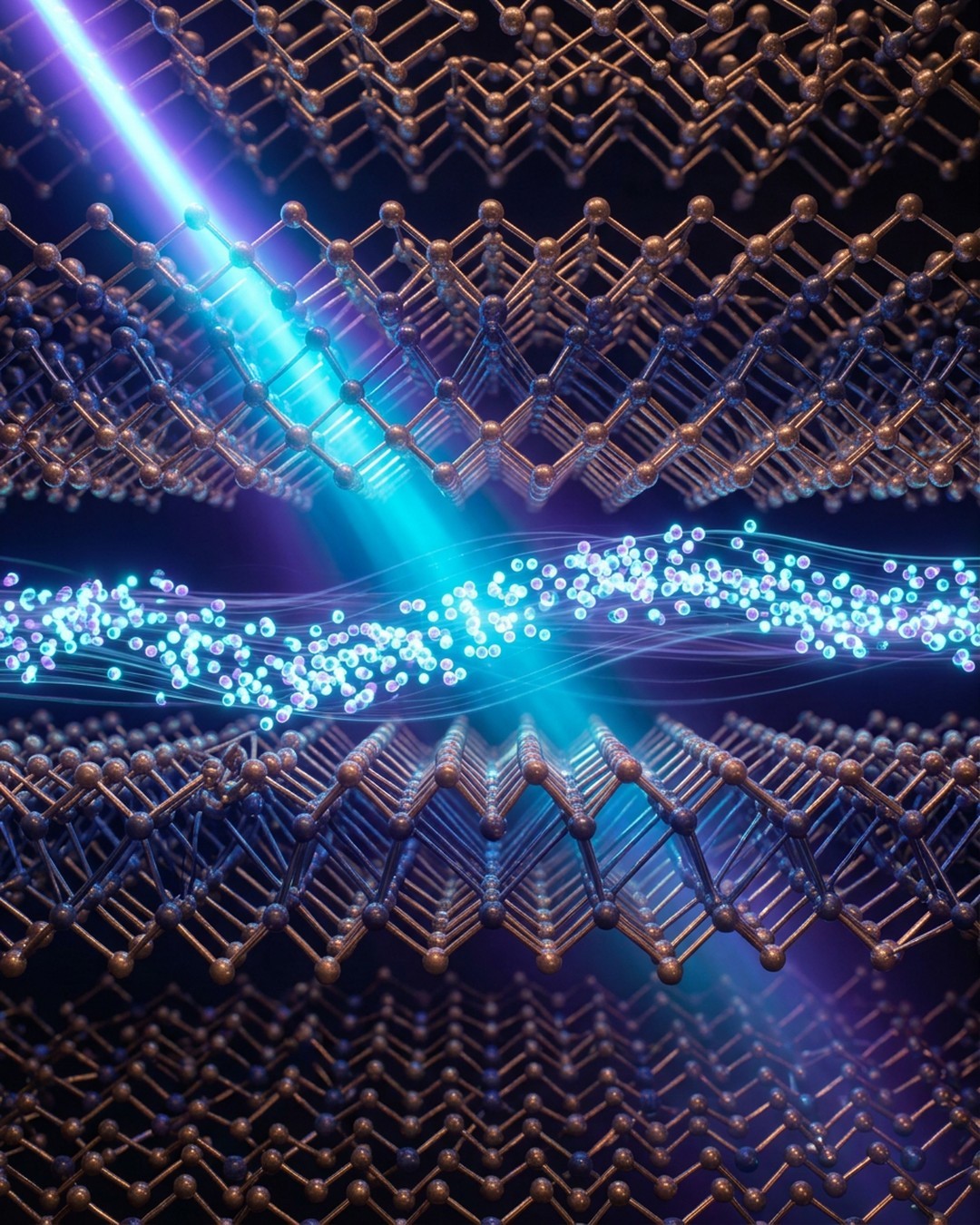
Researchers at the University of Chicago Pritzker School of Molecular Engineering discovered that electrons in the magnetic material Fe5GeTe2 enter a charge-ordered state where they move collectively in quantum lockstep and slow to a crawl. Published on August 14, 2026, in Science Advances, the study reveals that this coherent response persists up to approximately 100 kelvins and features a surprisingly flat electronic band structure. Led by Assistant Professor Shuolong Yang and postdoctoral scholars Gabriele Berruto and Qiang Gao, the team utilized angle-resolved photoemission spectroscopy with a microfocused ultraviolet laser to map the electronic band structure of Fe5GeTe2. Their findings demonstrate that strong electron interactions create both a flat electronic band and an unexpected charge order, contradicting existing theoretical models of the material's magnetic behavior. The discovery highlights a complex quantum many-body phenomenon where millions of electrons interact and synchronize rather than acting independently. This collective behavior suggests that internal magnetic interactions differ significantly from current theoretical predictions, opening new pathways for fundamental condensed matter physics research. The findings offer potential applications in developing novel quantum memory devices by allowing the material to switch between distinct electronic and magnetic phases using light instead of conventional electrical methods. Future research will focus on testing whether this unique electronic behavior survives down to a single atomic layer and determining if the effect can operate at substantially higher temperatures.

Schlüsselpunkte

01

🔹 Discovery Date and Core Findings

Published on August 14, 2026, in Science Advances, researchers at the University of Chicago found that electrons inside the van der Waals magnetic material Fe5GeTe2 mysteriously slow down while moving together in quantum lockstep, entering an unexpected charge-ordered state that persists up to approximately 100 kelvins (-280°F).

02

🔸 Experimental Methodology and Flat Band

Using angle-resolved photoemission spectroscopy (ARPES) with a 10-micrometer ultraviolet laser spot, postdoctoral scholars Gabriele Berruto and Qiang Gao mapped the electronic band structure and discovered a remarkably flat electronic band, which directly correlates with sluggish, highly collective electron motion.

03

⭐ Quantum Many-Body Phenomenon

Instead of measuring independent electrons, the research captured the interaction of thousands or millions of electrons moving coherently together, demonstrating a complex quantum many-body phenomenon that current theoretical models failed to predict for Fe5GeTe2.

04

📊 Implications for Magnetic Interactions

The identification of this interaction-driven flat band and charge order reveals that internal magnetic interactions in Fe5GeTe2 are entirely different from theoretical predictions, complicating the role of iron vacancies and atomic site occupancies in its magnetic behavior.

05

💡 Potential Applications in Quantum Memory

Experiments using microfocused lasers indicate the material can be switched between this quantum many-body phase and other phases, raising the prospect of controlling information states with light for future quantum memory devices, provided the effect can eventually operate at room temperature and in single atomic layers.

Möchten Sie Ihre eigene Mindmap erstellen?

Melden Sie sich bei Neumap AI an und beginnen Sie mit der Erstellung Ihrer eigenen Mindmaps!

Loslegen