Earth Twice As Vulnerable to Extreme Solar Storms

scitechdaily space-weather solar-storms geophysics nasa lancaster-university

Zusammenfassung

Mindmap Titelbild
KI Generiertes Titelbild

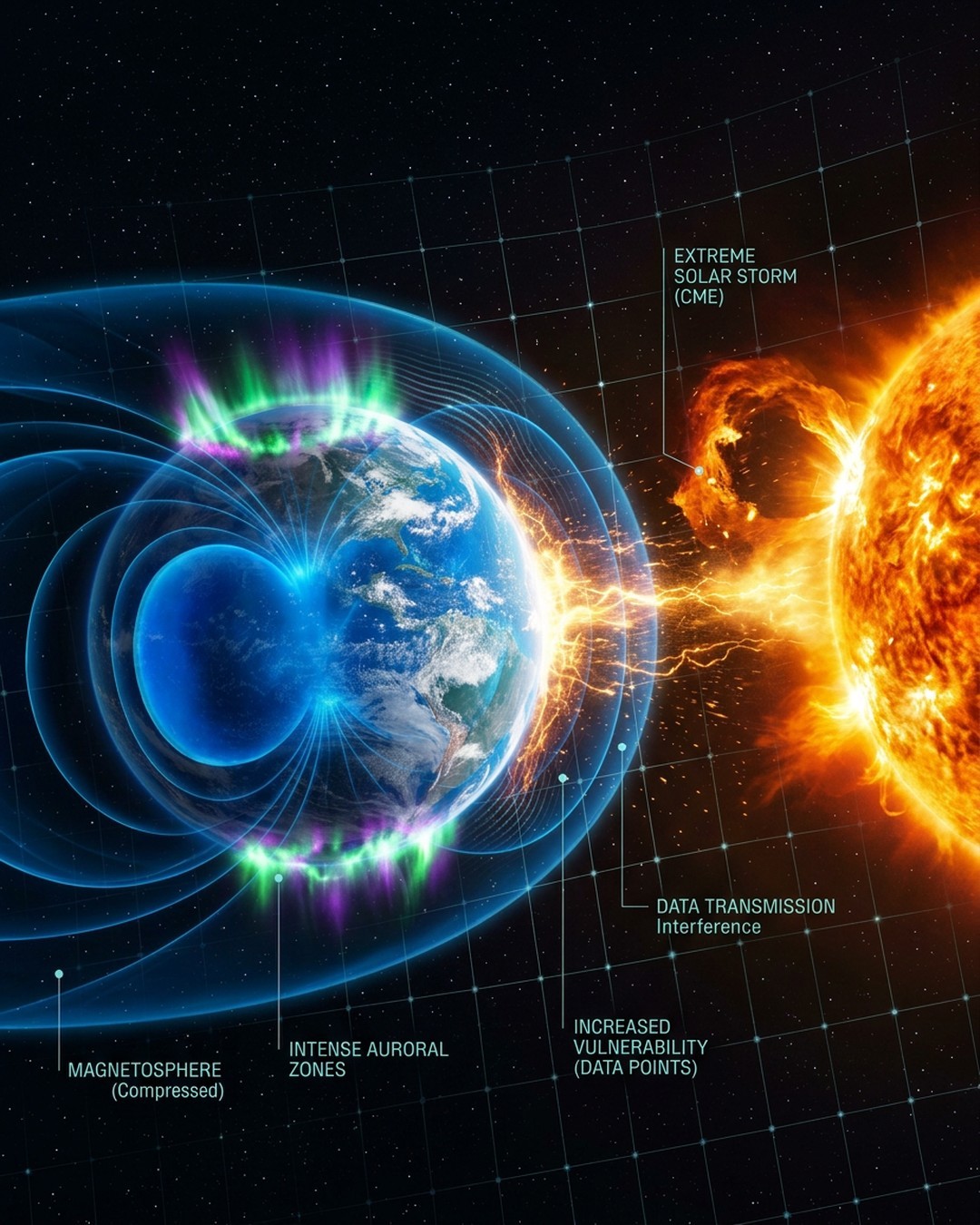
Recent research published in Nature on July 15, 2026, led by Dr. Nithin Sivadas of NASA Goddard Space Flight Center and Dr. Maria Walach of Lancaster University, reveals that Earth may be twice as vulnerable to extreme solar storms as previously thought. The study challenges a decades-old scientific assumption that Earth's magnetic field possesses a built-in safety limit or saturation ceiling that caps how severely geomagnetic activity can respond to intense solar wind. The authors argue that the supposed saturation limit is actually a statistical illusion caused by measurement uncertainties and regression to the mean. Because solar wind conditions are traditionally recorded by spacecraft at the first Lagrange point (L1), roughly 1 million miles or 1.6 million kilometers closer to the Sun than Earth, timing and strength mismatches occur before the solar wind reaches the planet's magnetosphere. To correct these statistical discrepancies, the research team analyzed more than 1 million measurements collected by NASA spacecraft orbiting much closer to Earth and applied rigorous statistical adjustments. Once these measurement errors and uncertainties were accounted for, the apparent saturation largely vanished, demonstrating that Earth's geomagnetic response remains closely proportional to solar wind intensity. These findings indicate that current space weather models may significantly underestimate the risks that extreme solar storms pose to modern technological infrastructure, including satellites, GPS navigation, radio communications, aviation, and interconnected power grids. Researchers urge that predictive models for extreme events be updated to account for this heightened vulnerability, emphasizing vigilance despite the rarity of such massive solar storms.

Schlüsselpunkte

01

🔹 Core Research Findings on Earth Vulnerability

Published in Nature on July 15, 2026, a study led by Dr. Nithin Sivadas of NASA Goddard Space Flight Center and Dr. Maria Walach of Lancaster University demonstrates that Earth may be twice as vulnerable to extreme solar storms as traditional models predict, with geomagnetic responses continuing to grow under extreme solar wind conditions rather than leveling off.

02

🔸 Debunking the Magnetic Shield Saturation Limit

Scientists previously believed Earth had a built-in safety limit or saturation ceiling where atmospheric currents stopped increasing proportionally. The new study proposes this ceiling is a statistical illusion caused by uncertainty in measurements and regression to the mean when analyzing rare space weather events.

03

⭐ Methodological Corrections Using NASA Spacecraft Data

The researchers tested their hypothesis using more than 1 million measurements collected by NASA spacecraft orbiting much closer to Earth than the L1 point (located roughly 1 million miles or 1.6 million kilometers sunward). By correcting for timing and intensity uncertainties, the apparent saturation effect disappeared.

04

📊 Risks to Modern Technological Infrastructure

Because models assuming an upper limit underestimate extreme space weather risks, a severe solar storm could severely impact modern infrastructure dependent on satellites, GPS signals, radio communications, aviation safety, astronaut radiation shielding, and interconnected electrical power networks.

05

💡 Implications for Future Space Weather Modeling

Researchers emphasize that while one-in-a-thousand-year extreme solar storms are extremely rare, predictive models must be updated to remove the protective ceiling assumption, ensuring better preparedness and vigilance against potential technological catastrophes.

Möchten Sie Ihre eigene Mindmap erstellen?

Melden Sie sich bei Neumap AI an und beginnen Sie mit der Erstellung Ihrer eigenen Mindmaps!

Loslegen