Discovery of Limnospondylus ajimuensis

Paleontology EvolutionaryBiology KyotoUniversity Fossils Amphibians Limnospondylus

Zusammenfassung

Mindmap Titelbild
KI Generiertes Titelbild

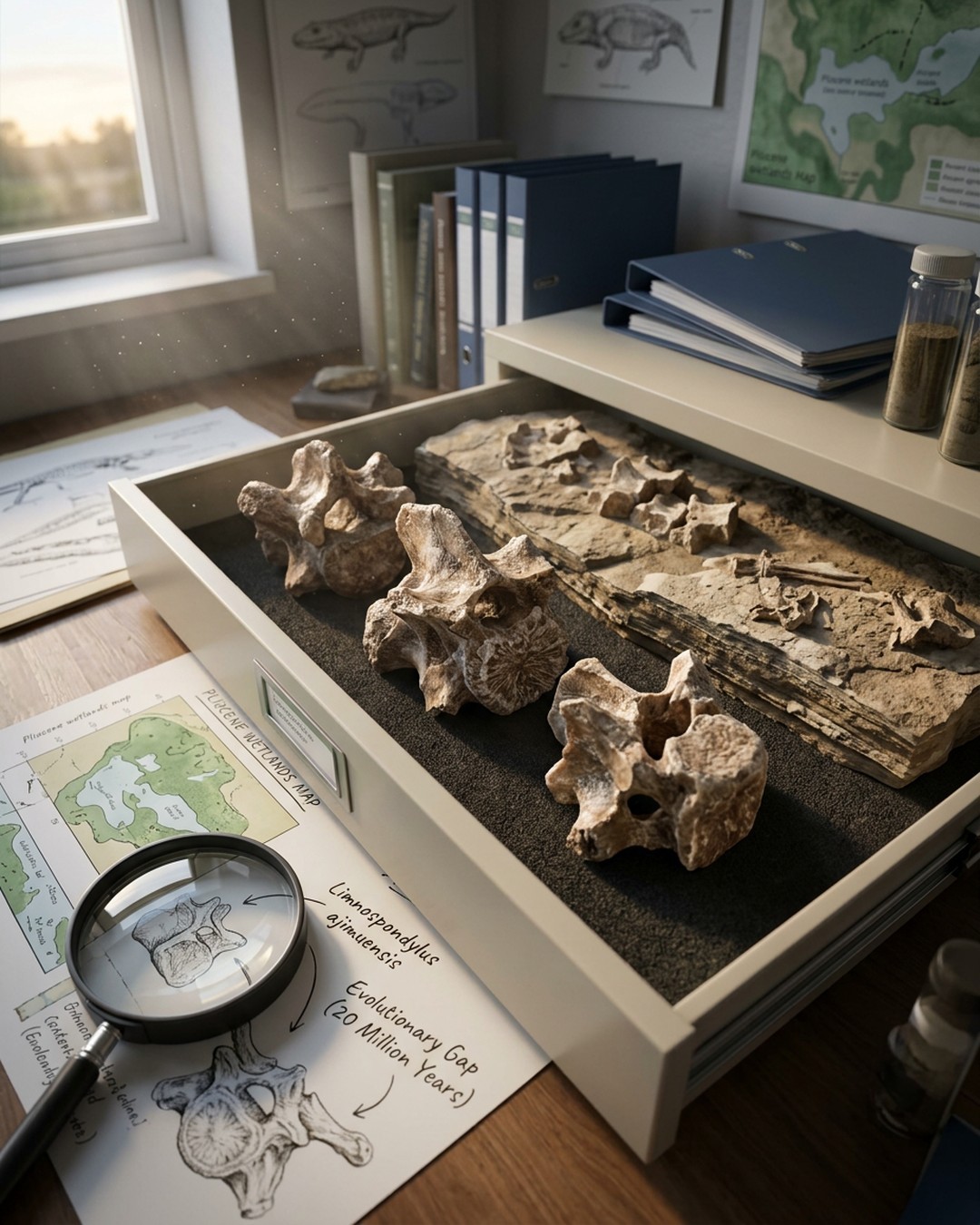
Researchers from Kyoto University have identified a new genus and species of giant salamander, Limnospondylus ajimuensis, based on three fossilized vertebrae discovered in the Ajimu region of Japan. Dating back approximately 3.5 million years to the Pliocene epoch, this amphibian inhabited warm, humid wetlands and reached lengths of about 1.1 meters. The discovery provides critical evidence of ancient biodiversity in Asia and helps bridge a 20-million-year gap in the fossil record of the Cryptobranchidae family. The study, published on June 3, 2026, in the journal PeerJ, highlights the importance of re-evaluating existing museum collections that were previously misclassified under the genus Andrias. By identifying unique anatomical features in the mid-trunk vertebrae, the team demonstrated that ancient giant salamanders were more diverse and occupied a broader range of freshwater environments than their modern descendants, which are now primarily restricted to flowing river systems. This research underscores the evolutionary resilience of the giant salamander lineage, which has persisted for nearly 60 million years. The findings serve as a reminder of the ecological shifts caused by global cooling at the end of the Pliocene, which likely drove the extinction of specialized lake-dwelling species like Limnospondylus while allowing river-adapted relatives to survive into the modern era. For researchers and conservationists, this discovery emphasizes the necessity of protecting extant giant salamander populations, such as Andrias japonicus, from contemporary threats like habitat destruction and hybridization. The study provides a foundational framework for future paleontological investigations and reinforces Japan's status as a vital region for understanding the evolutionary history of amphibians.

Schlüsselpunkte

01

🔹 Discovery of Limnospondylus ajimuensis

【📌 Key Finding】Researchers identified a new genus and species of giant salamander, Limnospondylus ajimuensis, from three fossilized vertebrae found in the Tsubusugawa Formation in Oita Prefecture, Japan. 【⭐ Data Support】The fossils date back approximately 3.5 million years to the Pliocene epoch. The animal is estimated to have reached a length of 1.1 meters (3.6 feet) at maturity, roughly 18 years of age.

02

🔸 Evolutionary Significance

【📌 Key Finding】The discovery fills a significant 20-million-year gap in the fossil record of the giant salamander family (Cryptobranchidae) in Asia. 【🔸 Impact Factors】It confirms that giant salamanders were once more diverse and occupied a wider variety of freshwater habitats, including lakes and marshes, compared to the river-dwelling habits of modern species.

03

⭐ Anatomical Classification

【📌 Key Finding】The classification was determined by analyzing an anterior trunk vertebra, a mid-trunk vertebra, and a sacro-caudal vertebra. 【⭐ Data Support】The mid-trunk vertebra exhibited a unique combination of anatomical features distinct from any known member of the Cryptobranchidae family, justifying the creation of a new genus and species.

04

📊 Environmental Context

【📌 Key Finding】The Ajimu region 3.5 million years ago was significantly warmer and more humid than today, featuring extensive freshwater lakes and marshes. 【🔸 Impact Factors】The extinction of Limnospondylus ajimuensis is likely linked to global cooling at the end of the Pliocene, which transformed these wetland habitats and favored the survival of river-adapted lineages like Andrias japonicus.

05

💡 Conservation and Future Research

【📌 Key Finding】The study suggests that many fragmentary fossils currently in museum collections, previously labeled as Andrias, may actually represent undiscovered genera or species. 【⭐ Data Support】Lead researcher Masahiro Noda emphasizes that this historical context highlights the urgent need to protect modern Japanese giant salamanders from current threats such as habitat loss and genetic hybridization.

Möchten Sie Ihre eigene Mindmap erstellen?

Melden Sie sich bei Neumap AI an und beginnen Sie mit der Erstellung Ihrer eigenen Mindmaps!

Loslegen