Erucamide: A Natural Molecule to Prevent Vision Loss

RetinalDegeneration Neuroscience ScrippsResearch Erucamide VisionLoss BiomedicalResearch

Zusammenfassung

Mindmap Titelbild
KI Generiertes Titelbild

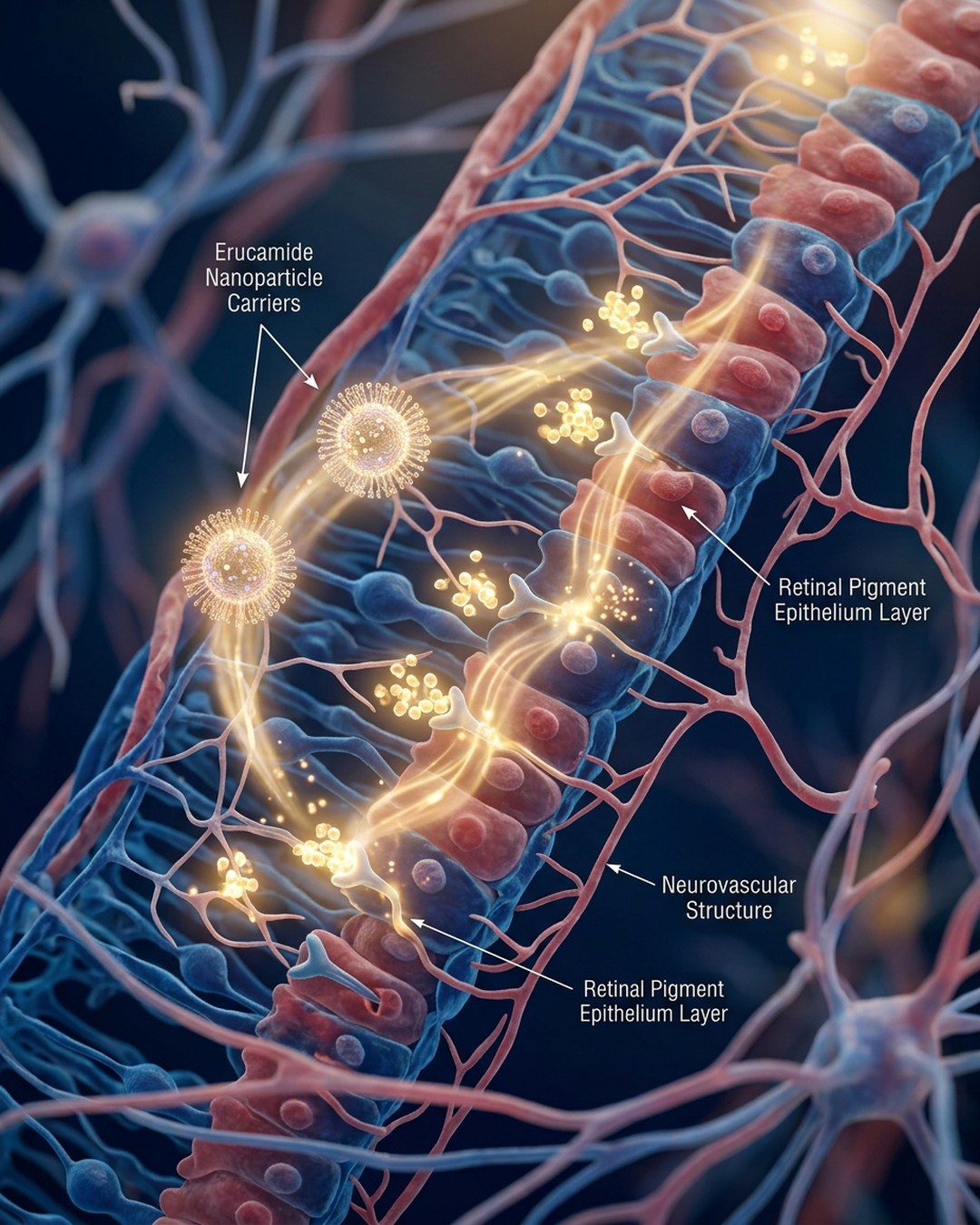
Researchers at Scripps Research have identified a naturally occurring lipid molecule, erucamide, that plays a critical role in the retina's defense against degenerative diseases. Published on June 19, 2026, in Nature Neuroscience, the study reveals that erucamide levels decline as photoreceptors die, and restoring this molecule can activate protective immune responses to stabilize retinal tissue. The scientific team, led by Professor Martin Friedlander, posits that the retina actively manages injury through a complex neurovascular unit. By utilizing mass spectrometry-based metabolomics, they discovered that erucamide acts as a signaling messenger that engages TMEM19 proteins on myeloid cells, thereby promoting neurovascular health and slowing the progression of conditions like age-related macular degeneration and retinitis pigmentosa. This discovery shifts the therapeutic focus from targeting photoreceptors directly to modulating the surrounding retinal environment. The researchers successfully utilized porous silicon nanoparticles to overcome the hydrophobic nature of erucamide, ensuring controlled delivery and stability within the eye, which effectively preserved retinal structure in preclinical models. While this breakthrough offers a promising strategy for treating vision-threatening diseases, future efforts will focus on optimizing delivery methods and testing related lipid molecules. This research provides a foundational framework for developing therapies that reinforce the body's innate protective mechanisms to combat progressive vision loss.

Schlüsselpunkte

01

🔹 Discovery of Erucamide as a Retinal Signaling Molecule

Researchers identified erucamide, a lipid molecule, as a key signaling agent in the retina. Published on June 19, 2026, the study found that erucamide levels significantly drop during the progression of retinal degeneration, suggesting it is a vital component of the eye's natural defense system against damage.

02

🔸 Mechanism of Action: Myeloid Cell Activation

Erucamide does not act directly on photoreceptors but instead binds to the TMEM19 protein on CD11b+ myeloid cells. This interaction activates these immune cells, which then release signals that support the neurovascular unit, helping to maintain the health of retinal nerve cells and blood vessels.

03

⭐ Innovative Delivery via Nanoparticles

Because erucamide is hydrophobic and difficult to distribute in aqueous environments, the team utilized porous silicon nanoparticles. These engineered carriers allowed for the stable, controlled release of the molecule into the retina, overcoming previous limitations in drug delivery for lipid-based compounds.

04

📊 Research Methodology and Findings

The team employed mass spectrometry-based metabolomics to analyze preclinical models of retinal degeneration. They observed that restoring erucamide levels did not reverse existing damage but successfully slowed the progression of degeneration by preserving the structure and function of the remaining retinal tissue.

05

💡 Future Therapeutic Implications

The study suggests a new strategy for treating diseases like age-related macular degeneration and diabetic retinopathy by reinforcing the retina's own protective mechanisms. Future research will focus on developing water-soluble formulations and testing related lipid molecules to enhance therapeutic efficacy.

Möchten Sie Ihre eigene Mindmap erstellen?

Melden Sie sich bei Neumap AI an und beginnen Sie mit der Erstellung Ihrer eigenen Mindmaps!

Loslegen