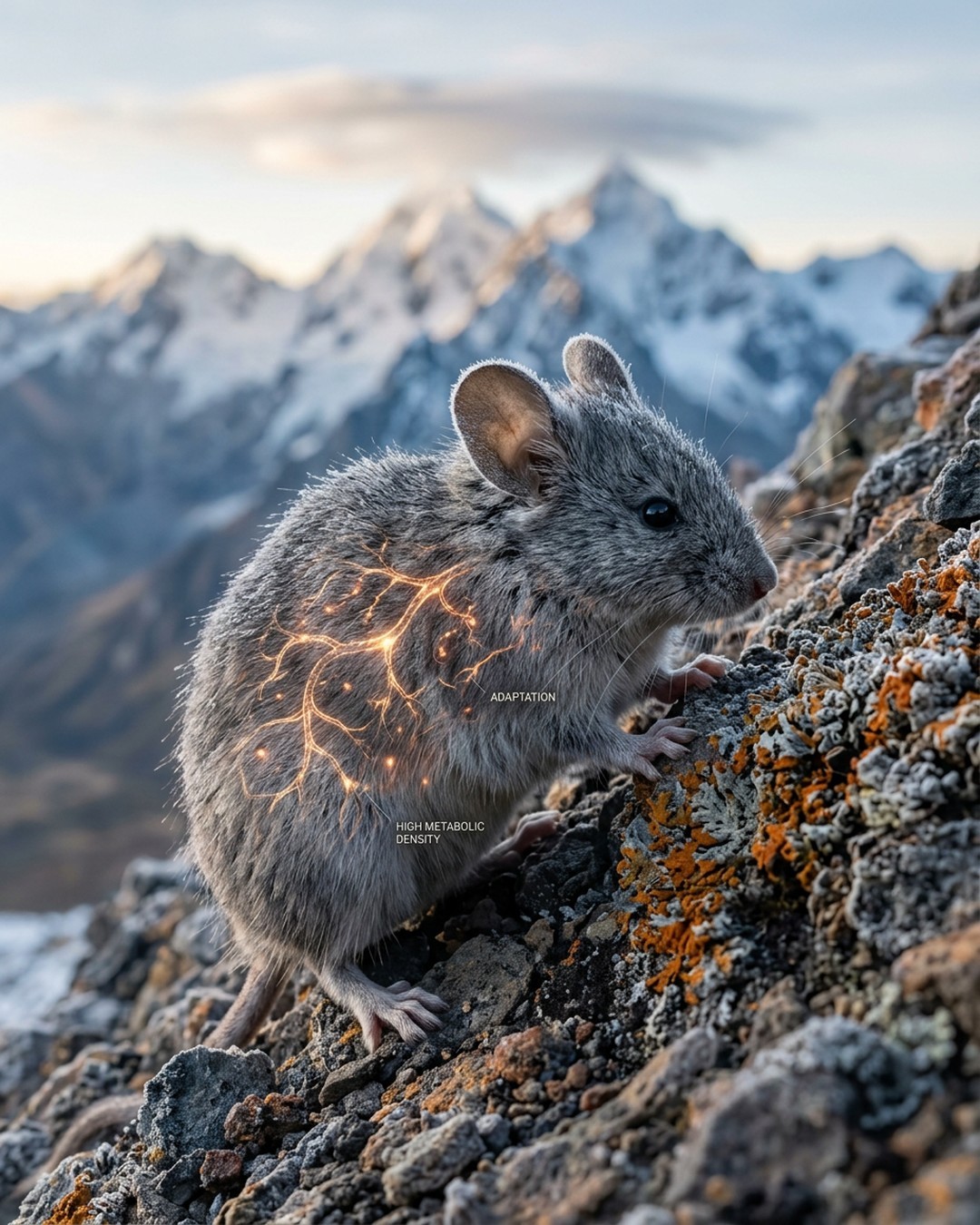
Adaptations of the World's Highest-Living Mammal

biology evolution mammals Andes adaptation science-research

Zusammenfassung

Mindmap Titelbild
KI Generiertes Titelbild

The Andean leaf-eared mouse (Phyllotis vaccarum) has been discovered living at altitudes exceeding 6,700 meters (22,000 feet) in the Andes, shattering the previous scientific assumption that mammalian life was limited to approximately 5,500 meters. This discovery reveals that these rodents have evolved a complex suite of physiological and genetic adaptations to survive in an environment characterized by extreme cold, low oxygen levels, and scarce food resources. Researchers from McMaster University and an international team emphasize that this survival is not due to a single trait but a holistic biological transformation. The mice exhibit specialized muscle tissue, enhanced metabolic efficiency, and digestive adaptations that allow them to thrive in conditions previously considered uninhabitable for mammals, effectively rewriting the known limits of mammalian life. The study highlights that these mice possess muscle cells packed with mitochondria, enabling them to function like endurance athletes by sustaining heat production without rapid exhaustion. Furthermore, they have evolved to process unconventional food sources such as lichens and wind-blown insects, demonstrating that evolutionary success in extreme environments requires systemic bodily changes rather than isolated breakthroughs. These findings provide critical insights into how species adapt to rapid environmental changes. By understanding the multi-faceted pressures of temperature, oxygen availability, and nutrition, scientists can better predict how biodiversity might respond to shifting global climates, proving that evolution possesses a remarkable capacity to experiment under extreme stress.

Schlüsselpunkte

01

🔹 Discovery of High-Altitude Mammalian Life

The Andean leaf-eared mouse (Phyllotis vaccarum) was documented living above 6,700 meters (22,000 feet) on an Andean volcano. This finding contradicts the long-standing scientific belief that mammals could not survive above 5,500 meters (18,000 feet), which was previously considered the upper limit for permanent mammalian habitation.

02

🔸 Physiological Adaptations for Extreme Cold

To survive in freezing, oxygen-depleted environments, these mice have evolved specialized muscle tissue similar to that of endurance athletes. Their cells are densely packed with mitochondria, which allow for sustained heat production. Additionally, they efficiently burn fat to fuel shivering muscles and specialized tissues that generate heat without physical movement.

03

⭐ Metabolic and Digestive Evolution

Beyond respiratory and thermal adaptations, the mice have evolved to handle an unpredictable diet. Genetic evidence indicates adaptations in metabolism and the ability to neutralize toxic plant chemicals, allowing them to consume lichens, seeds, and insects carried by the wind in barren volcanic regions.

04

📊 Research Methodology and Findings

Published in Science on July 9, 2026, the study compared highland mice with lowland populations of the same species and closely related lowland species. Controlled experiments simulating 7,000-meter (23,000-foot) conditions confirmed that highland mice maintain superior heat generation and oxygen efficiency compared to their lowland counterparts.

05

💡 Implications for Climate Change

The research suggests that environmental adaptation is a complex, multi-system process. As climate change alters oxygen levels, food availability, and temperature simultaneously, the study of these mice serves as a model for understanding how species might survive or fail under rapid, multi-pressure environmental shifts.

Möchten Sie Ihre eigene Mindmap erstellen?

Melden Sie sich bei Neumap AI an und beginnen Sie mit der Erstellung Ihrer eigenen Mindmaps!

Loslegen