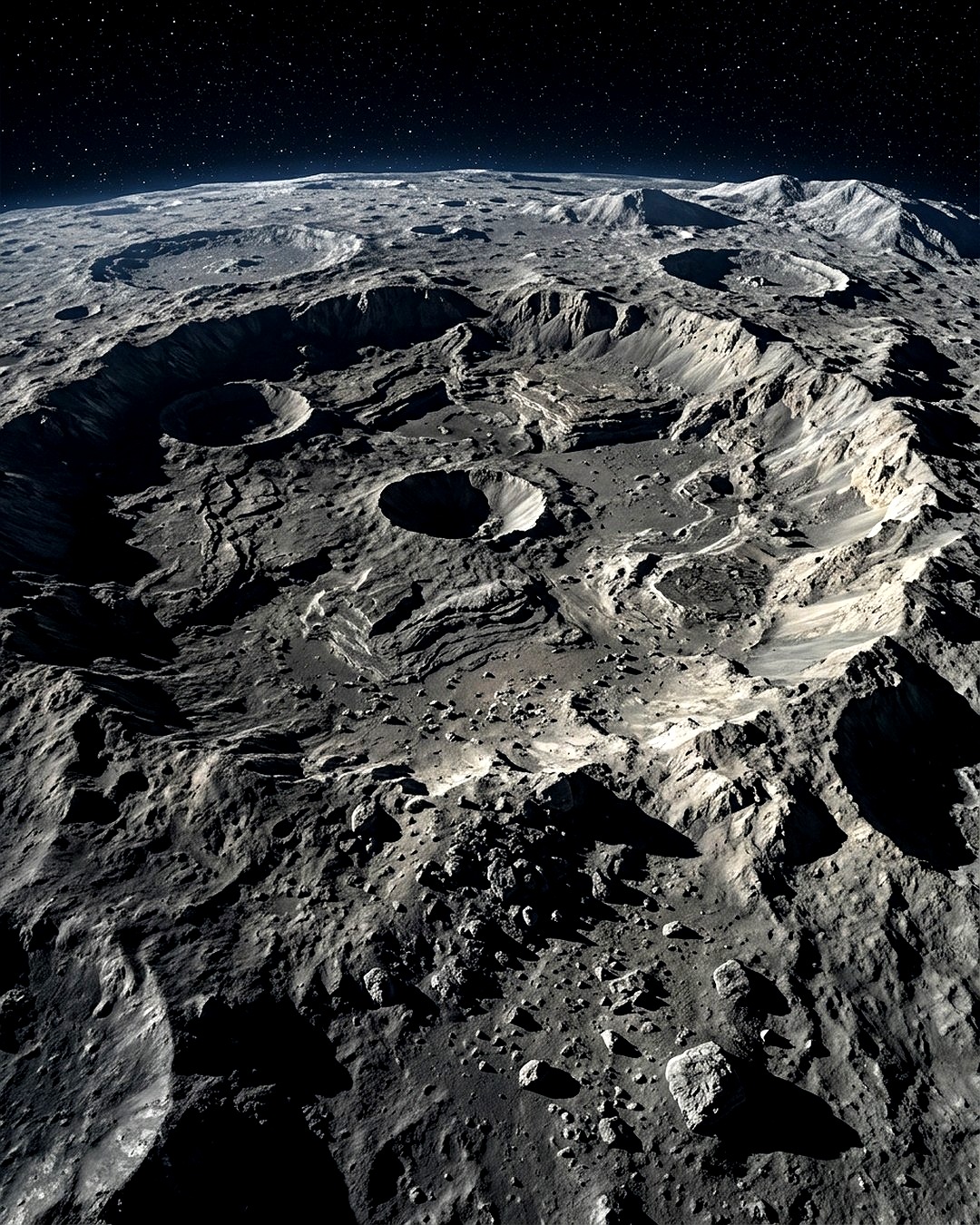
🌕 Lunar Far Side Collisions

SciTechDaily Astronomy Geology Moon SpaceExploration LunarSample PlanetaryScience

Zusammenfassung

Mindmap Titelbild
KI Generiertes Titelbild

An international research team led by scientists at the University of Hong Kong has identified two types of magnesium-rich rocks with distinct origins within the South Pole-Aitken basin. This discovery helps explain why the near and far sides of the Moon look remarkably different. By analyzing lunar samples and mission data, researchers established a timeline for major ancient impacts. The study sheds light on how successive cosmic collisions reshaped the lunar surface over hundreds of millions of years. The researchers argue that a series of three massive impacts played a critical role in shaping the geology of the Moon's far side. They contend that impact melt sheets and subsequent debris scattering created the complex rock distribution observed today. This stance challenges simpler models of lunar evolution by emphasizing the cumulative effects of multiple giant collisions. The authors maintain that direct samples from the far side are essential for resolving long-standing planetary mysteries. The investigation relies on surface measurements from Chang'e-4 and the first-ever rock samples returned by the Chang'e-6 mission. Moderately magnesium-rich norites formed from a thick sheet of molten rock following the initial South Pole-Aitken basin impact. Highly magnesium-rich rocks formed through a separate magnesium-suite magmatism process linked to the original impact event. Radiometric and geological analysis dates the South Pole-Aitken basin formation to approximately 4.34 billion years ago, the Apollo basin to 4.2 billion years ago, and the Orientale basin to 3.87 billion years ago. These findings provide planetary scientists with a refined framework for understanding impact cratering and crustal evolution across the solar system. Researchers can apply this chronological model when studying impact basins on other rocky bodies like Mars and Mercury. The work underscores the immense scientific value of sample-return missions targeting unexplored planetary regions. Ultimately, interpreting lunar asymmetry advances our comprehension of early solar system bombardment history.

Schlüsselpunkte

01

🏛️ South Pole-Aitken Basin Significance

Located on the Moon's far side, the South Pole-Aitken basin is one of the oldest and largest impact structures in the entire solar system. Understanding its complex history helps explain why the lunar near and far sides exhibit such dramatic differences. The region remained largely unexplored until recent decades due to the challenges of landing on the lunar far side. Examining this structure provides critical data regarding the early geological evolution of planetary bodies.

02

📊 Chang'e Mission Contributions

The Chang'e-4 mission achieved the first successful landing on the lunar far side in the year 2019. Subsequently, the Chang'e-6 mission brought the first physical rock samples from this unexplored region back to Earth in 2024. Researchers at the University of Hong Kong utilized these allocated samples alongside surface measurements to reconstruct impact history. Satellite observations and numerical simulations further enabled scientists to trace rock origins across the wider basin.

03

🔸 Two Distinct Rock Origins

Researchers identified two distinct groups of magnesium-rich rocks with remarkably different geological origins within the basin. Moderately magnesium-rich norites formed from a thick sheet of molten rock that gradually cooled following the original impact. A second group containing considerably more magnesium formed through magnesium-suite magmatism associated with the initial impact event. Subsequent impacts by later craters like Finsen and Chaffee S scattered these ancient rocks toward the landing sites.

04

📈 Timeline of Ancient Collisions

The international research team established a precise timeline for three major ancient lunar collisions. The South Pole-Aitken basin formed approximately 4.34 billion years ago during the early bombardment period. A second major impact created the Apollo basin around 4.2 billion years ago. Finally, the Orientale basin formed approximately 3.87 billion years ago, concluding this sequence of major reshaping events.

05

💡 Volcanic History and Magma Structures

Earlier research by the same team uncovered evidence of prolonged volcanic activity and unrecognized magma structures in the Apollo basin. Underground accumulations of titanium-rich minerals known as ilmenite-bearing cumulates help account for contrasting volcanic histories. These subsurface mineral deposits explain why magma behavior differed significantly between the Moon's two sides. Integrating surface rock data with subsurface magmatic findings creates a comprehensive picture of lunar asymmetry.

Möchten Sie Ihre eigene Mindmap erstellen?

Melden Sie sich bei Neumap AI an und beginnen Sie mit der Erstellung Ihrer eigenen Mindmaps!

Loslegen