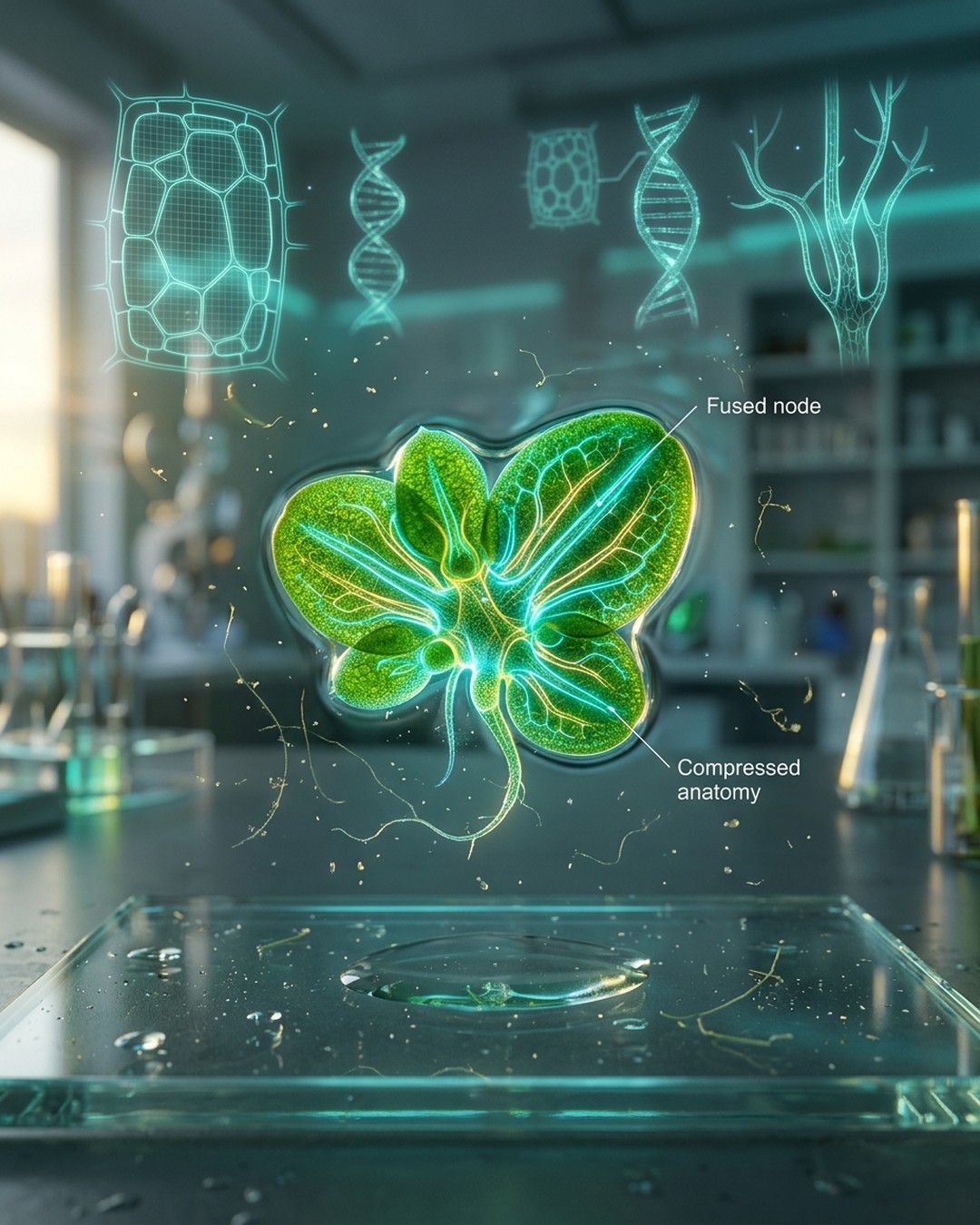
Secrets of Duckweed Miniaturization

scitechdaily biology botany genetics plant-science duckweed

Zusammenfassung

Mindmap Titelbild
KI Generiertes Titelbild

Researchers at the University of Nottingham have published a study in Current Biology on October 20, 2026, revealing how duckweed, one of the world's smallest flowering plants, manages to shrink to a body size of just a few millimeters without losing its original anatomical blueprint. Lead researcher Dr. Anthony Bishopp and co-author Dr. Alex Ware explained that rather than discarding organs or structures through extreme miniaturization, duckweed tightly compresses and fuses its essential shoot components into an incredibly compact body. This groundbreaking discovery challenges the long-standing biological assumption that extreme miniaturization in plants and animals inevitably involves the loss of core organs and structural body plans. Understanding this unique compact anatomy provides a crucial foundation for future agricultural cultivation, positioning duckweed as an untapped, highly efficient protein and food source for terrestrial consumption and long-duration space missions.

Schlüsselpunkte

01

🔹 Discovery of Duckweed Miniaturization Mechanism

Researchers at the University of Nottingham published a study in Current Biology on October 20, 2026, investigating duckweed, one of the world's smallest flowering plants measuring about 0.1 inch across, and discovered how it achieves extreme miniaturization without losing its original plant architecture (evidenceIds: S0020, S0021).

02

🔸 Compression vs. Loss of Biological Structures

Lead researcher Dr. Anthony Bishopp noted that unlike animals, which typically lose organs during miniaturization, duckweed retains its complete shoot organization by tightly compressing and fusing its structural components rather than throwing away parts of the evolutionary blueprint (evidenceIds: S0023, S0024).

03

⭐ Potential for Future Food and Space Missions

Scientists are investigating duckweed as an unexplored, highly promising future source of food and protein for both terrestrial agriculture and long-duration human space missions, building on relatives that include much larger herbaceous species (evidenceIds: S0025, S0026).

04

📊 Overcoming Agricultural and Anatomical Challenges

Unlike major agricultural crops with thousands of years of selective breeding, duckweed remains largely uncultivated and poorly understood, making these new anatomical findings essential for identifying traits that can be improved for large-scale crop production (evidenceIds: S0026, S0027).

05

💡 Reassessing Plant Evolution and Simplicity

Co-author Dr. Alex Ware emphasized that duckweed's astonishingly small size does not make it primitive or structurally deficient, but rather demonstrates a sophisticated evolutionary mechanism of physical compression that contributes to broader plant science research (evidenceIds: S0027, S0028).

Möchten Sie Ihre eigene Mindmap erstellen?

Melden Sie sich bei Neumap AI an und beginnen Sie mit der Erstellung Ihrer eigenen Mindmaps!

Loslegen