Earth and Mars Formed Through Different Planetary Processes

scitechdaily astronomy earth-science geochemistry planet-formation

Zusammenfassung

Mindmap Titelbild
KI Generiertes Titelbild

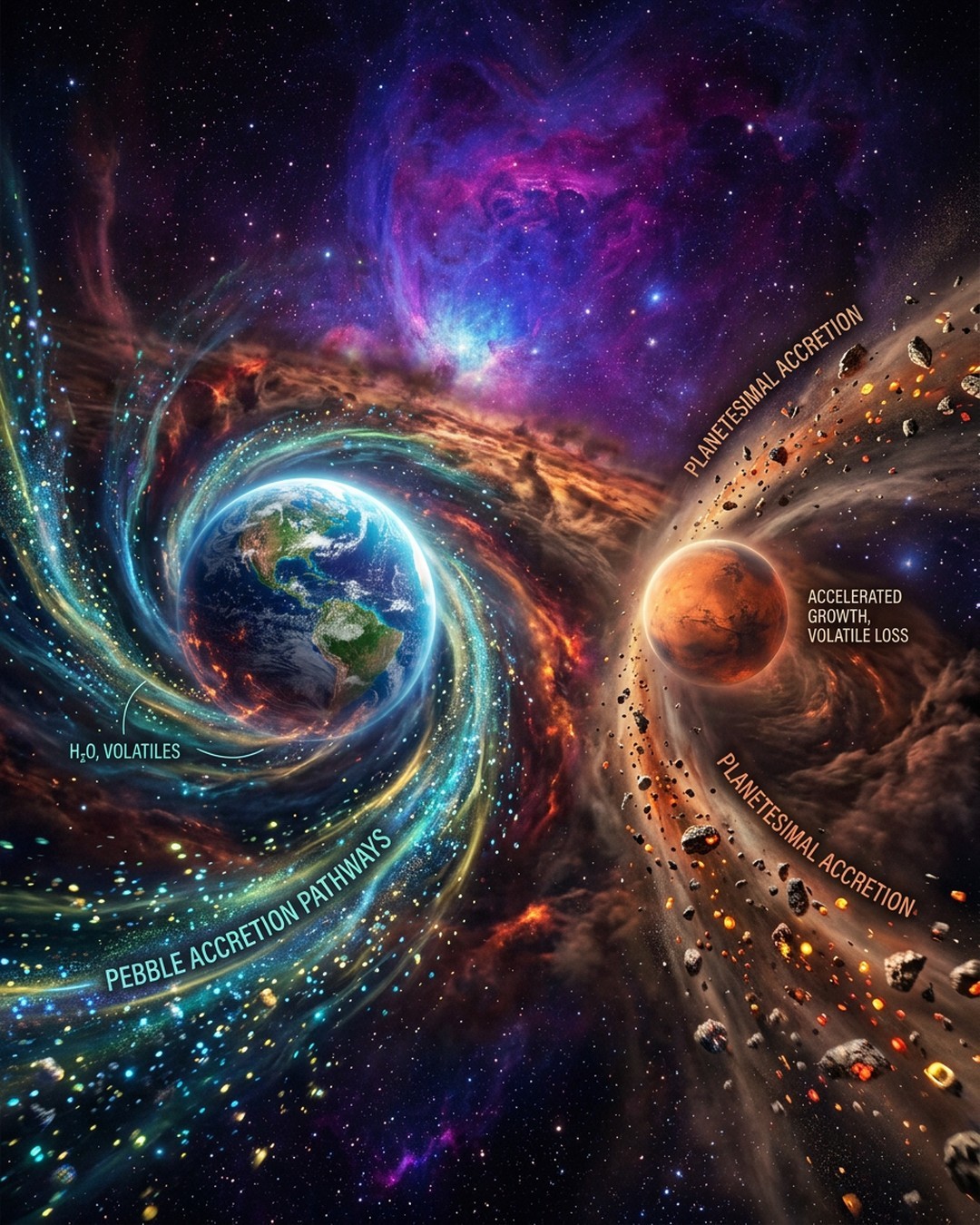
Earth and Mars formed side by side approximately 4.5 billion years ago, yet recent research published in Nature Astronomy on September 25, 2026, reveals they developed through fundamentally different building processes. Led by researchers at the University of Copenhagen including Professor Anders Johansen and Assistant Professor Haiyang Wang, the study utilized volatile element analysis to uncover distinct formation pathways for the two rocky planets. The authors emphasize that while both planets grew via hybrid accretion involving planetesimals and pebble accretion, the proportions differ drastically. At least 75 percent of Earth's mass originated from young protoplanets that grew through pebble accretion, whereas roughly three-quarters of Mars' mass came from smaller planetesimals. The research methodology combines chemical fingerprints of volatile elements such as sodium, zinc, and potassium with advanced computer models. This approach bypasses ambiguities common in traditional isotope-based methods, offering a more direct window into the primordial conditions of our solar system. These findings carry significant implications for astrobiology and the search for habitable worlds beyond our solar system. Understanding how rocky planets retain volatile substances like water during formation helps scientists predict the habitability of exoplanets in distant star systems.

Schlüsselpunkte

01

🔹 Formation Timeline and Core Discovery

【📌 Key Finding】Earth and Mars formed approximately 4.5 billion years ago in the same solar system but grew through fundamentally different proportions of planetary building processes. 【🔸 Impact Factors】Professor Anders Johansen and Assistant Professor Haiyang Wang co-led the study at the University of Copenhagen, published on September 25, 2026, in Nature Astronomy. 【⭐ Data Support】Despite developing side by side, their distinct formation pathways challenge traditional assumptions that neighboring planets share nearly identical histories.

02

🔸 Divergent Accretion Proportions

【📌 Key Finding】Earth and Mars relied on pebble accretion and planetesimal collisions in vastly different ratios. 【🔸 Impact Factors】At least 75 percent of Earth's mass originated from young protoplanets that grew large by accreting pebbles, while planetesimals contributed up to 25 percent. 【⭐ Data Support】In stark contrast, roughly three-quarters of Mars' mass came from planetesimals, with the remaining quarter originating from pebble accretion.

03

⭐ Chemical Clues and Volatile Elements

【📌 Key Finding】Researchers reconstructed planetary history by analyzing volatile elements in planetary mantles and crusts. 【🔸 Impact Factors】Elements such as sodium, zinc, and potassium evaporate at high temperatures, preserving geochemical clues about early formation conditions. 【⭐ Data Support】The research team combined these chemical fingerprints with computer models, establishing that mantle compositions serve as permanent imprints of the formation process over 4.5 billion years.

04

📊 Methodological Advantage Over Isotopes

【📌 Key Finding】The new volatile-based methodology provides a more precise and direct way to understand planet formation. 【🔸 Impact Factors】Traditional isotope-based approaches often yield multiple interpretations and ambiguities. 【⭐ Data Support】Even when testing various assumptions regarding original solar system building materials, the chemical contrast and structural differences between Earth and Mars remained consistently robust.

05

💡 Implications for Habitable Exoplanets

【📌 Key Finding】Understanding rocky planet formation mechanisms aids the search for life-supporting worlds beyond our solar system. 【🔸 Impact Factors】Formation conditions directly dictate how much volatile material, including water and life-supporting substances, a planet retains. 【⭐ Data Support】This research framework helps scientists improve predictions regarding the habitability of rocky planets discovered outside our solar system.

Möchten Sie Ihre eigene Mindmap erstellen?

Melden Sie sich bei Neumap AI an und beginnen Sie mit der Erstellung Ihrer eigenen Mindmaps!

Loslegen