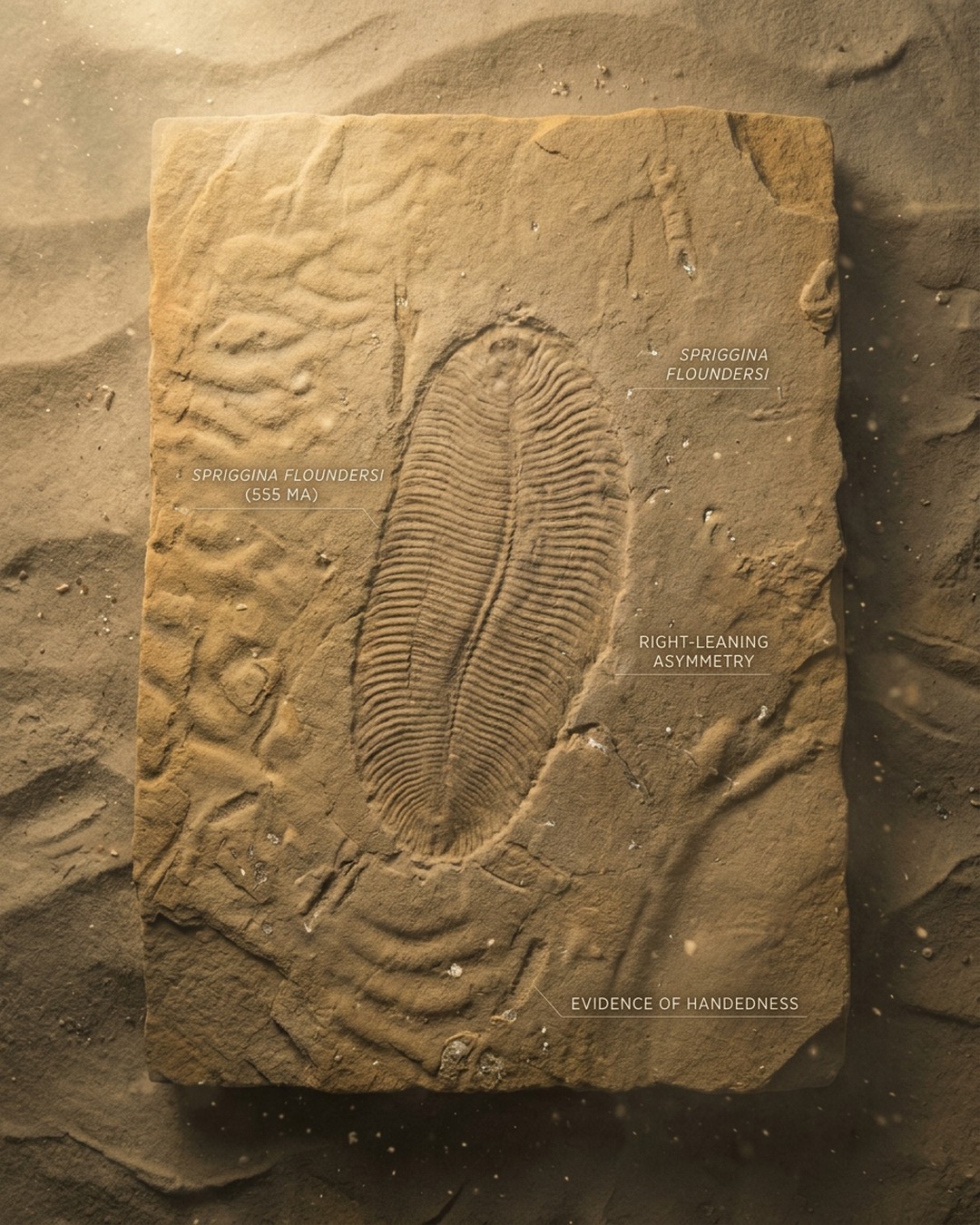
Evidence of Handedness in 555-Million-Year-Old Spriggina Fossils

paleontology evolutionary-biology Ediacaran-Period Spriggina-floundersi fossil-analysis

Zusammenfassung

Mindmap Titelbild
KI Generiertes Titelbild

Researchers have identified evidence of handedness in Spriggina floundersi, a worm-like creature that lived approximately 555 million years ago during the Ediacaran Period. By analyzing 100 fossil specimens collected in South Australia, scientists discovered a statistically significant preference for bending to the right, suggesting that complex nervous system functions and behavioral asymmetries emerged much earlier than previously thought. The study, led by Scott Evans at the American Museum of Natural History, challenges the previous assumption that such advanced biological traits only appeared during the Cambrian Period. The findings indicate that the foundational characteristics of mobile animal life, including bilateral symmetry and functional asymmetry, were already well-established in the Ediacaran, providing a precursor for the rapid diversification seen in the subsequent Cambrian explosion. This discovery highlights that the complex animal groups we recognize today did not emerge spontaneously but were built upon evolutionary foundations laid down half a billion years ago. The ability to favor one side, while maintaining the flexibility to move in both directions to avoid circular motion, represents a sophisticated level of biological organization for early multicellular organisms. For evolutionary biologists and paleontologists, this research underscores the importance of the Ediacaran Period in the history of life. It provides a deeper understanding of how behavioral traits evolve and suggests that the roots of modern animal movement and neurological complexity are significantly deeper in the fossil record than once believed.

Schlüsselpunkte

01

🔹 Discovery of Ancient Handedness

Researchers identified a 555-million-year-old worm, Spriggina floundersi, that exhibited a preference for turning to the right. This discovery represents the oldest known example of handedness in the fossil record, suggesting that advanced nervous system development occurred during the Ediacaran Period.

02

🔸 Statistical Evidence from Fossils

Analysis of 100 fossil specimens from South Australia revealed that twice as many fossils were bent to the left as to the right. Because these fossils are mirror-image impressions created when storms buried the creatures in sand, the data confirms the animals themselves possessed a natural tendency to bend to the right.

03

⭐ Evolutionary Significance

The presence of handedness indicates that early multicellular life had already developed complex behavioral asymmetries. This finding pushes back the timeline for the emergence of such traits from the Cambrian Period (starting 541 million years ago) to the earlier Ediacaran Period.

04

📊 Biological Context and Movement

Spriggina lived in shallow oceans and foraged on the seafloor. While they showed a preference for right-side bending, specimens also displayed bends to both sides, suggesting they retained the flexibility to move in either direction to avoid being trapped in circular movement patterns.

05

💡 Foundations for the Cambrian Explosion

The study suggests that the rapid diversification of animal life during the Cambrian explosion was built upon foundations established in the Ediacaran. Traits like bilateral symmetry and handedness provided the necessary biological framework for later organisms to evolve more complex features, such as limbs for efficient movement.

Möchten Sie Ihre eigene Mindmap erstellen?

Melden Sie sich bei Neumap AI an und beginnen Sie mit der Erstellung Ihrer eigenen Mindmaps!

Loslegen