Venus Active Subsurface Geology and Rift Valleys

scitechdaily venus planetary-science geology eth-zurich space-exploration

Resumen

Mind Map Cover Image
Imagen de Portada Generada por IA

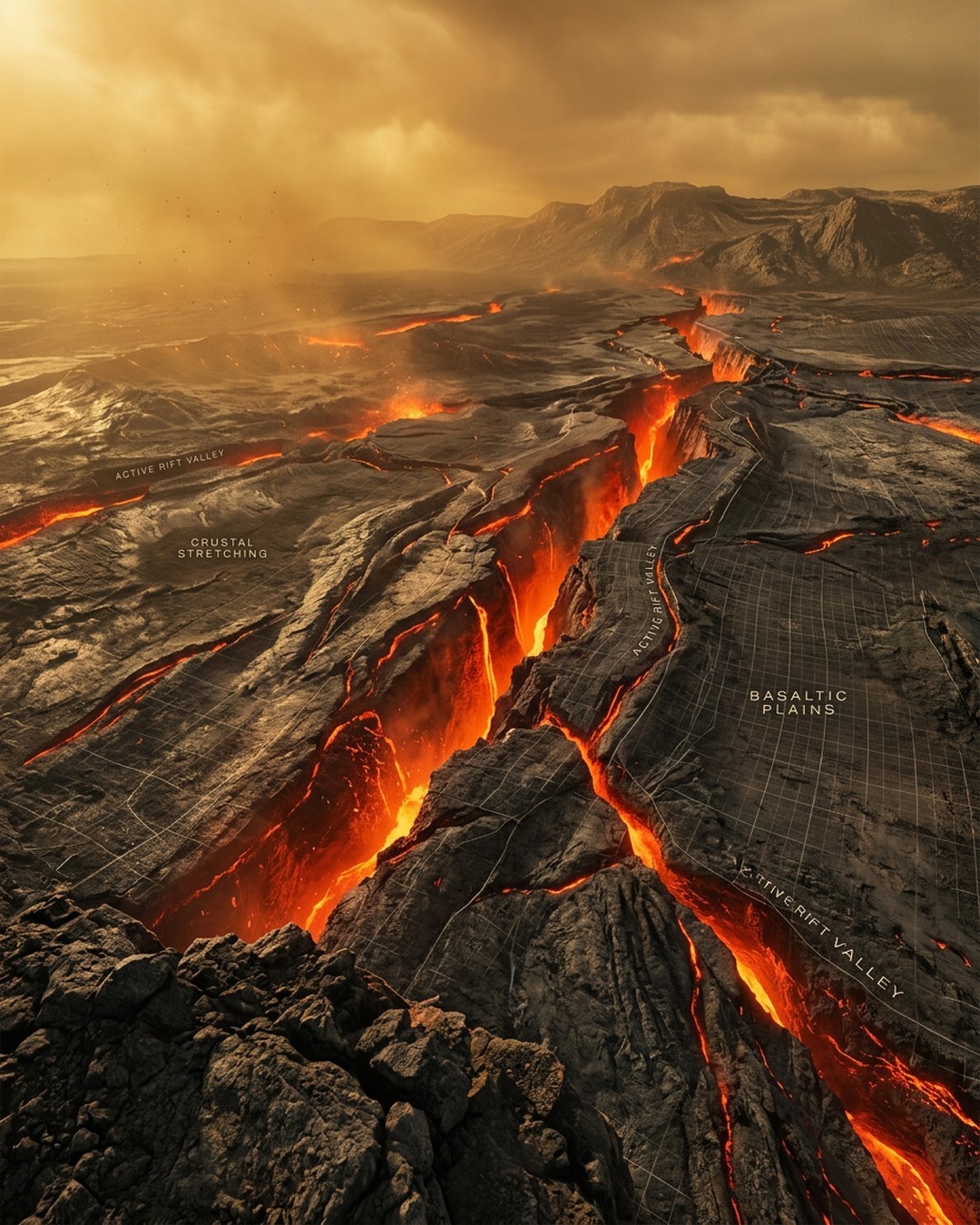
Published on July 30, 2026, new research led by ETH Zurich geodynamicist Taras Gerya reveals that Venus remains geologically active beneath its scorching surface, with giant rift valleys currently forming or recently active. Researchers Xi Yang and Anna Gülcher developed high-resolution three-dimensional computer simulations published in Nature Geoscience to analyze how Venusian crust responds when pulled apart. The authors emphasize that Venus is not a geologically dead world as previously assumed. By studying rift flanks, which are broad ridges created when material beneath stretching crust pushes upward, the team discovered a geological clock allowing comparison with radar maps gathered by NASA's Magellan spacecraft in the early 1990s. The essence of the study demonstrates that Venusian rifts in regions like Ganis Chasma, Dali Chasma, and Devana Chasma share structural traits with young, active formations. These rifts may be spreading at rates of 3 to 10 centimeters per year, driven by rising internal heat rather than Earth-style plate tectonics. These findings provide critical targets for upcoming missions such as NASA's VERITAS and DAVINCI probes, as well as ESA's EnVision orbiter planned for launch in November 2031, which will further investigate the planet's interior structure and ongoing surface deformation.

Puntos clave

01

🔹 July 30, 2026 Research Findings on Venusian Activity

Published on July 30, 2026, in Nature Geoscience, research led by Taras Gerya from ETH Zurich demonstrates that Venus is geologically active beneath its surface. Giant rift valleys are actively forming or have recently formed, challenging the long-held belief that Venus is a geologically dead planet.

02

🔸 Extreme Surface Conditions and Structural Comparisons

Venus shares similar size, mass, and rocky composition with Earth, but possesses an average surface temperature of 465 degrees Celsius (869 degrees Fahrenheit) under a carbon dioxide atmosphere. Unlike Earth, Venus lacks global plate tectonics and oceans, but its crust still stretches and cracks under rising internal heat to form rift valleys stretching nearly 10,000 kilometers (6,200 miles).

03

⭐ High-Resolution 3D Simulations and Geological Clock

Lead author Xi Yang and Anna Gülcher created high-resolution three-dimensional computer simulations to model crustal deformation. The simulations revealed a geological clock based on rift flanks, which are broad ridges pushed upward during active spreading that gradually sink and flatten as the crust relaxes over time in the absence of water erosion.

04

📊 Radar Mapping Correlations and Rapid Spreading Rates

Comparing simulated models with NASA Magellan spacecraft radar data from the early 1990s identified specific regions like Ganis Chasma, Dali Chasma, and Devana Chasma containing features of young rifts. These systems may be spreading at rates of 3 to 10 centimeters (1.2 to 3.9 inches) per year, comparable to tectonic plate movements on Earth.

05

💡 Future Space Missions and Instrumentation

The identified rift formations provide precise targets for upcoming exploration missions. These include NASA's VERITAS radar mapping mission, NASA's DAVINCI atmospheric probe, and ESA's EnVision orbiter scheduled for launch in November 2031, which will study the planet from interior to upper atmosphere with contributions from ETH geophysics professors Paul Tackley and Taras Gerya.

¿Quieres crear tu propio mapa mental?

¡Inicia sesión en Neumap AI y comienza a crear tus propios mapas mentales!

Comenzar