Candida Auris Hair Follicle Colonization Study

scitechdaily medical-research mycology immunology candida-auris

Resumen

Mind Map Cover Image
Imagen de Portada Generada por IA

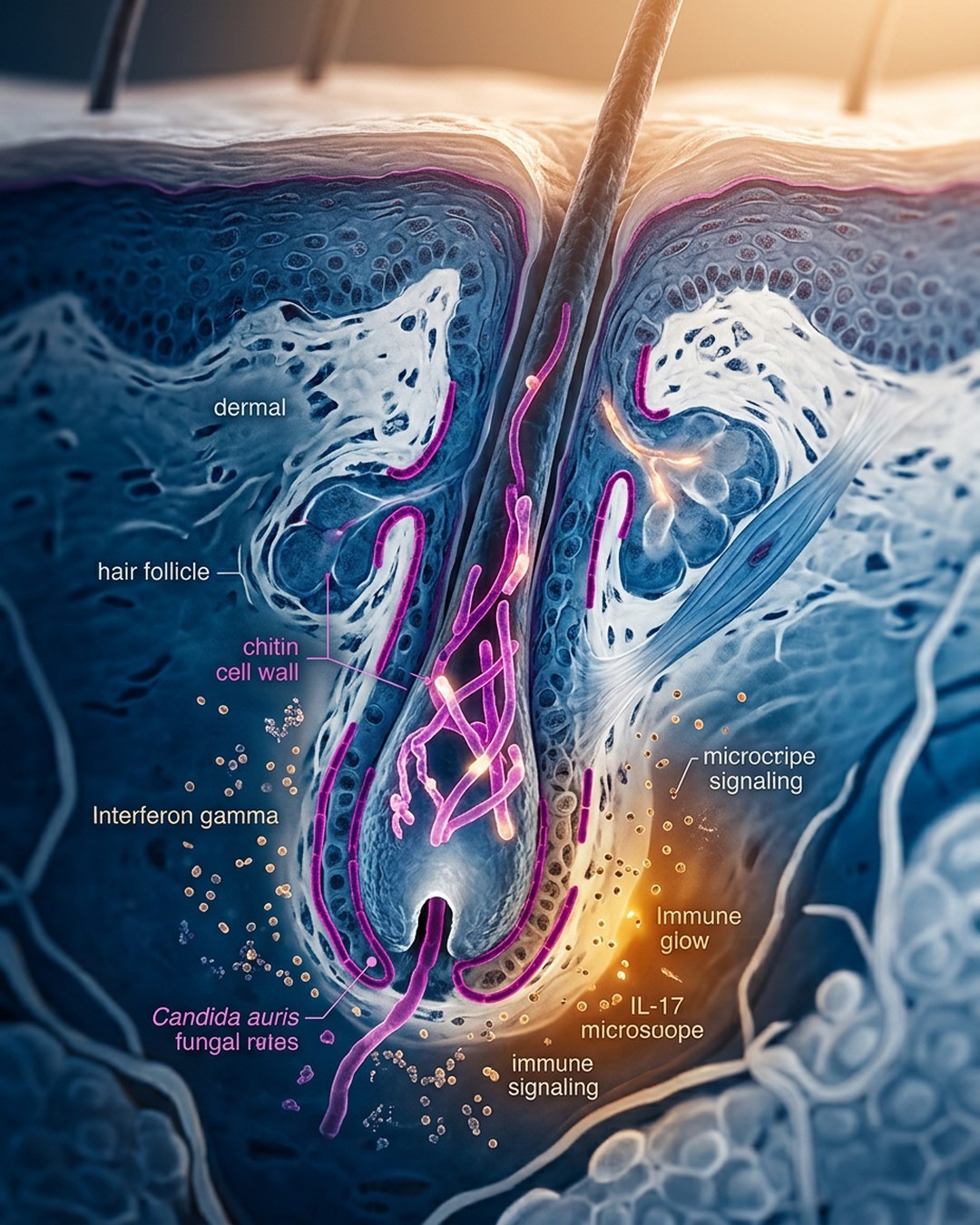
University of California San Francisco researchers published a study in Science on August 6, 2026, revealing how the hospital-associated fungus Candida auris persists on human skin by hiding within hair follicles. While common skin fungi like Candida albicans are quickly cleared by the immune system via the IL-17 signaling pathway, Candida auris exposes surface chitin to trigger an inappropriate interferon gamma immune response. This suppresses standard antifungal defenses and delays skin cell replacement, creating a protected sanctuary that enables the pathogen to survive and subsequently invade vulnerable patients, resulting in approximately 3,000 deaths annually in US healthcare facilities. The researchers emphasize that understanding this specific immune-evasion mechanism provides actionable targets for future therapies, such as blocking chitin interactions or redirecting immune signals from interferon gamma back to IL-17. This discovery bridges the gap between harmless surface colonization and dangerous systemic infection in immunocompromised individuals, highlighting how opportunistic microbes exploit host biology. The strategic insight centers on manipulating host-microbe interactions at the epithelial barrier, demonstrating that microbial evasion relies on active hijacking of localized immune pathways rather than passive concealment. By pinpointing the exact molecular dialogue between fungal chitin and skin immunity, medical researchers can design targeted topical treatments to eradicate persistent hospital pathogens before they reach the bloodstream. Clinicians and medical researchers can utilize these findings this week by reviewing infection control protocols in long-term care facilities and considering novel therapeutic targets against fungal cell wall components. Future preventative strategies should focus on topical immunomodulation to restore normal antifungal clearance in high-risk hospital patients.

Puntos clave

01

🔹 Candida Auris Threat and Background

【📌 Core Issue】Candida auris is a hospital-associated fungus first identified in Japan in 2009 that poses severe systemic risks to vulnerable patients. 【⭐ Impact Data】The pathogen kills about 3,000 patients each year in US hospitals and long-term care facilities when it enters the bloodstream. 【🔸 Clinical Challenge】Medical professionals currently lack effective ways to eliminate the fungus from the skin surface once colonization occurs.

02

🔸 Comparative Animal Study Findings

【📌 Research Method】UCSF researchers compared Candida auris with Candida albicans, a common skin fungus, using mouse models. 【⭐ Clearance Rates】Candida albicans vanished within days due to rapid immune clearance, whereas Candida auris successfully persisted by settling deep into hair follicles. 【💡 Colonization Advantage】This specialized follicular persistence sets up the fungus to invade deeper tissues once the host immune system is weakened.

03

⭐ Immune Evasion Mechanism via Chitin

【📌 Immune Pathways】Candida albicans activates IL-17 to strengthen antifungal defenses, while Candida auris stimulates interferon gamma, a signal typical of viral infections. 【⚙️ Molecular Trigger】Candida auris reshapes its outer cell wall to expose more chitin, prompting immune cells around hair follicles to produce interferon gamma. 【⚖️ Cellular Consequences】Interferon gamma suppresses IL-17 and slows the normal replacement of follicle cells, accumulating damaged cells that form a protected nest for the fungus.

04

📊 Research Team and Publication Details

【📌 Study Publication】Published in Science on August 6, 2026, by researchers from the University of California San Francisco (UCSF). 【👤 Key Personnel】Lead author Dean Merrill MD, co-senior authors Suzanne Noble MD PhD and Ari Molofsky MD PhD. 【🏛️ Funding Sources】Supported by the National Institutes of Health, Dermatology Foundation, and the Veterans Health Administration Office of Research and Development.

05

💡 Therapeutic Targets and Future Interventions

【📌 Prevention Strategies】Future treatments could block fungal chitin to stop interferon gamma signaling or restore the IL-17 antifungal response. 【🛡️ Clinical Implication】Understanding how microbes remain harmless on skin before turning dangerous helps explain the transition to severe systemic infections. 【🎯 Actionable Outlook】Targeting skin colonization mechanisms offers a novel way to protect medically vulnerable patients in healthcare settings.

¿Quieres crear tu propio mapa mental?

¡Inicia sesión en Neumap AI y comienza a crear tus propios mapas mentales!

Comenzar