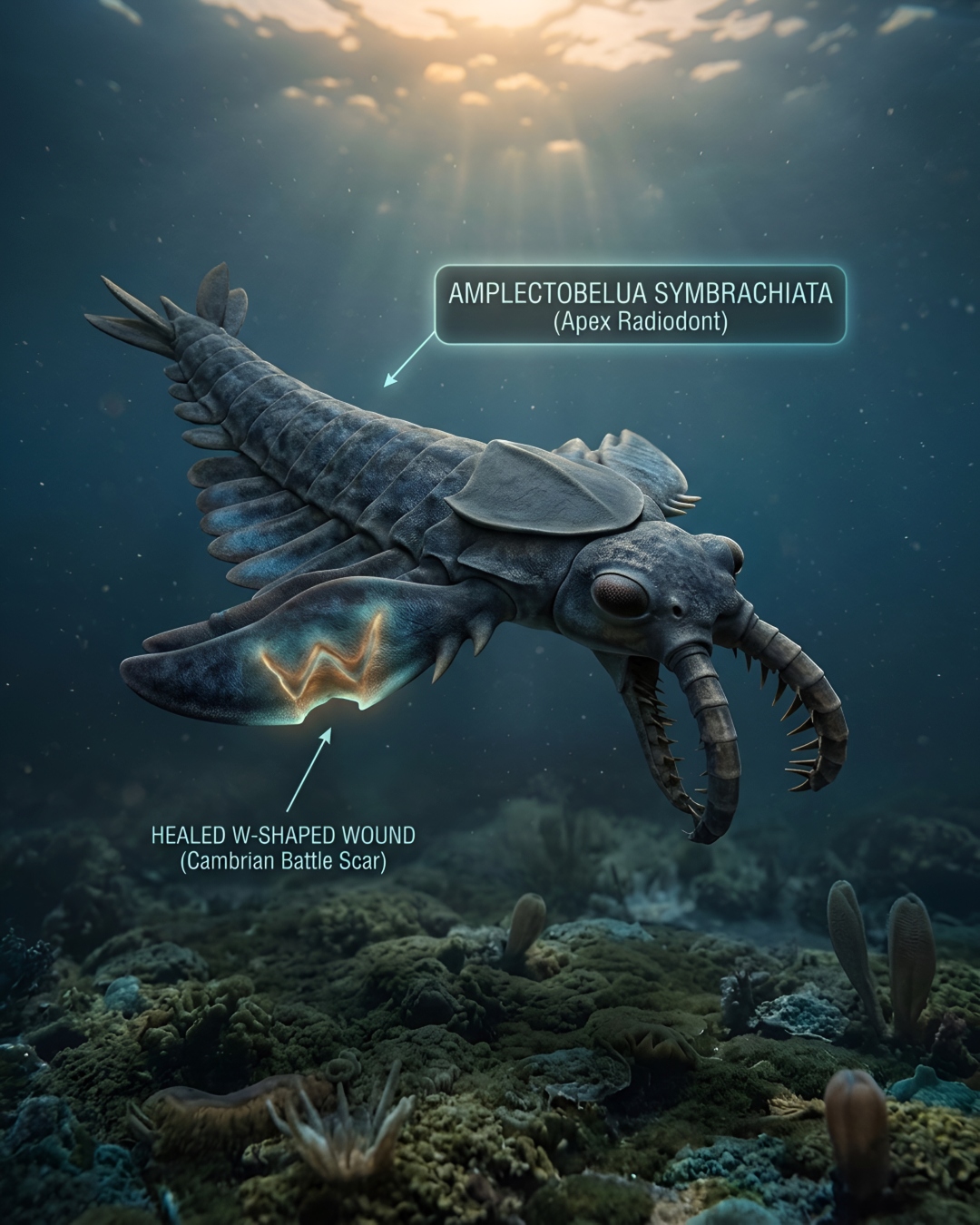
Healed Fang Wound on 520-Million-Year-Old Apex Predator

Paleontology CambrianPeriod Radiodonts FossilDiscovery EvolutionaryBiology

Resumen

Mind Map Cover Image
Imagen de Portada Generada por IA

Researchers have discovered a unique 520-million-year-old fossil from the Cambrian Period featuring a healed bite wound on a swimming flap of Amplectobelua symbrachiata, an apex predator belonging to the radiodont group. Found in the Yu'anshan Formation in China, this rare fossil provides direct evidence of prehistoric predation and aggressive interactions among ancient marine apex predators. X-ray fluorescence mapping and the presence of a dark melanisation band around the W-shaped injury confirm that the wound occurred while the organism was alive and successfully healed. The researchers, including Stephen Pates and Kunsheng Du, argue that the specific W-shape and location of the trauma strongly indicate a fang attack from another predator, potentially a rival radiodont or even a member of the same species. While alternative hypotheses such as moulting damage have been suggested by experts like Joe Moysiuk, the morphological characteristics of the injury heavily favor a predation event. This discovery offers unprecedented insight into the fierce ecological pressures and survival struggles in early marine ecosystems. This finding represents a significant milestone in paleontological research because soft-tissue fossils of radiodonts are exceptionally rare due to their delicate swimming flaps. Unlike trilobites, which frequently display healed injuries owing to their hard exoskeletons and abundance in the fossil record, finding similar evidence in soft-bodied radiodonts is unprecedented. The study bridges critical knowledge gaps regarding predator-prey dynamics and intraspecific competition during the Cambrian explosion. Paleontologists and evolutionary biologists can utilize these findings to better model ancient marine food webs and the intensity of evolutionary pressures 520 million years ago. Future excavations in exceptional fossil preservation sites like the Yu'anshan Formation may yield additional specimens to further clarify the frequency of non-lethal predatory attacks in early animal communities.

Puntos clave

01

🔹 Discovery of 520-Million-Year-Old Fossil Evidence

Researchers discovered an exceptional fossil of a swimming flap belonging to Amplectobelua symbrachiata, an apex predator from the Cambrian Period approximately 520 million years ago. The fossil, found in the Yu'anshan Formation in China, preserves soft tissues remarkably well and contains a distinct W-shaped injury on its edge.

02

🔸 Confirmation of Healed Predation Wound via X-Ray Mapping

X-ray fluorescence mapping verified that the W-shaped feature shares the same chemical composition as the rest of the fossil, ruling out structural artifacts from preservation. A dark melanisation band surrounding the injury indicates that tissue regeneration occurred while the animal was actively alive, confirming a successfully healed wound.

03

⭐ Identification and Characteristics of Radiodonts

Amplectobelua symbrachiata belonged to radiodonts, an extinct group of arthropods combining squid-like and lobster-like features. Growing up to nearly a meter long, they possessed two vicious grasping appendages and swimming flaps, making them dominant apex predators in Cambrian seas despite softer swimming flaps that rarely fossilize.

04

📊 Comparison with Trilobite Predation Records

While hundreds of predation wounds are documented on trilobites due to their hard exoskeletons and long evolutionary lifespan extending to 250 million years ago, discovering a healed injury in a radiodont is unprecedented because radiodonts became extinct around 480 million years ago and rarely preserve soft tissues.

05

💡 Evaluation of Alternative Hypotheses and Conclusions

Although experts like Joe Moysiuk suggested the wound might stem from moulting trauma during exoskeleton shedding, lead researcher Stephen Pates concluded that the W-shape and specific anatomical location strongly point toward a predation attack from either a different species or a cannibalistic conspecific.

¿Quieres crear tu propio mapa mental?

¡Inicia sesión en Neumap AI y comienza a crear tus propios mapas mentales!

Comenzar