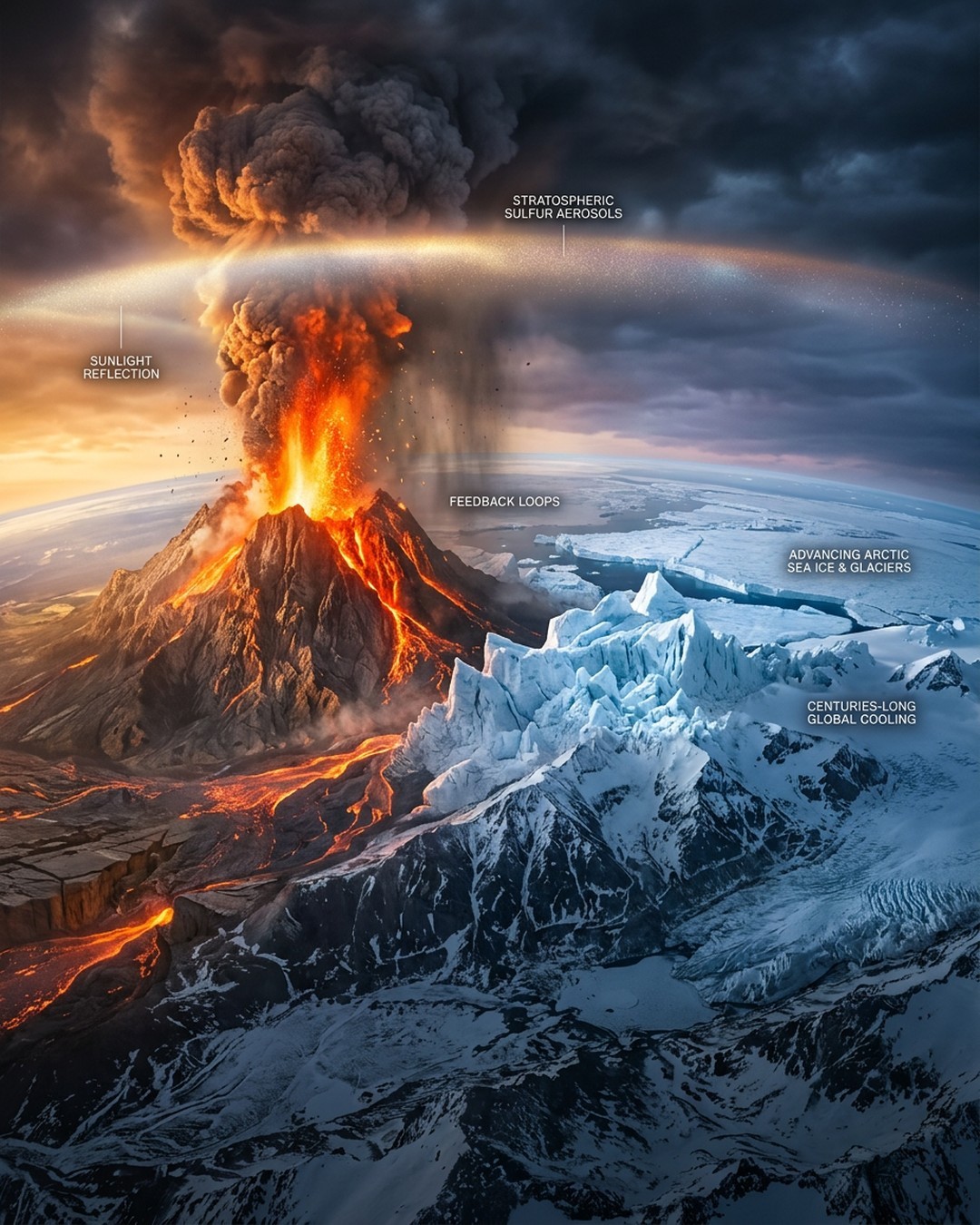
Ancient Super-Eruptions and Centuries-Long Global Cooling

scitechdaily climate-change earth-science geology paleoclimatology volcano

Resumen

Mind Map Cover Image
Imagen de Portada Generada por IA

Recent scientific research published in Nature Communications on May 28, 2026, reveals that some of history's most powerful volcanic super-eruptions pushed Earth into sustained cold spells lasting for centuries during the Holocene epoch. Led by postdoctoral researcher Alice Paine from the University of Basel and funded by the Swiss National Science Foundation, the international team analyzed records of 51 major eruptions and correlated them with 22 periods of major glacier growth across 17 regions. The researchers discovered that over 80 percent of the Holocene's prolonged cold periods coincided with at least one major volcanic eruption, with every known eruption of magnitude 7 or greater closely linked to glacier advances appearing in both hemispheres. Rather than keeping the planet cold through continuous ash fallout, these explosive events injected massive quantities of sulfur high into the atmosphere, creating long-lasting aerosol layers that reflected sunlight and initiated powerful climatic feedback loops. The mechanism involves a complex cascading chain of events where initial solar reflection cools the surface, causing Arctic sea ice to expand rapidly. This expanding bright ice reflects more sunlight, reduces heat transfer between the ocean and atmosphere, alters North Atlantic circulation, and shifts the tropical rain belt southward. These slow-responding oceanic and cryospheric systems sustain the cooling for decades or centuries long after the original volcanic sulfur has washed out of the atmosphere. Understanding these ancient super-eruptions provides crucial insights into Earth's climate vulnerability, though researchers emphasize that modern anthropogenic greenhouse gas emissions create a radically different atmospheric state today. While a massive eruption in the current climate might cause sudden disruptions, its interaction with ongoing global warming remains a complex knowledge gap requiring further investigation.

Puntos clave

01

🔹 Holocene Climate Mystery and Volcanic Trigger

【📌 Research Finding】The Holocene epoch, spanning the past 11,700 years, experienced 22 major cold periods characterized by temperature drops, rainfall shifts, and mountain glacier advances. 【🔸 Impact Factors】Led by Alice Paine at the University of Basel and published in Nature Communications on May 28, 2026, a new study demonstrates that explosive volcanic eruptions provided the initial shock for these historical cooling episodes. 【⭐ Data Support】Researchers analyzed 51 major eruptions north of 20° south latitude and found that over 80 percent of the 22 glacier advances coincided with at least one major eruption.

02

🔸 Statistical Correlation with Magnitude 7+ Eruptions

【📌 Extreme Events】Every known Holocene eruption with a magnitude of 7 or greater occurred close in time to a glacier advance, with 72 percent showing evidence of advancing glaciers in both hemispheres. 【🔸 Robustness】To test statistical significance, the team generated 10 million random sets of eruption dates, confirming the association between the largest eruptions and glacier advances at the 99 percent confidence level. 【⭐ Historical Examples】Notable past events such as the 1257 Samalas eruption, the K-Ah eruption in Japan, and the Kurile Lake eruption in Russia each released more than twice the sulfur load of the 1815 Mount Tambora eruption.

03

⭐ Sulfur Aerosols and the Snowball Feedback Effect

【📌 Primary Mechanism】Volcanoes inject massive quantities of sulfur high into the atmosphere to form tiny aerosol particles that reflect incoming sunlight back into space, rapidly cooling Earth's surface. 【🔸 Cascading Impacts】The initial cooling causes Arctic sea ice to spread, which reflects more sunlight, limits ocean-atmosphere heat transfer, alters North Atlantic ocean currents, and shifts the tropical rain belt southward. 【⭐ Multi-Decadal Persistence】While sulfur particles wash out of the atmosphere within years, the slowly responding ocean and sea ice systems sustain the cooling for decades or centuries, allowing mountain glaciers in regions like the Alps to grow extensively.

04

📊 Comparison with Historical Short-Term Events

【🔵 Mount Tambora (1815)】Caused immediate, short-term climate shock known as the 'Year Without a Summer' in 1816, with severe crop failures and food shortages that faded once volcanic particles cleared. 【🟠 Holocene Super-Eruptions】Triggered long-term, multi-century cooling phases by activating slow Earth system feedbacks involving sea ice and ocean circulation rather than just temporary atmospheric darkening. 【⚖️ Key Differences】Short-term volcanic cooling relies strictly on persistent atmospheric ash and aerosols, whereas multi-century cooling relies on cryospheric and oceanic tipping points set in motion by initial sulfur injections.

05

💡 Modern Climate Implications and Future Research

【📌 Anthropogenic Context】Human activity has dramatically transformed the atmosphere through greenhouse gas emissions, creating a baseline climate state with no close equivalent in the Holocene record. 【🔸 Vulnerability Debate】Some scientists argue rapidly changing climate makes Earth more vulnerable to sudden disruptions, while others believe even massive eruptions would offer only temporary interruptions to ongoing global warming. 【⭐ Knowledge Gap】Alice Paine and co-authors emphasize that as global climate change accelerates, the interactions between volcanic forcing and modern greenhouse warming present complex new challenges requiring further study.

¿Quieres crear tu propio mapa mental?

¡Inicia sesión en Neumap AI y comienza a crear tus propios mapas mentales!

Comenzar