Stellar Plasma Outbursts Blocked by Magnetic Fields

sciencenews astronomy plasma-physics stellar-magnetic-fields coronal-mass-ejections

Resumen

Mind Map Cover Image
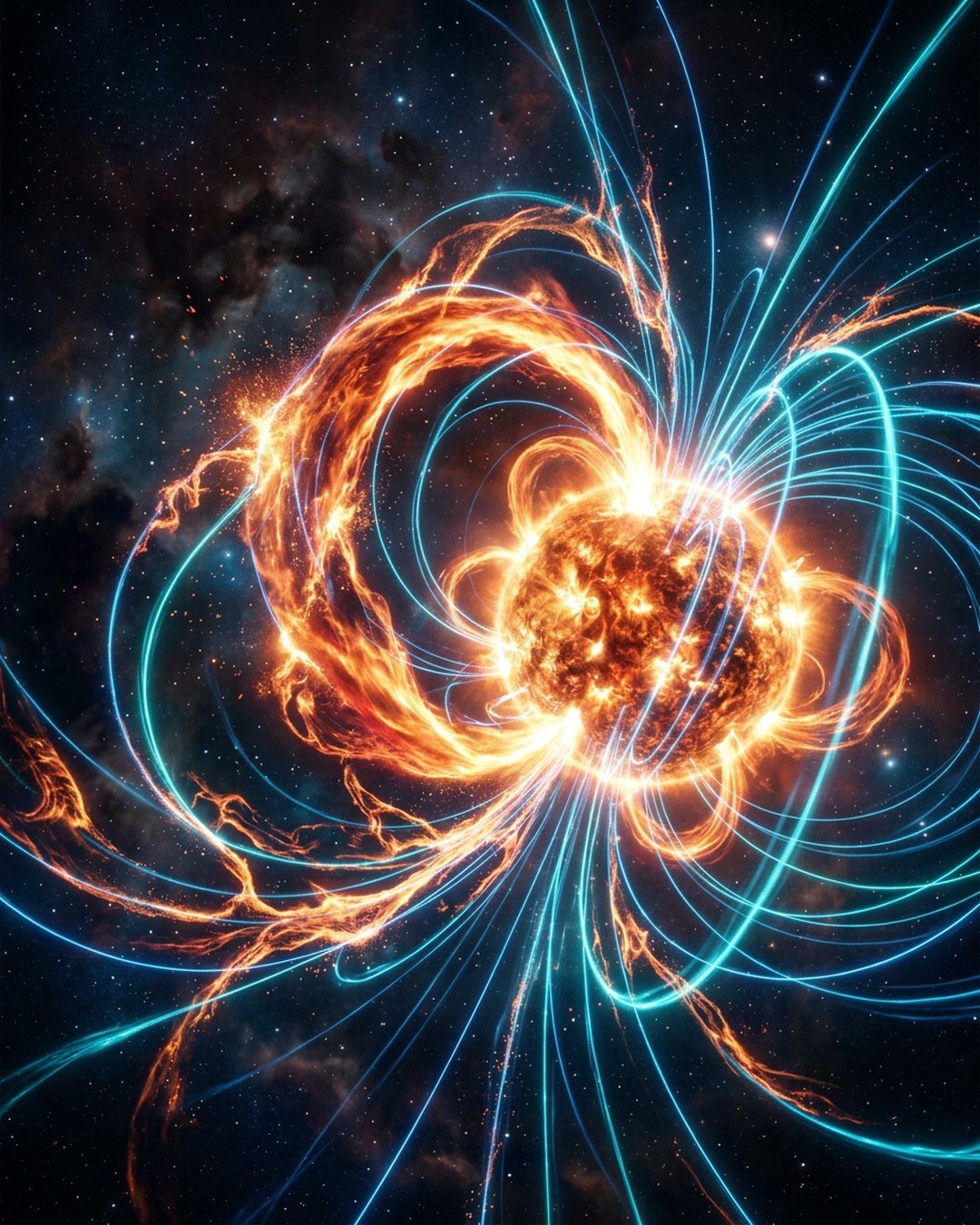
Imagen de Portada Generada por IA

Recent scientific experiments suggest that strong magnetic fields surrounding certain active stars can successfully block and suppress coronal mass ejections, explaining the mysterious absence of such plasma outbursts on many flare-heavy stars. Researchers utilized lasers to fire streams of plasma into varying magnetic fields, discovering that intense magnetic forces halt, branch out, and turn back the plasma streams due to a phenomenon known as kink instability. Astronomers note that understanding this suppression mechanism is critical for evaluating exoplanet habitability, because frequent and powerful coronal mass ejections can strip planets of their protective atmospheres. The author aims to highlight the complex relationship between stellar magnetic fields and plasma outbursts, emphasizing how laboratory simulations bridge the gap between microscopic physics and stellar astronomy. By investigating these stellar mechanics, scientists hope to solve why highly active stars rarely show outward signs of mass ejections despite frequent surface radiation bursts. This research offers valuable insight into stellar environments and redefines how astronomers search for signs of life-supporting exoplanet systems. The essence of the study lies in demonstrating that plasma behavior under magnetic stress follows mathematical scaling relationships connecting millimeter-long laboratory setups to massive celestial bodies. The findings propose that active stars may trap or break up coronal mass ejections before they escape into deep space, meaning the absence of observed outbursts does not necessarily mean they are not occurring. Consequently, stellar magnetic environments act as vital gatekeepers determining whether surrounding planets face sterilizing radiation or maintain stable atmospheric conditions. Researchers recommend that future astronomical observations account for stellar magnetic suppression when assessing planetary habitability zones and searching for exoplanet life. Scientists must combine long-term stellar monitoring with advanced magnetohydrodynamic modeling to fully map out how stars host planetary systems. Ultimately, incorporating magnetic field dynamics into astrobiology models will refine our understanding of which star systems can successfully nurture life over cosmic timescales.

Puntos clave

01

🔹 Stellar Plasma Outburst Suppression Mechanism

【📌 Key Finding】Strong magnetic fields surrounding active stars can halt and suppress coronal mass ejections, explaining why flare-heavy stars rarely display visible plasma outbursts. 【🔸 Impact Factors】Astrophysicist Julián Alvarado Gómez and colleagues found that intense magnetic forces trigger a kink instability, causing plasma streams to branch out like trees and turn back. 【⭐ Data Support】Laboratory experiments conducted at the Extreme Light Infrastructure Nuclear Physics facility in Romania successfully reproduced this phenomenon by firing lasers to launch plasma into varying magnetic fields.

02

🔸 Laboratory Simulation and Mathematical Scaling

【📌 Key Finding】Researchers scaled down cosmic phenomena into millimeter-long laboratory experiments that accurately reflect stellar physics. 【🔸 Impact Factors】Computer simulations confirmed that magnetic field strength dictates whether plasma continues unperturbed or experiences severe trajectory disruption. 【⭐ Data Support】Despite experimental plasma streams being only millimeters long, mathematical scaling relationships validate that they exhibit physics directly comparable to massive stars.

03

⭐ Implications for Exoplanet Habitability

【📌 Key Finding】Coronal mass ejections pose a severe threat to planetary atmospheres, making stellar magnetic suppression a crucial factor in astrobiology. 【🔸 Impact Factors】Unchecked coronal mass ejections can blast an exoplanet hard enough to strip away its atmosphere, turning it into a barren rock. 【⭐ Data Support】Astronomer Joe Callingham emphasizes that understanding stellar host behavior is an essential piece of the habitability puzzle when determining if exoplanets can support life.

04

📊 Observational Challenges and Future Research

【📌 Key Finding】The apparent dearth of coronal mass ejections on active stars stems from both observational limitations and strong magnetic trapping. 【🔸 Impact Factors】Astronomers may simply need to extend observation periods, as evidenced by recent 2025 detections of coronal mass ejections on other stars. 【⭐ Data Support】Future investigations require combining prolonged stellar telescope monitoring with sophisticated magnetohydrodynamic models to map elusive stellar outbursts.

05

💡 Comparison Between Sun and Active Stars

【🔵 The Sun】Exhibits routine coronal mass ejections with relatively moderate magnetic fields that allow outbursts to escape into space easily. 【🟠 Active Stars】Possess much stronger magnetic fields that trap or break up plasma streams, creating a regime largely unseen in our solar system. 【⚖️ Key Differences】Active stars operate under extreme magnetic confinement which actively suppresses mass ejections, whereas the sun readily expels plasma into the interstellar medium.

¿Quieres crear tu propio mapa mental?

¡Inicia sesión en Neumap AI y comienza a crear tus propios mapas mentales!

Comenzar