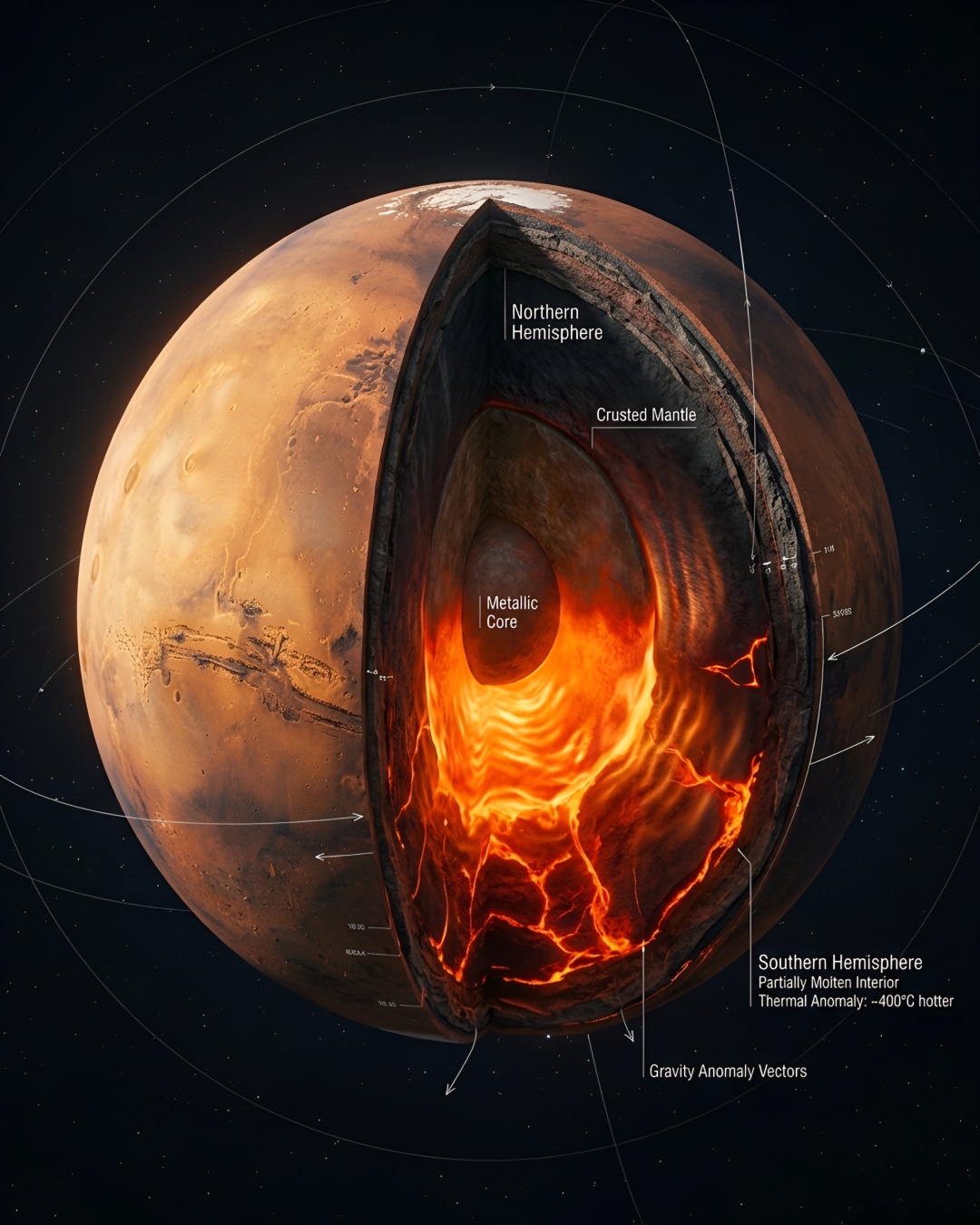
A 400-Degree Mystery Deep Inside Mars

scitechdaily mars planetary-science caltech space-exploration

Resumen

Mind Map Cover Image
Imagen de Portada Generada por IA

Scientists have discovered a vast thermal imbalance deep inside Mars, revealing that the planet's southern interior is about 200 to 400 degrees Celsius warmer than the northern half and possibly partially molten. Published on August 27, 2026, in the journal Nature, the research was led by Caltech alumnus Alexander Berne and utilized decades of gravity data from three spacecraft missions to perform tidal tomography. The research team found that Mars is thermally asymmetric below the surface, mirroring its well-known surface dichotomy of high southern terrain and low northern plains. This significant temperature difference helps explain several previously mysterious phenomena, including unusual magnetic signatures in southern iron-rich minerals and seismic wave behavior recorded by NASA's InSight mission. The underlying cause of this massive thermal anomaly remains uncertain, with potential explanations pointing to a giant impact releasing heat from the north, spontaneous mantle convection in the south, or thick geological insulating structures trapping excess heat. Resolving this mystery will provide critical insights into Mars's geological evolution, past hydrology, and ancient potential for supporting life. Researchers and space agencies can leverage these findings to design future planetary exploration missions and better understand the internal dynamics of rocky planets. Understanding the planetary interior serves as a crucial blueprint for deciphering how planetary bodies form, evolve, and retain conditions necessary for water distribution and habitability.

Puntos clave

01

🔹 Discovery of Thermal Asymmetry Inside Mars

【📌 Key Finding】Scientists discovered a major thermal imbalance inside Mars, revealing that the southern interior is 200 to 400 degrees Celsius warmer than the north and partially molten. 【⭐ Data Support】The findings were published on August 27, 2026, in the journal Nature by lead researcher Alexander Berne, a Caltech alumnus and postdoctoral associate at the University of Arizona.

02

🔸 Tidal Tomography and Gravity Measurement Methodology

【📌 Key Finding】Researchers used tidal tomography by analyzing decades of observations from three missions: Mars Global Surveyor, Mars Odyssey, and Mars Reconnaissance Orbiter. 【🔸 Impact Factors】By tracking tiny changes in spacecraft velocities as the Sun's gravitational pull varied across Mars's elliptical orbit and tilted axis, the team reconstructed the planet's internal three-dimensional structure.

03

⭐ Connection to Martian Surface Dichotomy and Mysteries

【📌 Key Finding】The deep thermal anomaly aligns with the surface dichotomy between the heavily cratered southern highlands and the flat northern plains. 【⭐ Data Support】A hotter southern interior explains unusual magnetic signatures in iron-rich southern minerals and why seismic waves lose energy more quickly in the south as detected by NASA's InSight mission.

04

📊 Implications for Hydrology and Past Habitability

【📌 Key Finding】Understanding the north-south thermal difference provides vital clues about how water once moved across Mars and where basins may have collected liquid water. 【🔸 Impact Factors】Co-author Amirhossein Bagheri notes that the dichotomy informs processes influencing Martian hydrology and potential past environments capable of supporting life.

05

💡 Hypotheses on the Origin of the Thermal Anomaly

【📌 Key Finding】The exact origin of the southern thermal anomaly remains unknown, with three primary hypotheses currently under investigation. 【⭐ Data Support】Proposed explanations include a giant impact that released northern heat, spontaneous convection in the southern mantle, or thick geological structures acting as thermal blankets trapping heat below the surface.

¿Quieres crear tu propio mapa mental?

¡Inicia sesión en Neumap AI y comienza a crear tus propios mapas mentales!

Comenzar