AI Decodes Hidden Molecular Structure of Supercooled Water

ArtificialIntelligence MolecularChemistry Thermodynamics OsakaUniversity SupercooledWater ScientificResearch

Resumen

Mind Map Cover Image
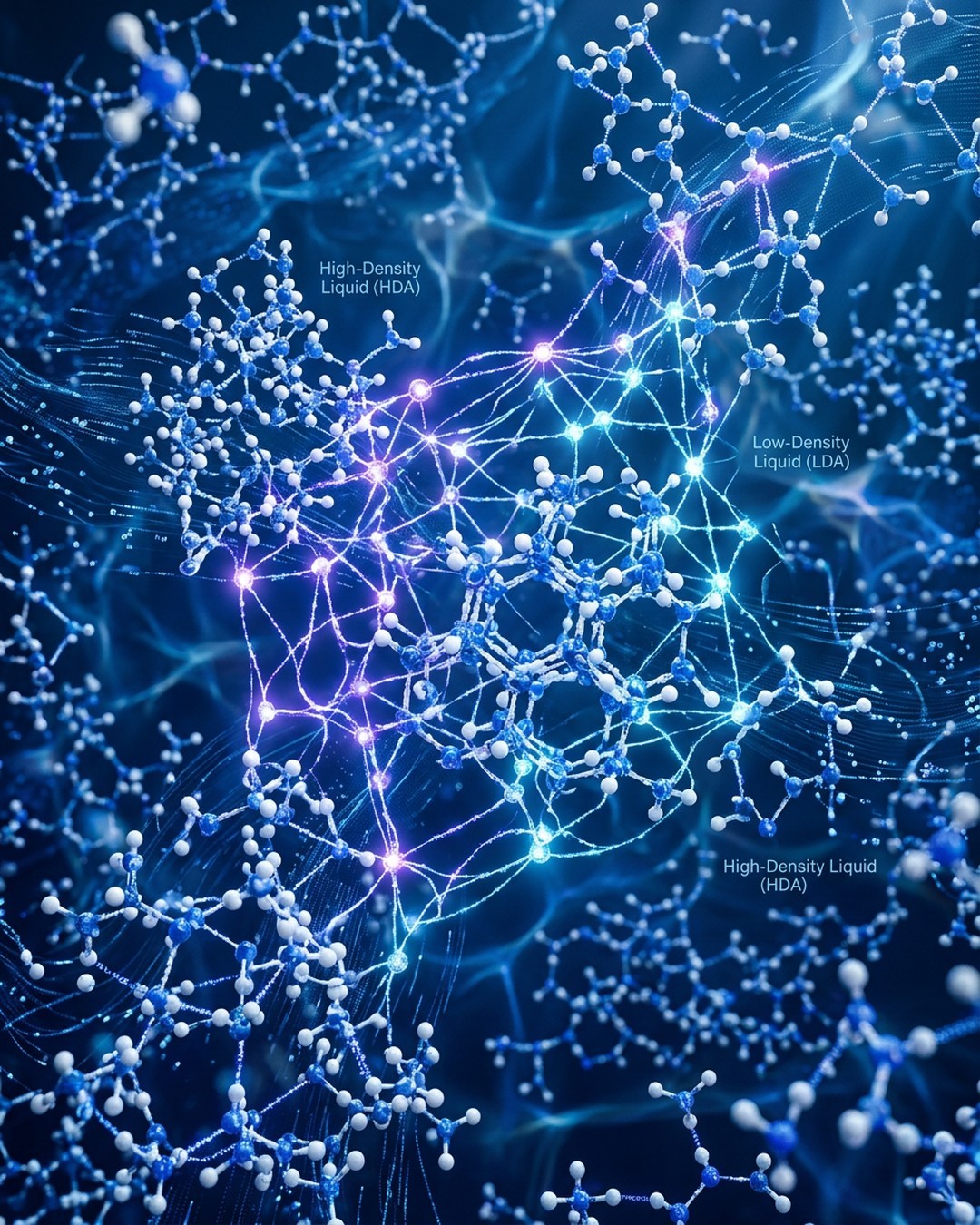
Imagen de Portada Generada por IA

Researchers at the University of Osaka have utilized artificial intelligence to decode the complex molecular structure of supercooled water, a state where water remains liquid below its freezing point. By employing a neural network to evaluate 16 different structural descriptors, the team successfully identified the most effective methods for characterizing the transition between high-density liquid (HDL) and low-density liquid (LDL) states. The study, published on July 6, 2026, in Communications Chemistry, addresses the long-standing scientific challenge of measuring water's microscopic structural changes. The authors, including Kohei Yoshikawa and Kang Kim, demonstrate that AI can effectively classify structural data from molecular dynamics simulations, providing a consistent framework to compare previously disparate measurement scales. This research provides a critical advancement in understanding water's anomalous thermodynamic properties, such as its expansion upon freezing. By determining which descriptors best capture structural information, the framework offers a new tool for scientists to map the relationship between microscopic molecular configurations and macroscopic physical behavior. The findings offer significant practical value for materials science and chemistry, enabling more precise modeling of water-based systems. Future applications include leveraging this AI-driven methodology to explore other complex substances, potentially unlocking further secrets regarding the fundamental nature of liquid states and phase transitions.

Puntos clave

01

🔹 AI-Driven Structural Analysis

【📌 Core Finding】Researchers at the University of Osaka developed an AI-based framework to evaluate 16 different structural descriptors for supercooled water. 【🔸 Impact Factors】The model uses a neural network to identify which descriptors most accurately capture the transition between high-density liquid (HDL) and low-density liquid (LDL) states. 【⭐ Data Support】The AI was trained on structural data derived from molecular dynamics simulations, allowing it to recognize patterns in hydrogen bond networks that human cognition struggles to compare directly.

02

🔸 Understanding Supercooled Water

【📌 Definition】Supercooled water is a state where liquid water remains unfrozen below its standard freezing point due to the absence of nucleation sites. 【🔸 Causal Relationship】The unusual behavior of water, such as expanding when freezing, is attributed to the competition between HDL and LDL structures. 【⭐ Mechanism】As temperature increases, the more compact HDL structures become dominant over the open LDL arrangements, driven by the shifting network of hydrogen bonds.

03

⭐ Overcoming Measurement Challenges

【📌 Problem】Previous structural descriptors were developed independently, leading to inconsistent scales and dimensions that prevented direct comparison. 【💡 Solution】The AI framework acts as a standardized evaluator, allowing scientists to determine which descriptors provide the clearest picture of water's behavior. 【⭐ Significance】This consistency is essential for connecting microscopic molecular configurations to macroscopic thermodynamic properties.

04

📊 Research Methodology and Publication

【📌 Publication】The study, titled 'Machine learning evaluation of structural descriptors for supercooled water', was published in Communications Chemistry on July 6, 2026. 【🔸 Authors】The research team includes Kohei Yoshikawa, Kokoro Shikata, Kang Kim, and Nobuyuki Matubayasi. 【⭐ Methodology】The team utilized a neural network to perform trial-and-error learning, effectively classifying structural data to identify the most efficient descriptors for characterizing water's hidden molecular secrets.

05

💡 Future Implications

【📌 Application】The framework provides a robust tool for studying the origins of water's anomalous properties. 【🔸 Strategic Value】By improving the accuracy of structural descriptors, this research guides the development of better tools for analyzing complex substances. 【⭐ Outlook】The methodology could be extended to other liquids, potentially revolutionizing how scientists model phase transitions and thermodynamic behavior in various chemical systems.

¿Quieres crear tu propio mapa mental?

¡Inicia sesión en Neumap AI y comienza a crear tus propios mapas mentales!

Comenzar