Swimming vs Running: Cardiovascular Effects

cardiology exercise-science heart-health swimming-vs-running scientific-research

Resumen

Mind Map Cover Image
Imagen de Portada Generada por IA

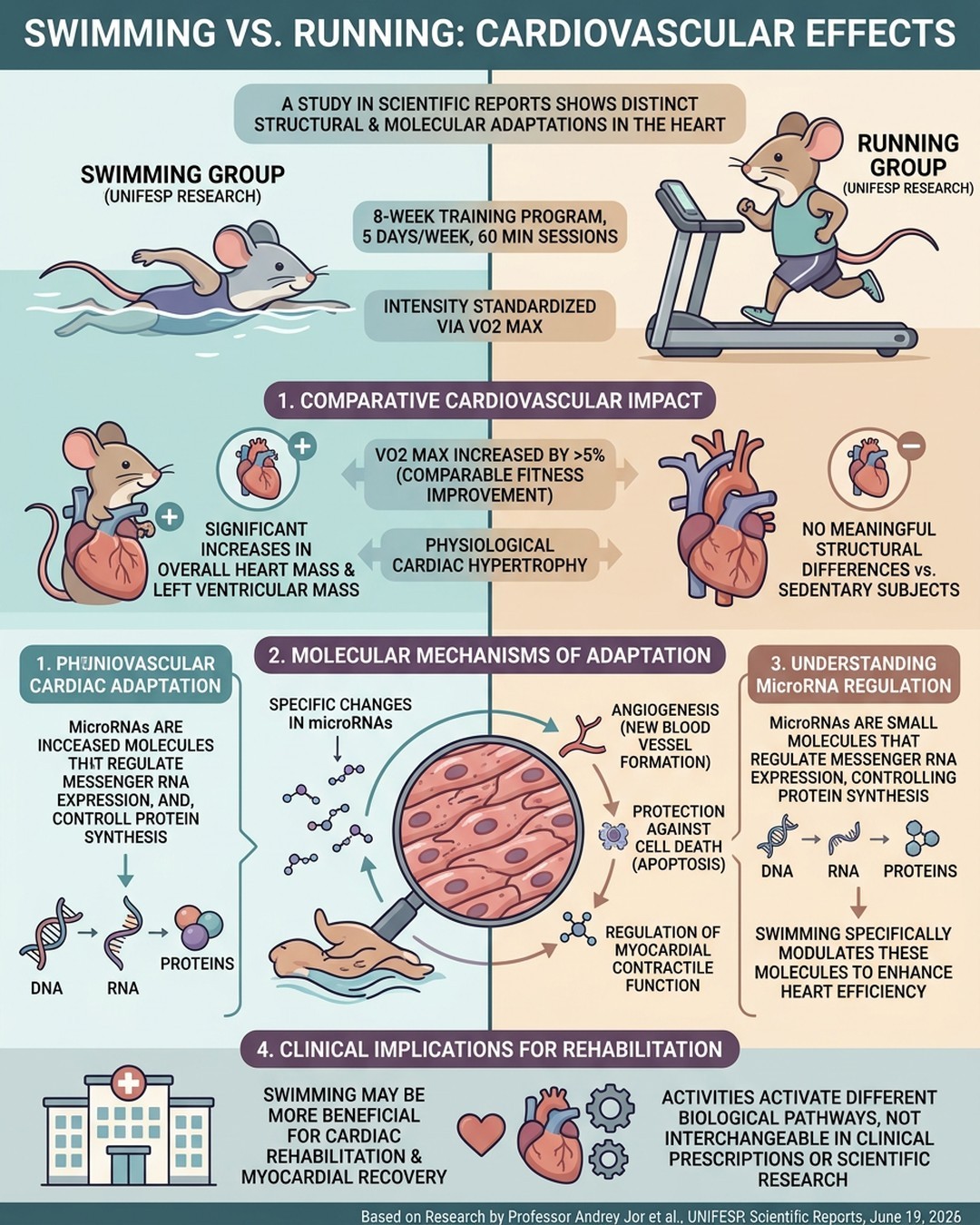
A study published on June 19, 2026, in Scientific Reports reveals that while swimming and running provide comparable improvements in overall cardiorespiratory fitness, swimming induces superior structural and molecular adaptations in the heart. Researchers at the Federal University of São Paulo (UNIFESP) found that swimming specifically promotes healthy cardiac hypertrophy and enhances myocardial contractile force more effectively than running. The research team, led by Professor Andrey Jorge Serra, emphasizes that these two aerobic activities utilize distinct biological pathways. While both exercises increased maximum oxygen consumption (VO2 max) by over 5% in an eight-week mouse model, only swimming resulted in significant increases in total heart mass and left ventricular mass, suggesting it may be a more potent intervention for cardiac rehabilitation. The study identifies that swimming triggers specific changes in microRNAs, which are critical regulators of protein synthesis. These molecular shifts facilitate essential cardiovascular processes, including angiogenesis (the development of new blood vessels), protection against programmed cell death, and improved regulation of heart muscle contraction, which were not observed to the same extent in the running group. These findings provide significant practical value for clinical and personal exercise planning. For individuals seeking targeted cardiovascular recovery or enhanced heart efficiency, swimming may offer unique physiological benefits. The study also cautions researchers to avoid using swimming and running interchangeably in future scientific trials, as their distinct cardiovascular impacts could skew experimental results.

Puntos clave

01

🔹 Comparative Cardiovascular Impact

【📌 Key Finding】While both swimming and running improve cardiorespiratory fitness (VO2 max increased by >5% in both groups), swimming is superior in inducing physiological cardiac hypertrophy. 【🔸 Impact Factors】Swimming leads to significant increases in overall heart mass and left ventricular mass, whereas running showed no meaningful structural differences compared to sedentary subjects.

02

🔸 Molecular Mechanisms of Adaptation

【📌 Key Finding】Swimming triggers distinct changes in microRNAs that regulate heart cell growth and function. 【⭐ Data Support】These microRNAs control critical pathways including angiogenesis (new blood vessel formation), protection against cell death (apoptosis), and the regulation of myocardial contractile function, which are more pronounced in swimmers than in runners.

03

⭐ Experimental Methodology

【📌 Study Design】Researchers at UNIFESP conducted an eight-week training program with mice divided into sedentary, running, and swimming groups. 【🔸 Control】Sessions lasted 60 minutes, five days per week. Intensity was standardized using VO2 max rather than speed to ensure a fair comparison between the two fundamentally different physical activities.

04

📊 Clinical Implications for Rehabilitation

【📌 Practical Application】The study suggests that swimming may be more beneficial for cardiac rehabilitation and myocardial recovery. 【🔸 Strategic Insight】Because swimming and running activate different biological pathways, they should not be treated as interchangeable in clinical exercise prescriptions or scientific research settings.

05

💡 Understanding MicroRNA Regulation

【📌 Definition】MicroRNAs are small molecules that regulate messenger RNA expression, effectively controlling protein synthesis. 【🔸 Significance】The study highlights that swimming specifically modulates these molecules to enhance heart efficiency, providing a deeper understanding of how exercise-induced physiological hypertrophy is controlled at the genetic level.

¿Quieres crear tu propio mapa mental?

¡Inicia sesión en Neumap AI y comienza a crear tus propios mapas mentales!

Comenzar