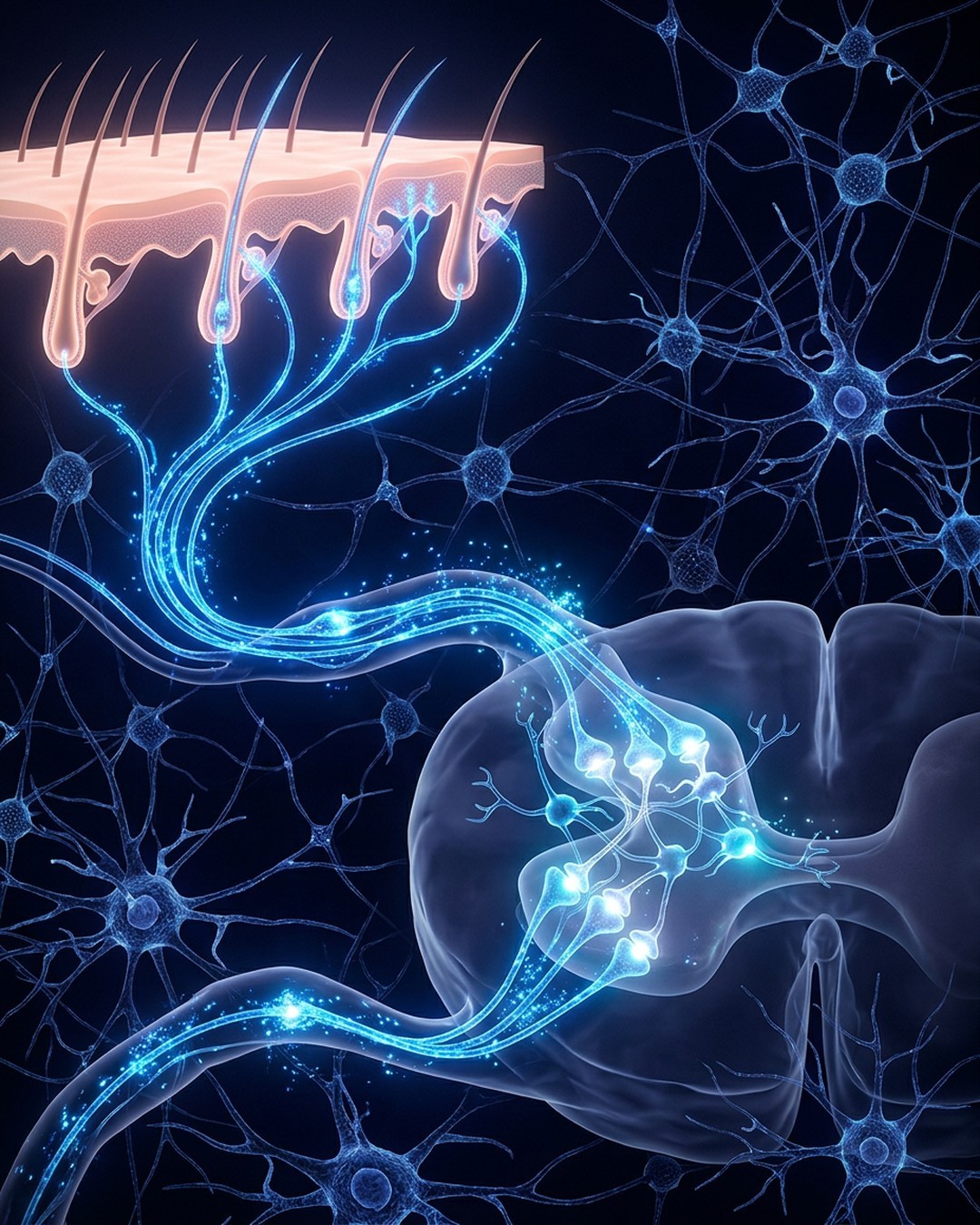
Biological Pathway of Mechanical Itch

Neuroscience Dermatology UniversityOfMichigan ChronicItch BiologicalResearch

Resumen

Mind Map Cover Image
Imagen de Portada Generada por IA

Researchers at the University of Michigan have identified a previously unknown sensory pathway involving vellus-like hairs that triggers mechanical itch sensations. Published in the journal Neuron on June 16, 2026, this study reveals that specific sensory neurons detect the movement of fine peach fuzz hairs and relay these signals to the nervous system, providing a potential target for treating chronic itching disorders. The research team, led by Bo Duan, emphasizes that while chemical itch is well-understood, mechanical itch remains mysterious. By studying mice with chronic skin inflammation, the scientists demonstrated that disabling the neurons connected to these vellus-like hairs significantly reduces scratching behavior, suggesting a dedicated biological system for this sensation. The study highlights that humans likely share this mechanism, as we possess the necessary genes and proteins to produce these touch-sensitive neurons. The findings also explain why we are not constantly scratching, pointing to specialized gating circuits in the spinal cord that filter out non-threatening sensory information before it reaches conscious awareness. This discovery offers a promising new direction for medical intervention in chronic skin conditions. By targeting these specific sensory neurons, future therapies could provide relief for millions of patients suffering from persistent, debilitating itch symptoms.

Puntos clave

01

🔹 Discovery of Mechanical Itch Pathway

Researchers identified a specialized sensory pathway in mice where vellus-like hairs (fine peach fuzz) act as triggers for itch. Unlike chemical itch caused by allergens or bites, this mechanical itch is driven by physical stimulation of these hairs, which are particularly concentrated around the mouth and ears.

02

🔸 Neural Mechanism and Experimental Evidence

The study, published in Neuron on June 16, 2026, found that specific sensory neurons relay itch signals from hair movement to the spinal cord. Experiments showed that mice lacking these neurons exhibited a dramatic reduction in scratching, while optogenetic activation of these cells using blue light successfully induced scratching behavior.

03

⭐ Human Relevance and Clinical Potential

Although direct testing on humans is limited, researchers confirmed that humans possess the same genes and proteins required for this sensory system. Human neurons cultured in a lab responded to the same proteins identified in mice, suggesting that this pathway is a viable target for developing new treatments for chronic itching disorders like eczema.

04

📊 The Role of Spinal Gating Circuits

The study addresses why humans are not constantly scratching despite the sensitivity of vellus hairs. The spinal cord contains 'gating' circuits that act as filters, suppressing mechanical itch signals from everyday stimuli like clothing or breezes, ensuring that only relevant threats trigger the urge to scratch.

05

💡 Evolutionary Defense Mechanism

The system likely evolved as a protective mechanism to detect small pests, insects, or parasites. By concentrating these sensitive hairs around vulnerable areas like the mouth and ears, mammals could identify and remove potential threats before they caused significant harm or infection.

¿Quieres crear tu propio mapa mental?

¡Inicia sesión en Neumap AI y comienza a crear tus propios mapas mentales!

Comenzar