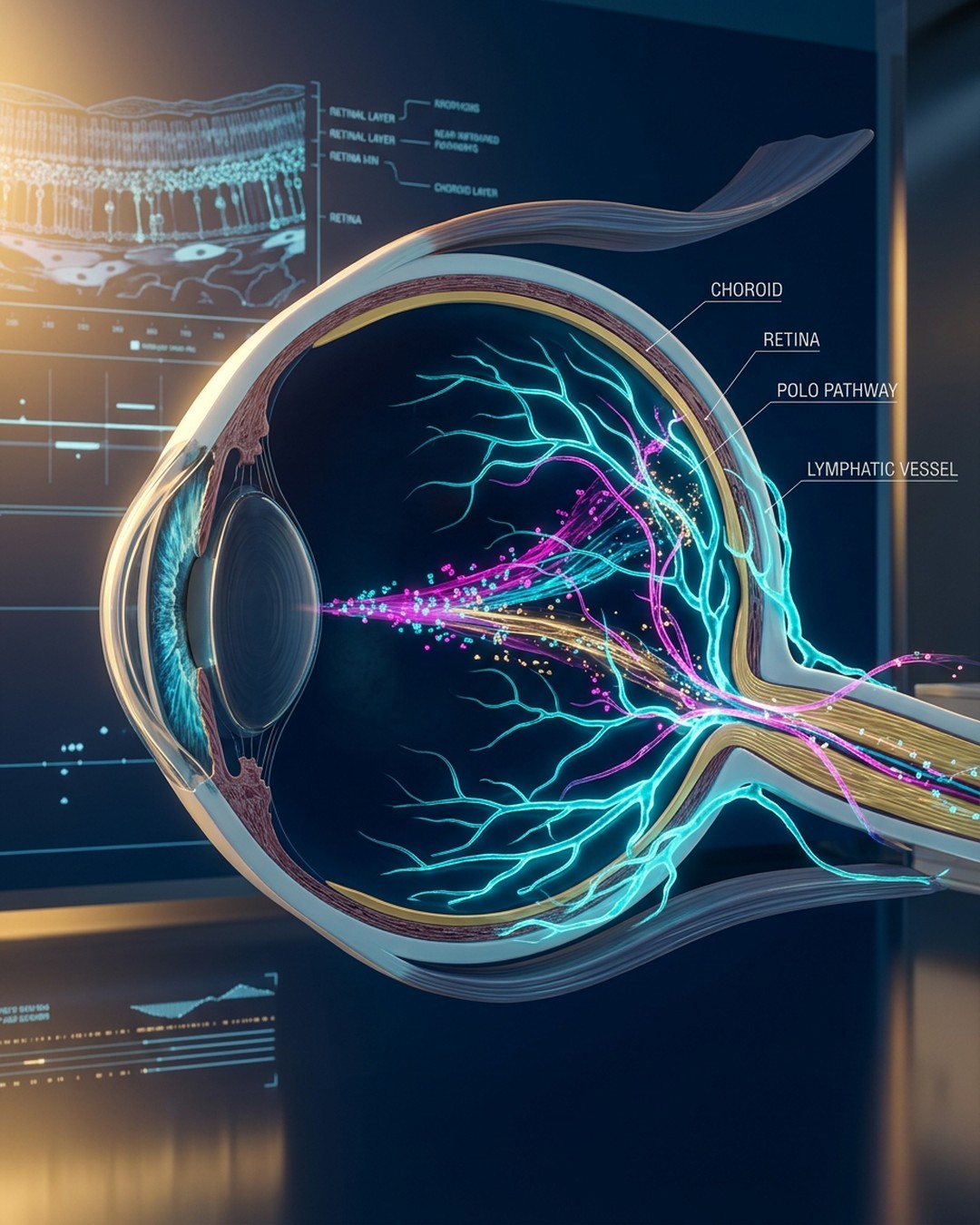
Discovery of the POLO Pathway in the Human Eye

scitechdaily ophthalmology retina glaucoma macular-degeneration scientific-discovery

Resumen

Mind Map Cover Image
Imagen de Portada Generada por IA

Researchers at the University of British Columbia and the University of Toronto have discovered a previously unknown drainage route at the back of the eye, named the posterior ocular lymphatic outflow or POLO pathway, published in Translational Vision Science & Technology in July 2026. This hidden lymphatic network within the choroid carries fluid, metabolic waste, and inflammatory material out of the eye and into the body's larger lymphatic system within minutes. The authors emphasize that this groundbreaking discovery challenges a century-old medical assumption that the eye lacked a lymphatic system at its back, fundamentally altering how scientists understand the microenvironment of the retina. By demonstrating active clearance behind the retina, the research provides a vital mechanistic link to major blinding conditions such as glaucoma and age-related macular degeneration. The essence of this research lies in tracing fluorescent tracer molecules and utilizing MRI and near-infrared fluorescence in mouse models to visualize active fluid movement from the choroid into orbital tissue and lymph nodes. This breakthrough shifts the scientific paradigm from viewing the eye as an entirely closed hydraulic chamber to recognizing an accessible drainage and immune-interfacing pathway. Looking forward, this discovery opens strategic avenues for developing novel therapeutics designed to enhance waste clearance, prevent fluid accumulation, and improve drug delivery directly to the back of the eye. Future clinical translation will focus on confirming whether identical lymphatic pathways function in humans to combat progressive vision loss.

Puntos clave

01

🔹 Discovery of the POLO Pathway

Researchers at the University of British Columbia and the University of Toronto identified a new drainage route called the posterior ocular lymphatic outflow (POLO) pathway, located within the choroid layer behind the retina. Published in Translational Vision Science & Technology in July 2026, this system flushes fluid, metabolic waste, and inflammatory material out of the eye into the broader lymphatic network.

02

🔸 Overturning a Century-Old Medical Assumption

For over 100 years, mainstream medical science assumed the eye possessed no lymphatic system. The pioneering work led by Dr. Neeru Gupta and Dr. Yeni Yücel began challenging this dogma in 2009 with front-of-eye findings and has now definitively proven active lymphatic drainage exists at the back of the eye where critical vision loss originates.

03

⭐ Advanced Imaging and Methodology

The research team tracked waste clearance in real time using mouse models combined with magnetic resonance imaging (MRI), near-infrared fluorescence, and microscopic analysis. By placing fluorescent tracer molecules behind the eye, they observed fluid traveling directly into nearby orbital tissue and reaching surrounding lymph nodes within minutes.

04

📊 Implications for Major Blinding Diseases

Conditions such as glaucoma and age-related macular degeneration (affecting approximately 2.5 million Canadians) are heavily linked to excess fluid, tissue stress, and inflammatory debris accumulation. The discovery of the POLO pathway establishes a clear physical mechanism connecting impaired waste clearance to the progression of these blinding disorders.

05

💡 Future Therapeutic and Clinical Applications

This foundational discovery offers a novel biological target for developing treatments that enhance natural fluid clearance and prevent disease. Furthermore, the newly mapped pathway could facilitate more effective, targeted drug delivery systems to the back of the eye, transforming future therapeutic approaches in ophthalmology.

¿Quieres crear tu propio mapa mental?

¡Inicia sesión en Neumap AI y comienza a crear tus propios mapas mentales!

Comenzar