Is Planet Nine Real? Solar System Mystery

Astronomy PlanetNine SolarSystem SpaceScience KuiperBelt Astrophysics

Resumen

Mind Map Cover Image
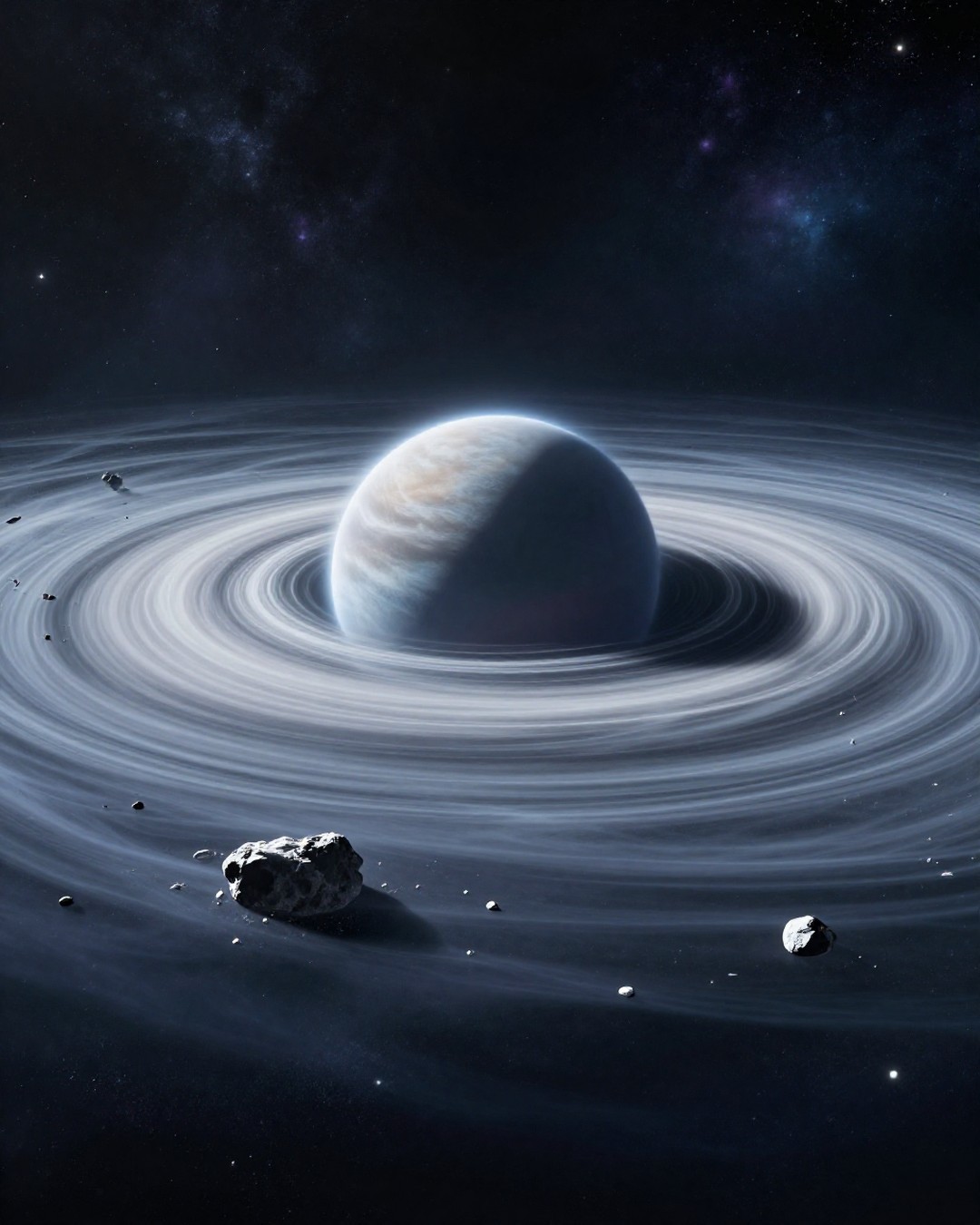
Imagen de Portada Generada por IA

The existence of Planet Nine remains a significant astronomical mystery, with recent discoveries in the Kuiper Belt providing both potential evidence and new challenges to the theory. Originally proposed in 2016 by Konstantin Batygin and Mike Brown to explain the erratic orbits of trans-Neptunian objects, the hypothesis suggests a massive, undiscovered planet exerts gravitational influence on the outer Solar System. While some scientists argue that these orbital anomalies are strong indicators of a hidden planet, others suggest alternative explanations like debris rings or observational limitations. The author maintains a cautious, scientific perspective, highlighting that while the Planet Nine theory is compelling, recent findings such as the discovery of the sednoid 2023 KQ14 complicate the narrative. These stable, distant objects suggest that if a massive planet exists, it must be located much further away than previously estimated, potentially beyond 500 astronomical units (AU). The lack of direct observational data remains the primary hurdle in confirming or debunking the existence of this elusive celestial body. The core scientific debate centers on whether the observed orbital patterns of Kuiper Belt objects are truly anomalous or merely a result of incomplete data. Because these distant objects have orbital periods spanning thousands of years, current observational windows are too short to definitively confirm gravitational perturbations caused by a massive, distant planet. The scientific community continues to rely on ground-based and space-based telescopes to gather more data, as physical exploration via spacecraft remains impractical due to the extreme distances involved. For readers interested in space science, this topic underscores the iterative nature of astronomical discovery. The ongoing search for Planet Nine serves as a reminder that our understanding of the Solar System is still evolving. Future advancements in telescope sensitivity and long-term monitoring of trans-Neptunian objects are essential for resolving this mystery. Enthusiasts should follow updates from major observatories like the Subaru telescope to track new findings in the outer reaches of our cosmic neighborhood.

Puntos clave

01

🔹 The Planet Nine Hypothesis (2016)

Proposed by Konstantin Batygin and Mike Brown at Caltech, the theory posits that a massive, undiscovered planet exists in the outer Solar System. This planet is hypothesized to explain the erratic, non-circular orbits of various trans-Neptunian objects (TNOs) in the Kuiper Belt, which do not follow expected gravitational paths.

02

🔸 Evidence and Skepticism

【📌 Supporting Evidence】Proponents point to the clustering of orbits of distant Kuiper Belt objects as proof of gravitational influence. 【🔸 Counter-Arguments】Skeptics argue that the current orbital data is insufficient, suggesting alternative explanations such as a massive ring of debris or even a small black hole, or simply that the observed patterns are statistical coincidences.

03

⭐ The Challenge of 2023 KQ14

The discovery of 2023 KQ14, a 'sednoid' with a stable, highly elliptical orbit, poses a challenge to the Planet Nine theory. Because its path appears unaffected by a large gravitational source, researchers suggest that if Planet Nine exists, it must be located at a distance greater than 500 AU from the Sun, making it significantly harder to detect.

04

📊 Observational Limitations

The primary obstacle to confirming Planet Nine is the extreme duration of orbital periods. For instance, the object 2017 OF201 has an orbital period of approximately 24,000 years. Astronomers estimate that observing four to five full orbits is necessary to confirm subtle gravitational changes, a timeframe far exceeding current human observational capabilities.

05

💡 Future Outlook and Exploration

Direct exploration is currently unfeasible; a spacecraft like NASA's New Horizons would take roughly 118 years to reach the suspected region. Consequently, the scientific community remains dependent on advanced ground-based telescopes, such as the Subaru telescope in Hawaii, to discover new distant objects and refine models of the outer Solar System.

¿Quieres crear tu propio mapa mental?

¡Inicia sesión en Neumap AI y comienza a crear tus propios mapas mentales!

Comenzar