AI Detects Solar Eruption Warnings

scitechdaily artificial-intelligence solar-storms space-weather machine-learning

Resumen

Mind Map Cover Image
Imagen de Portada Generada por IA

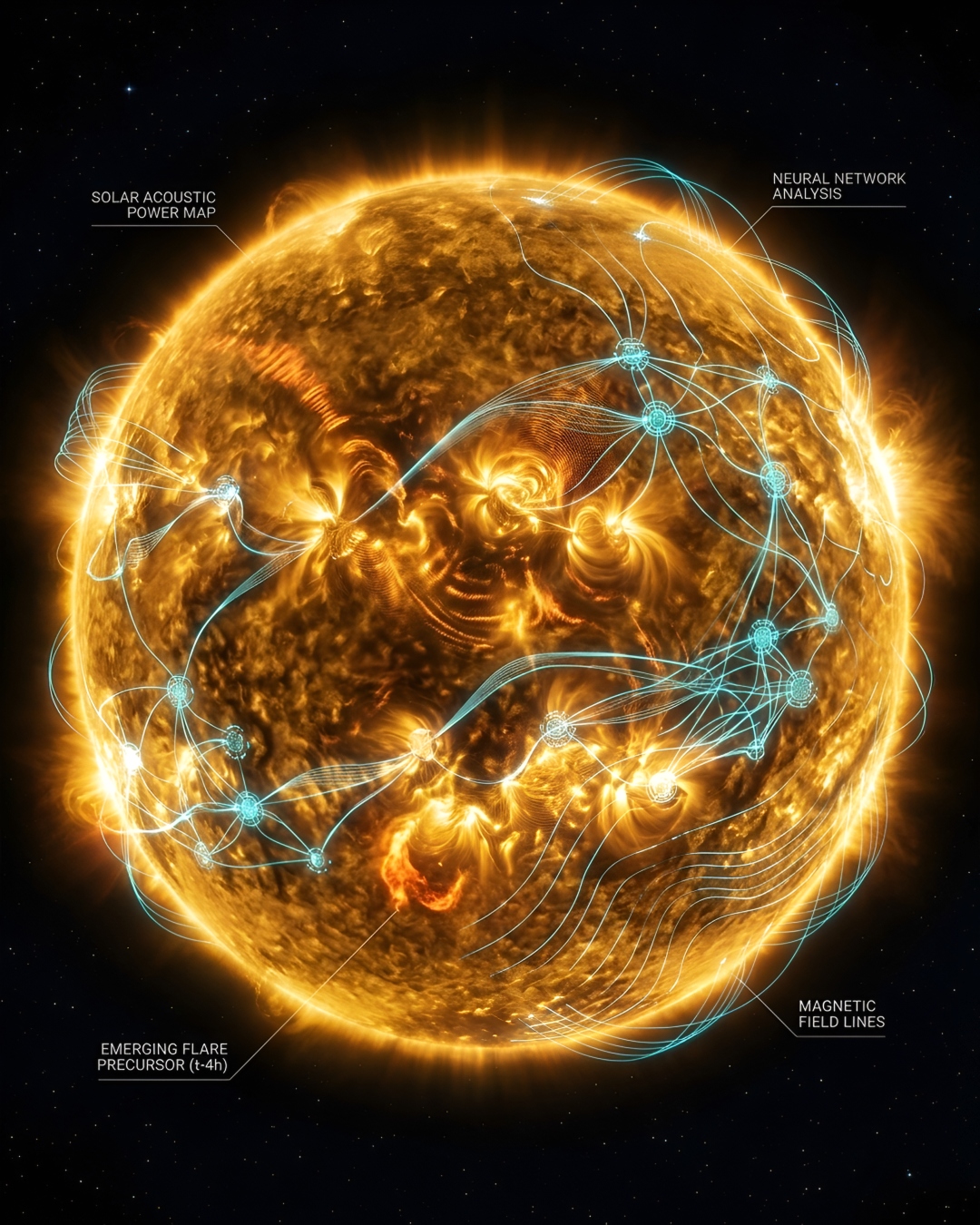
A research team led by the New Jersey Institute of Technology (NJIT) developed an artificial intelligence model named EarlyDetect that successfully identifies faint warning signs of solar active regions nearly nine hours before they become visible on the Sun's surface. Published on August 14, 2026, in the Journal of Geophysical Research: Machine Learning and Computation, the model uses a Transformer architecture to analyze hourly acoustic power maps and magnetic field measurements collected by NASA's Solar Dynamics Observatory. The authors emphasize that early detection of emerging active regions can provide critical preparation time for satellite communications companies and power grid operators to mitigate potential damage from solar storms. Despite its strong performance in testing, the research team cautions that EarlyDetect is not yet an operational real-time forecasting system, as it can still generate false alarms and requires testing across a broader range of solar events. The project represents a significant methodological breakthrough by demonstrating that traditional noise-filtering techniques can be detrimental to solar forecasting, because filtering removes the very faint fluctuations required for early warning predictions. By preserving unfiltered data and leveraging advanced machine learning, the researchers have opened new possibilities for future space weather prediction and heliophysics research. To foster community collaboration, the team released the Solar Active Region Emergence Dataset (SolARED) and launched the Solar Active Region Portal as public resources for researchers worldwide. Future applications will focus on refining the algorithm to reduce false positives, expanding datasets to include direct flare correlations, and improving the reliability of real-time forecasting systems.

Puntos clave

01

🔹 EarlyDetect AI Model Breakthrough

【📌 Core Finding】Developed by an NJIT-led team and published August 14, 2026, the EarlyDetect model spots faint precursor patterns of solar active regions an average of 9.24 hours before they become visible on the Sun surface. 【⭐ Data Support】The system relies on hourly acoustic power maps and magnetic field data captured by NASA Solar Dynamics Observatory (SDO).

02

🔸 Reversing Conventional Filtering Methods

【📌 Unexpected Result】Testing revealed that standard noise-filtering techniques actually degraded forecast quality by averaging away critical faint fluctuations. 【🔗 Causal Relationship】Preserving unfiltered noise allowed the Transformer architecture to recognize subtle acoustic and magnetic precursors that precede sunspot emergence.

03

⭐ Open Access Data Initiatives

【📌 Community Resources】The research team released the Solar Active Region Emergence Dataset (SolARED), the first public dataset for solar active region emergence. 【💡 Practical Application】Scientists created the Solar Active Region (SAR) Portal as an interactive platform for the machine learning and heliophysics communities to test prediction models.

04

📊 Current Limitations and Operational Challenges

【📌 Technical Hurdles】EarlyDetect cannot yet serve as a real-time operational forecasting system due to occasional false alarms and prediction lags. 【⚠️ Future Validation】Detecting active region emergence does not automatically indicate an impending solar flare or coronal mass ejection, requiring broader testing across more solar events.

05

💡 Collaborative Support and Funding

【📌 Research backing】The project received support from NJIT Grace Hopper AI Research Institute established in 2025 and NASA heliophysics grants including the DRIVE Center COFFIES. 【👥 Key Contributors】Lead researchers include undergraduate Jonas Tirona, Distinguished Professor Alexander Kosovichev, and Assistant Professor Mengjia Xu.

¿Quieres crear tu propio mapa mental?

¡Inicia sesión en Neumap AI y comienza a crear tus propios mapas mentales!

Comenzar