Screen Time Effects on Child Learning and Memory

scitechdaily developmental-psychology pediatrics public-health child-development screen-time

Resumen

Mind Map Cover Image
Imagen de Portada Generada por IA

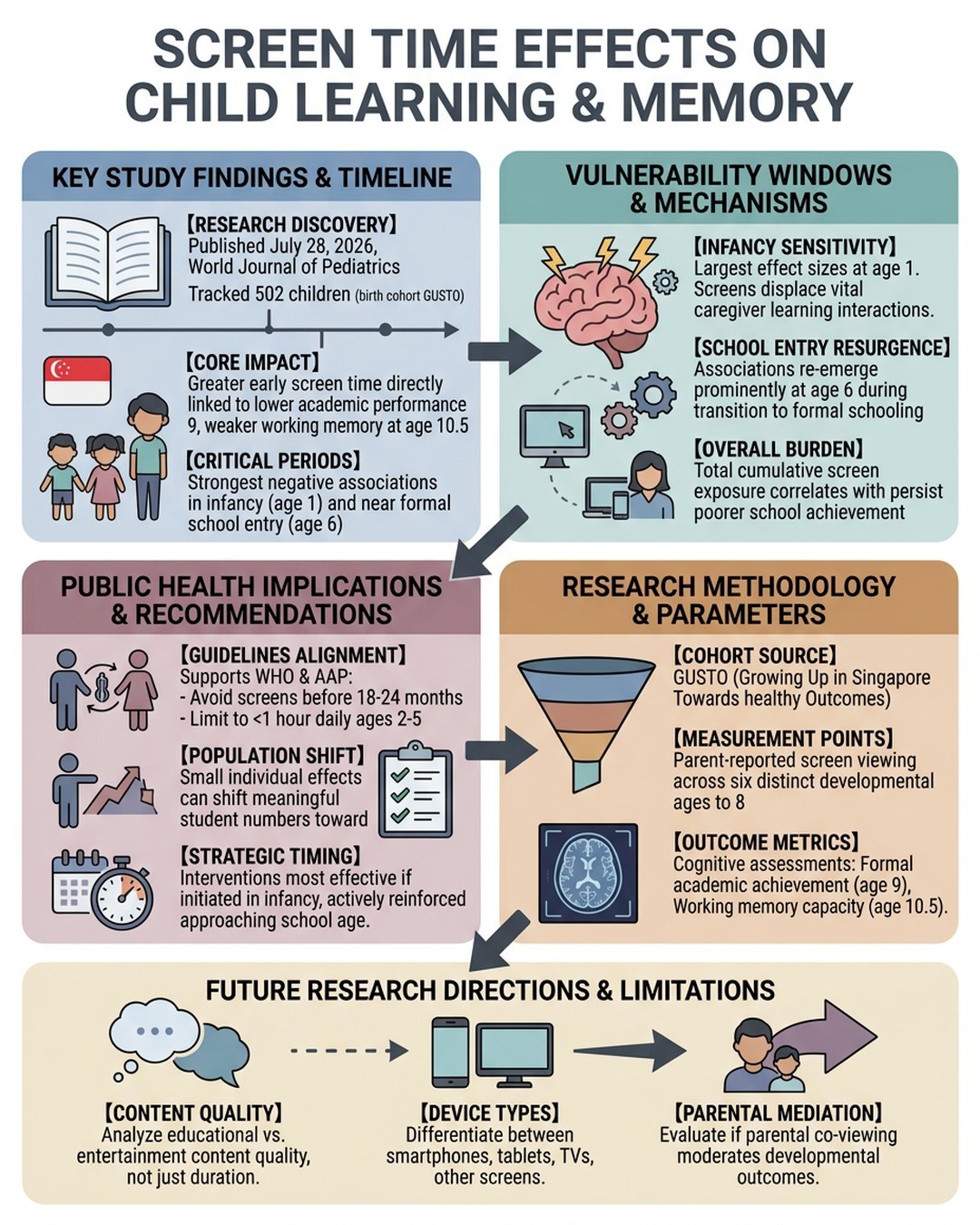
A recent long-term study published on July 28, 2026, in the World Journal of Pediatrics by researchers from Inserm and the National University of Singapore reveals that screen exposure timing during early childhood significantly shapes later learning and memory performance. Tracking 502 children from infancy through age 8 using the Growing Up in Singapore Towards healthy Outcomes birth cohort, the investigation discovered that higher screen time at age 1 and age 6 is strongly associated with lower academic performance at age 9 and weaker working memory at age 10.5. The study's authors emphasize that when children view screens is just as critical as the total duration, identifying infancy as a period of heightened neural vulnerability where screen interactions displace vital developmental learning experiences. Although viewing habits at ages 2 and 3 showed less immediate impact, the detrimental associations re-emerged strongly when children entered formal schooling at age 6, highlighting that cognitive risks persist beyond toddlerhood. The core mechanism driving these outcomes involves the displacement of face-to-face cognitive and social interactions necessary for brain development during critical windows. The findings reinforce current guidelines from the World Health Organization and the American Academy of Pediatrics, advocating that 'less is better' regarding screen consumption and suggesting that preventative measures must begin in infancy and continue through school entry. For parents, educators, and public health policymakers, these insights provide actionable guidance to establish strict viewing limitations during sensitive developmental phases. Future interventions should look beyond mere duration to evaluate content quality, device types, and parental co-viewing practices to better safeguard pediatric cognitive health and academic trajectories.

Puntos clave

01

🔹 Key Study Findings & Timeline

【📌 Research Discovery】A long-term study published on July 28, 2026, in the World Journal of Pediatrics tracked 502 children from infancy through age 8 using the Growing Up in Singapore Towards healthy Outcomes birth cohort. 【🔸 Core Impact】Greater screen viewing time during early childhood was directly linked to lower academic performance at age 9 and weaker working memory at age 10.5. 【⭐ Critical Periods】The strongest and most consistent negative associations were observed during infancy (age 1) and near formal school entry (age 6).

02

🔸 Vulnerability Windows & Mechanisms

【📌 Infancy Sensitivity】Effect sizes were largest at age 1, suggesting that early infancy is a window of heightened sensitivity where screen time displaces vital learning interactions from caregivers. 【🔸 School Entry Resurgence】While screen use at ages 2 and 3 showed fewer significant direct links, associations re-emerged prominently at age 6 when children transition into formal schooling. 【⭐ Overall Burden】Total cumulative screen exposure across early childhood correlates with persistently poorer school achievement.

03

⭐ Public Health Implications & Recommendations

【📌 Guidelines Alignment】The findings strongly support recommendations from the World Health Organization (WHO) and the American Academy of Pediatrics to avoid screens before 18 to 24 months and limit use to under one hour daily for ages 2 to 5. 【🔸 Population Shift】Even small negative effects per child can shift meaningful numbers of students toward poorer academic outcomes across an entire population. 【⭐ Strategic Timing】Interventions and screen-reduction efforts are most effective when initiated during infancy and actively reinforced as children approach school age.

04

📊 Research Methodology & Parameters

【📌 Cohort Source】Data originated from the Growing Up in Singapore Towards healthy Outcomes (GUSTO) birth cohort. 【🔸 Measurement Points】Parent-reported screen viewing habits were evaluated across six distinct developmental ages from infancy to age 8. 【⭐ Outcome Metrics】Cognitive assessments measured formal academic achievement at age 9 and working memory capacity at age 10.5, ensuring robust longitudinal tracking.

05

💡 Future Research Directions & Limitations

【📌 Content Quality】Future investigations must analyze the specific educational or entertainment quality of media content rather than focusing solely on viewing duration. 【🔸 Device Types】Researchers need to differentiate between smartphones, tablets, televisions, and other screen platforms. 【⭐ Parental Mediation】Subsequent studies should evaluate whether parental co-viewing moderates developmental outcomes and cognitive effects.

¿Quieres crear tu propio mapa mental?

¡Inicia sesión en Neumap AI y comienza a crear tus propios mapas mentales!

Comenzar