NASA Moon Base Development and Commercial Lunar Landers

NASA MoonBase ArtemisMission SpaceExploration CommercialLunarPayloadServices

Résumé

Image de couverture du mindmap
Image de Couverture Générée par IA

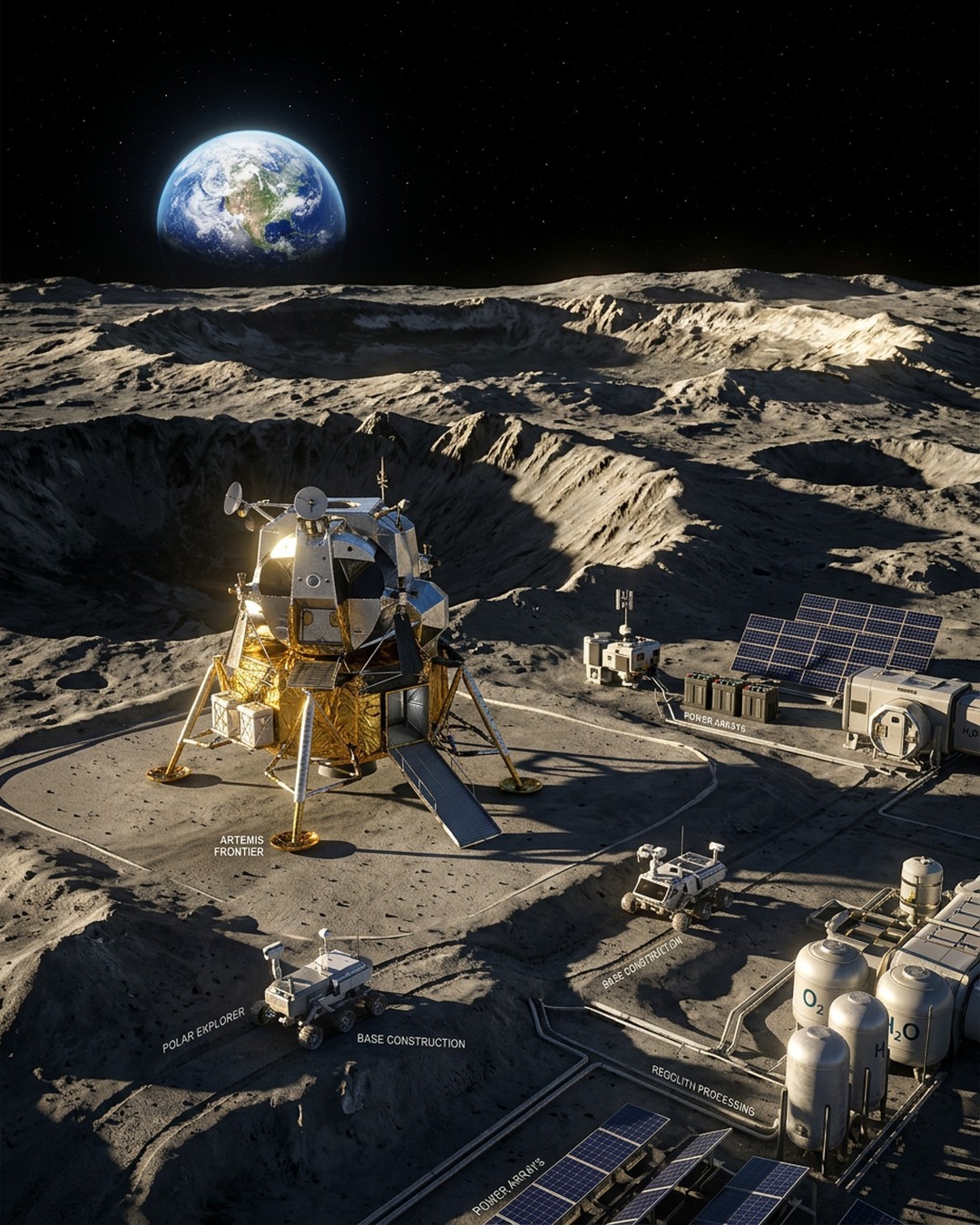
NASA is actively moving forward with plans for a permanent Moon Base near the lunar South Pole, with more than twenty robotic landings and a new fleet of commercial spacecraft scheduled through 2029. Commercial partners including Blue Origin, Firefly Aerospace, Intuitive Machines, and Voyager Lunar Systems are developing advanced landers to deliver essential infrastructure and scientific payloads by 2028. The author highlights how these collaborative commercial partnerships under the Commercial Lunar Payload Services initiative are crucial for establishing a reliable supply chain between Earth and the Moon. By testing equipment, validating autonomous landing systems, and demonstrating surface mobility, these robotic missions reduce mission risk before astronauts arrive. Key strategic developments include Blue Origin conducting environmental testing on its Blue Moon MK1 lander for the Endurance mission, Firefly Aerospace preparing Blue Ghost Mission 2 for a historic landing on the Moon's far side, and Intuitive Machines assembling its Nova-C lander Trinity and Altus 1 relay satellite for the Reiner Gamma mission. Practical application and future outlook involve utilizing infrastructure-class landers like Voyager Technologies' Griffin 1 carrying Astrolab's FLIP rover, alongside Northrop Grumman adapting power and avionics technology from the Gateway HALO module to demonstrate survive-the-night capabilities and shared surface power infrastructure for sustained human presence.

Points clés

01

🔹 Phase I Moon Base Architecture and Timeline

【📌 Key Finding】NASA is executing Phase I of its lunar base architecture through 2029, featuring more than twenty robotic landings near the lunar South Pole to prepare for future human habitation. 【🔸 Impact Factors】These robotic missions systematically test equipment, gather environmental data, and establish a reliable supply chain via the Commercial Lunar Payload Services initiative. 【⭐ Data Support】Deliveries by commercial partners are scheduled to scale up significantly by 2028, laying the groundwork for sustained scientific research and technology development.

02

🔸 Blue Origin Blue Moon MK1 Lander Testing

【📌 Key Finding】Blue Origin has completed extensive environmental testing on its single-launch Blue Moon MK1 cargo lander at NASA's Johnson Space Center. 【🔸 Impact Factors】The spacecraft verified operational readiness through thermal vacuum tests and successful communications checks with the Deep Space Network. 【⭐ Data Support】The upcoming Endurance mission will utilize MK1's 7-meter fairing capacity on New Glenn to deliver up to three metric tons of payload to the lunar surface.

03

⭐ Firefly Aerospace Far Side Mission and Elytra Integration

【📌 Key Finding】Firefly Aerospace is preparing Blue Ghost Mission 2, combining its Blue Ghost lander with the Elytra orbital spacecraft into a 22-foot-tall transport system. 【🔸 Impact Factors】This mission aims to achieve the first American robotic landing on the far side of the Moon to investigate lunar geology and the cosmic Dark Ages. 【⭐ Data Support】The spacecraft will carry three NASA payloads, leveraging autonomous landing technology proven during the 2025 mission.

04

📊 Intuitive Machines Nova-C Trinity and Reiner Gamma Exploration

【📌 Key Finding】Intuitive Machines is advancing its third lunar mission, IM-3, featuring the Nova-C lander named Trinity and the Altus 1 lunar data relay satellite. 【🔸 Impact Factors】The mission targets Reiner Gamma to explore a mysterious geomagnetic anomaly and lunar swirl using advanced sensors validated at NASA's Marshall Space Center. 【⭐ Data Support】Trinity will deliver five NASA payloads, six commercial payloads, and one civil payload to the lunar surface.

05

💡 Voyager Technologies Griffin 1 and Northrop Grumman Power Infrastructure

【📌 Key Finding】Voyager Technologies is testing its Griffin 1 lander at NASA JPL, scheduled to launch in late 2026 carrying Astrolab's FLEX Lunar Innovation Platform rover. 【🔸 Impact Factors】Concurrently, Northrop Grumman is adapting power and avionics technology from the Gateway HALO module for lunar surface operations. 【⭐ Data Support】These demonstrations focus on survive-the-night technology capable of operating through multi-day shadowed periods and establishing shared surface electrical power.

Voulez-vous créer votre propre mindmap ?

Connectez-vous à Neumap AI et commencez à créer vos propres mindmaps !

Commencer