OpenClaw Eight-Month Rollercoaster Analysis

OpenClaw AIAgent OpenSource StartupSchool2026 PeterSteinberger AI,Development

Résumé

Image de couverture du mindmap
Image de Couverture Générée par IA

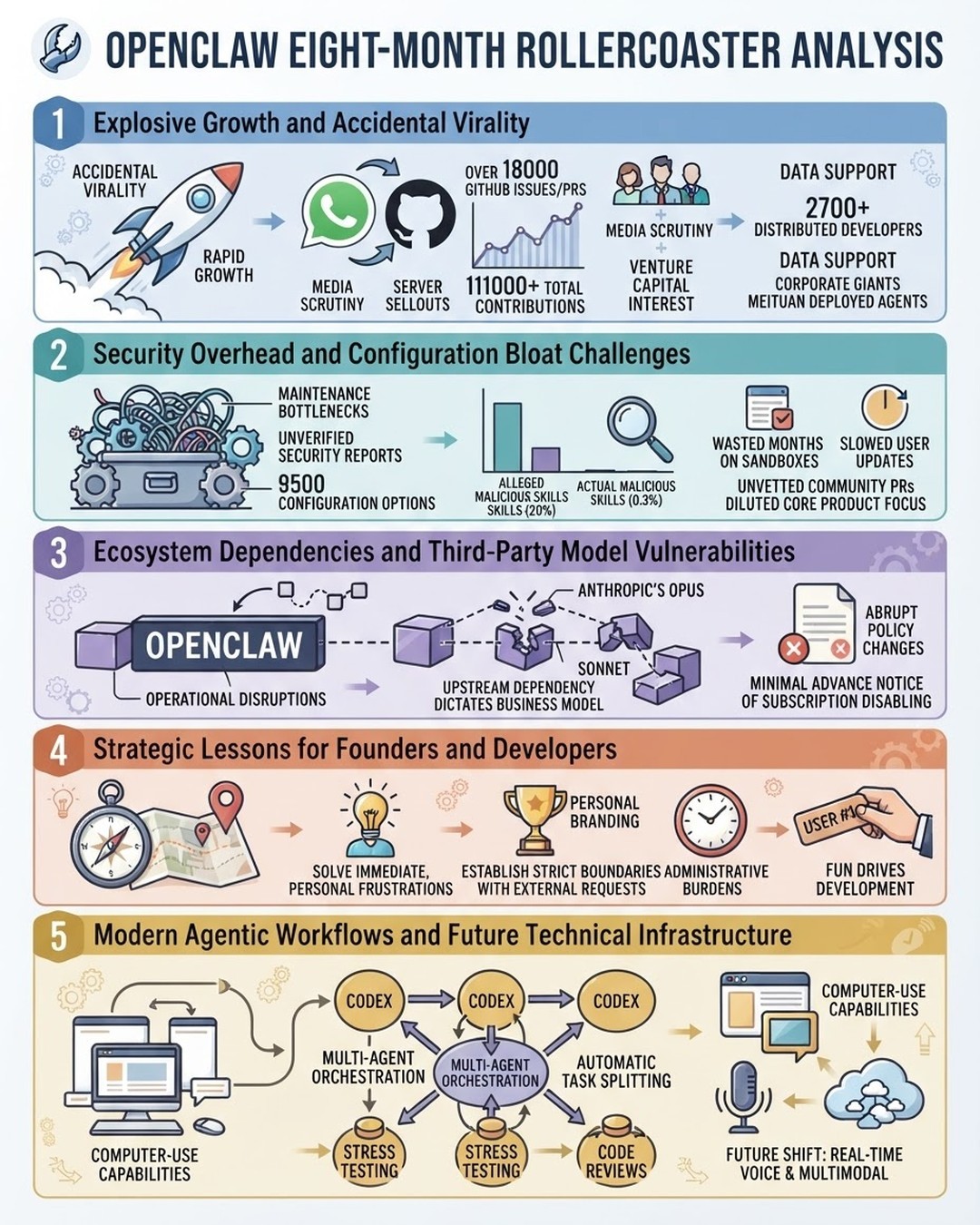
OpenClaw creator Peter Steinberger delivered a comprehensive post-mortem at Startup School 2026 regarding the eight-month rollercoaster ride of his viral open-source AI agent project. The journey involved intense public attention, massive security review overhead, severe configuration bloat with approximately 9500 configuration options, and critical ecosystem dependencies on third-party models like Anthropic's Opus and Sonnet. The author reflects on the heavy toll of managing sudden hyper-growth, balancing community feature requests, and dealing with over-optimized security demands versus product usability. Major enterprise trials, such as Meituan's extensive employee deployment of AI agents in early 2026, demonstrated both the transformative potential and the immense daily costs, highlighting that successful AI integration requires a systematic alignment of business operations, organizational structures, and technical systems rather than just deploying raw tools. Key strategic insights emphasize that an individual's personal brand is more defensible than any single cloned product, and that founders must build products they genuinely want to use themselves. Steinberger underscores that relying on third-party API providers directly dictates a project's business model, while maintaining personal enjoyment and trusting one's intuition remain the ultimate drivers of innovation and speed in software development. Practical application for developers and entrepreneurs includes prioritizing core user intuition over endless feature bloat, establishing strict boundaries with external security auditors and non-essential feature requests, and leveraging modern agentic workflows and computer-use sub-agents for automated QA and development scaling. The overarching lesson is to focus relentlessly on solving authentic personal annoyances rather than chasing market hype.

Points clés

01

🔹 Explosive Growth and Accidental Virality of OpenClaw

【📌 Key Finding】OpenClaw evolved from a simple WhatsApp relay prototype written on a rainy November day into a global open-source phenomenon with over 18000 GitHub issues and pull requests across 111000 total contributions within eight months. 【🔸 Impact Factors】The project triggered massive public attention, server sellouts of Mac Mini hardware, and an overwhelming influx of media scrutiny, security reports, and venture capital interest that nearly caused founder Peter Steinberger to delete the entire project. 【⭐ Data Support】More than 2,700 distinct developers made code commits to the repository, while corporate giants like Meituan deployed the agents at scale, burning millions of dollars daily in API tokens before standardizing product workflows.

02

🔸 Security Overhead and Configuration Bloat Challenges

【📌 Key Finding】The project suffered from severe maintenance bottlenecks due to excessive focus on unverified security reports and an accumulation of approximately 9500 configuration options. 【🔸 Impact Factors】Media claims alleged that 20 percent of OpenClaw skills were malicious, whereas comprehensive code scans revealed the true proportion was a mere 0.3 percent. Responding to these alerts forced the maintainers to waste months adding sandboxes and white-listing features that ultimately degraded software performance and slowed down user updates. 【⭐ Data Support】The proliferation of unvetted community pull requests and endless user customization requests transformed the repository into an unmanageable architecture, proving that trying to build software for everyone dilutes core product focus.

03

⭐ Ecosystem Dependencies and Third-Party Model Vulnerabilities

【📌 Key Finding】OpenClaw was deeply dependent on third-party model providers, most notably Anthropic's Opus and OpenAI's models, exposing the project to sudden operational disruptions when upstream subscription policies changed abruptly. 【🔸 Impact Factors】The core principle established from this dependency is that your dependent party's business model directly dictates your own business model. 【⭐ Data Support】When Anthropic provided minimal advance notice regarding subscription disabling for specific configurations, the project lacked sufficient time to pivot completely to open-weight models, leading to temporary user migration to rival frameworks like Hermes Agent.

04

📊 Strategic Lessons for Founders and Developers

【📌 Key Finding】Successful software creation relies heavily on personal engagement, foundational intuition, and building products that solve immediate, personal frustrations. 【🔸 Impact Factors】Key strategic rules include prioritizing personal branding over cloned products, recognizing that fun is the ultimate driver of development velocity, and acting as the primary user (User Number One) to ensure authentic product-market fit. 【⭐ Data Support】Founders must establish strict boundaries with external security researchers and feature requests, avoiding the trap of spending months on non-essential bug fixes and administrative burdens like setting up non-profit entities.

05

💡 Modern Agentic Workflows and Future Technical Infrastructure

【📌 Key Finding】The evolution of agent architectures has shifted from basic loops and graphs to sophisticated multi-agent orchestration utilizing computer-use and browser-use capabilities. 【🔸 Impact Factors】Development workflows now leverage models like Codex accompanied by a dozen sub-agents to automatically split tasks, perform stress testing, and conduct code reviews prior to human intervention. 【⭐ Data Support】Current technical bottlenecks center on computational management and reliable state migration across local macOS environments and cloud clusters, with future systems moving rapidly away from text-only interfaces toward real-time voice and multimodal agent interactions.

Voulez-vous créer votre propre mindmap ?

Connectez-vous à Neumap AI et commencez à créer vos propres mindmaps !

Commencer