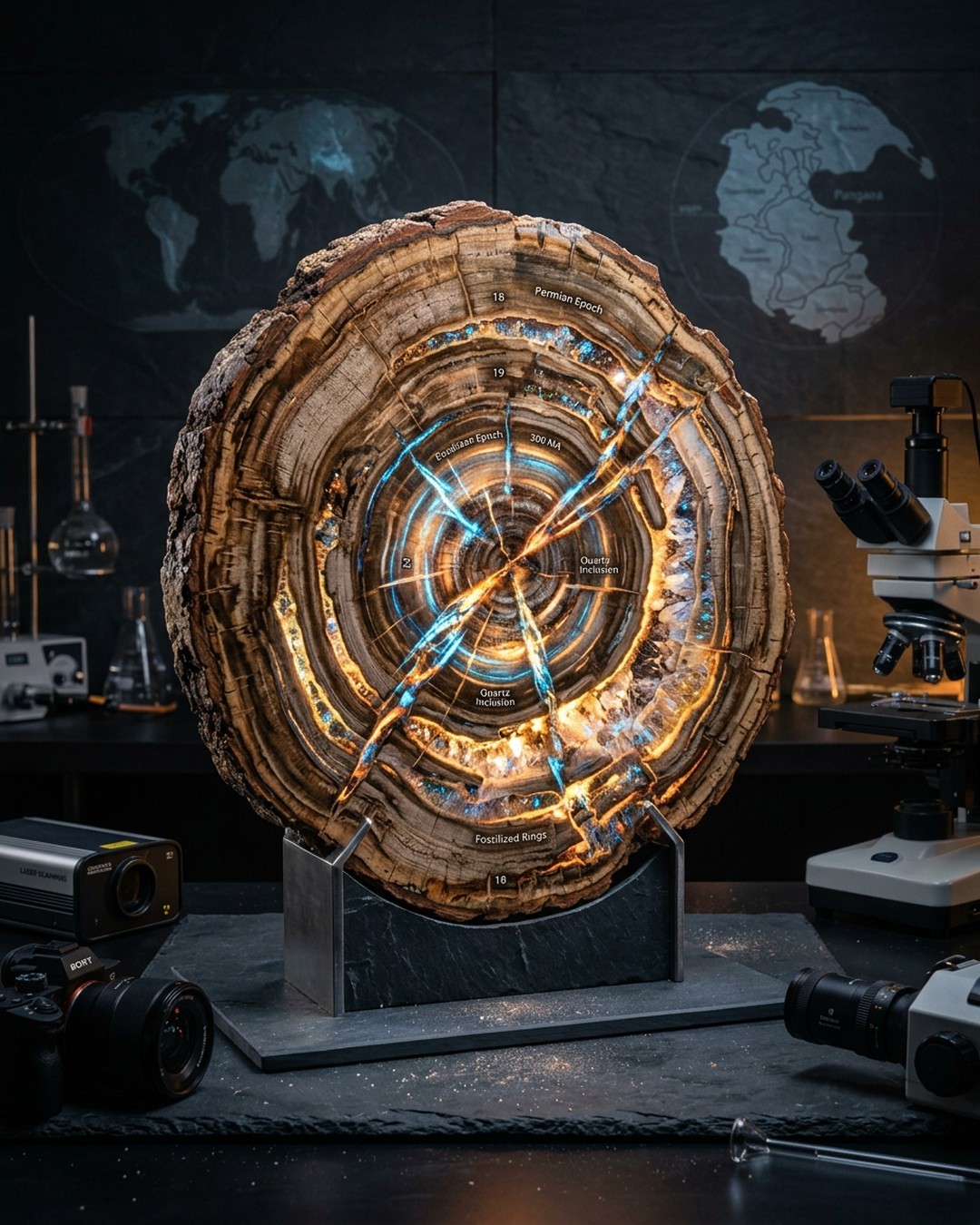
300-Million-Year-Old Geological Time Capsule in Fossilized Wood

scitechdaily geology fossils geochemistry earth-science university-of-munster

Résumé

Image de couverture du mindmap
Image de Couverture Générée par IA

Scientists led by Dr. Steffen Trümper from the University of Münster have discovered that quartz inside fossilized wood can act as a natural geological archive spanning up to 300 million years. Published in Scientific Reports on July 14, 2026, the study examined 20-meter-long fossilized trunks from the Kyffhäuser Mountains in Germany, revealing how mineralized wood preserves the history of sedimentary basin sinking and tectonic events. The researchers demonstrate that the transformation of ancient wood into quartz is far more complex than previously understood, identifying five successive generations of silica mineralization. These stages formed from distinct chemical solutions, retaining critical records of temperature, pressure, and environmental changes across roughly 200 million years, extending to 300 million years when accounting for subsequent tectonic uplift. Advanced analytical techniques, including quartz cathodoluminescence, fluid inclusion analysis, oxygen and silicon isotope measurements, and in-situ U-Pb dating, revealed that parts of the fossilized wood were buried three to five and a half kilometers deep at temperatures between 160 and 240 degrees Celsius. This breakthrough establishes fossilized wood found globally as a powerful new tool for geologists to trace continental evolution and sedimentary basin development, offering high-resolution insights into Earth history that depend largely on the climate and sedimentary conditions present during initial burial.

Points clés

01

🔹 Discovery of 300-Million-Year-Old Geological Archive

Geologist Dr. Steffen Trümper and researchers from the University of Münster published a study in Scientific Reports on July 14, 2026, demonstrating that quartz inside fossilized wood acts as a natural archive recording long-term geological and tectonic changes across 300 million years.

02

🔸 Kyffhäuser Mountains Reference Site

The study focused on fossilized trunks up to 20 meters long found in the Kyffhäuser Mountains of northern Thuringia, Germany. These specimens originated from tropical dry forests on Pangaea approximately 300 million years ago, preserved within reddish fluvial sediments of the Saale Basin.

03

⭐ Five Successive Generations of Silica Mineralization

Researchers identified five distinct phases of silica replacement that evolved from different chemical solutions over 200 million years (from the late Carboniferous to the Early Cretaceous). Each generation preserved unique structural, chemical, and age data reflecting changing environmental conditions.

04

📊 Deep Burial and Temperature Evidence

Using fluid inclusion analysis and Raman thermometry, scientists discovered that microscopic pockets within the quartz recorded burial depths between 3 and 5.5 kilometers underground, where the ancient wood experienced extreme temperatures ranging from 160 to 240 degrees Celsius.

05

💡 Advanced Analytical Techniques and Global Implications

The team utilized quartz cathodoluminescence, isotope measurements, electron probe microanalysis, and in-situ U-Pb dating. Because fossilized wood occurs worldwide, this methodology provides scientists with a novel global tool to trace continental evolution and sedimentary basin development.

Voulez-vous créer votre propre mindmap ?

Connectez-vous à Neumap AI et commencez à créer vos propres mindmaps !

Commencer