Brain Memory Readiness and Plasticity Windows

scitechdaily neuroscience memory-formation hippocampus brain-plasticity

Résumé

Image de couverture du mindmap
Image de Couverture Générée par IA

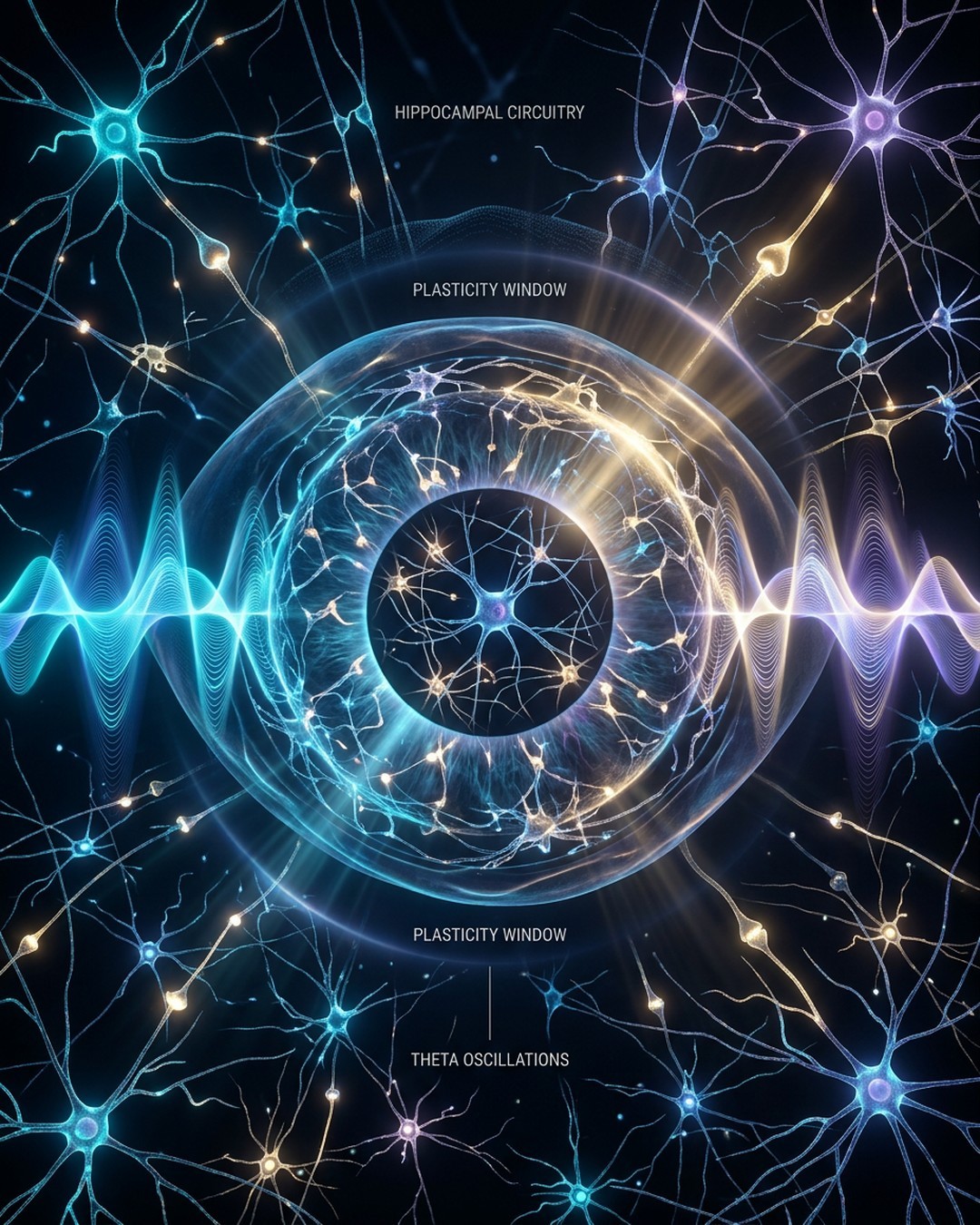
Recent research published on July 28, 2026, in Nature Communications by scientists at the University of Tübingen reveals that the brain does not maintain a constant state of readiness to form memories. Led by Professor Andrea Burgalossi, the study demonstrates that natural fluctuations in alertness, as measured by pupil dilation, create brief windows during which hippocampal circuits become unusually receptive to reshaping and encoding new experiences. The researchers emphasize that episodic memory formation relies heavily on these dynamic internal brain states rather than merely on external environmental inputs. By tracking place cells and theta oscillations in mice, the team discovered that heightened alertness directly activates specific subsets of neurons, opening temporal windows of enhanced neural plasticity necessary for capturing one-off life events instantly. The study highlights that stimulating individual memory-related neurons during these moments of heightened alertness successfully recruits new place cells into the hippocampal network. This proves that the brain moves through alternating cycles of high and low receptivity, dictating precisely when experiences can be transformed into lasting physical memory traces. These findings offer profound implications for understanding cognitive processes and neurological functions related to learning and memory storage. By identifying how natural physiological states govern memory acquisition, researchers can now explore controlled methods to target these plastic windows, opening new avenues for studying memory disorders and enhancement.

Points clés

01

🔹 Discovery of Dynamic Memory Readiness

Published on July 28, 2026, in Nature Communications, research from the University of Tübingen led by Professor Andrea Burgalossi discovered that the hippocampus does not process and store memories at a constant rate, but instead passes through brief, fluctuating states of high and low readiness.

02

🔸 Alertness and Pupil Dilation Link

Researchers tracked internal brain states in mice by measuring pupil size, discovering that pupil dilation directly correlates with increased alertness and the activation of specific subsets of place cells within the hippocampus, even during periods of physical immobility.

03

⭐ Role of Theta Oscillations in Plasticity

The strength of theta oscillations—rhythmic neural waves associated with learning and navigation—rises and falls with alertness, signaling periodic windows of heightened neural plasticity where brain circuits are exceptionally capable of reorganizing connections.

04

📊 Recruitment of New Memory Cells

By artificially stimulating memory-related neurons during moments of high alertness, researchers successfully induced unreactive neurons to develop location-specific activity, proving that targeted stimulation during plastic windows can recruit new place cells into the network.

05

💡 Implications for Episodic Memory

Because episodic memories of unique life events happen only once without rehearsal, the brain relies on these short, spontaneously opening physiological windows to capture, process, and permanently store real-time experiences efficiently.

Voulez-vous créer votre propre mindmap ?

Connectez-vous à Neumap AI et commencez à créer vos propres mindmaps !

Commencer