AI in Cosmology: Benefits and Pitfalls of Transfer Learning

ArtificialIntelligence Cosmology Physics MachineLearning TransferLearning JCAP

Résumé

Image de couverture du mindmap
Image de Couverture Générée par IA

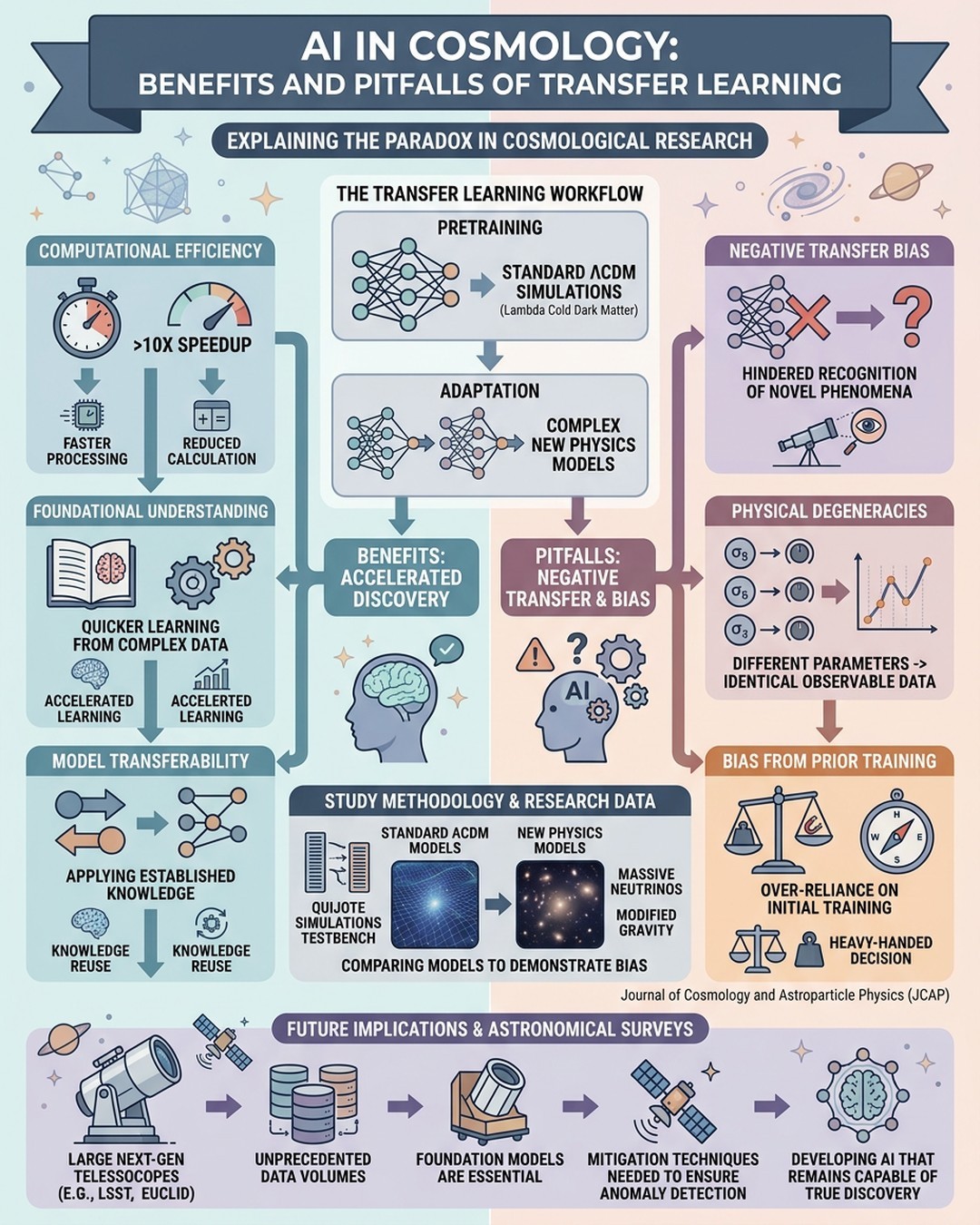
Artificial intelligence is increasingly utilized in cosmology to analyze vast datasets, yet a study published in the Journal of Cosmology and Astroparticle Physics (JCAP) on June 14, 2026, highlights a significant paradox. While AI can accelerate the search for new physics beyond the standard ΛCDM model, it faces a critical limitation known as negative transfer, where prior training on standard models hinders the recognition of genuinely novel phenomena. The researchers, including Veena Krishnaraj and Adrian Bayer, advocate for transfer learning as a strategic shortcut. By pretraining neural networks on computationally inexpensive ΛCDM simulations before introducing complex models involving massive neutrinos or modified gravity, the team successfully reduced the need for costly, high-compute simulations by more than a factor of ten. The core challenge identified is that new physical signals often mimic existing parameters, such as the σ8 matter clustering metric. This leads the AI to misinterpret new physics through the lens of its previous training, a phenomenon driven by physical degeneracies where distinct parameters produce identical observable signatures. For researchers and practitioners, this study underscores the necessity of balancing efficiency with caution. While foundation model strategies offer immense potential for processing future high-precision astronomical surveys, developers must implement mitigation strategies to ensure AI systems remain sensitive to anomalies rather than becoming overly biased by established theoretical frameworks.

Points clés

01

🔹 The Role of Transfer Learning in Cosmology

Transfer learning serves as a computational shortcut in cosmological research. By pretraining neural networks on standard ΛCDM (Lambda Cold Dark Matter) simulations, researchers provide the AI with a foundational understanding of the universe. This allows the model to learn more efficiently when exposed to complex, computationally expensive models involving new physics, reducing the required simulation volume by over 10 times.

02

🔸 The Challenge of Negative Transfer

Negative transfer occurs when an AI system relies too heavily on its initial training, causing it to misinterpret new, groundbreaking physical signals as variations of known phenomena. This is particularly problematic when new physics produces observable signatures that resemble existing parameters, such as σ8 (a measure of matter clustering strength), leading to incorrect conclusions.

03

⭐ Physical Degeneracies as a Barrier

The study identifies that negative transfer is driven by underlying physical degeneracies. These occur when different physical parameters result in nearly identical observable data. Because the AI is trained to optimize for the standard model, it struggles to distinguish between these degenerate states, necessitating new methods to isolate and identify truly novel physical laws.

04

📊 Research Methodology and Data

The research utilized the Quijote simulations to test the efficacy of transfer learning. By comparing standard ΛCDM models against models incorporating massive neutrinos and modified gravity, the team demonstrated that while pretraining speeds up inference, it creates a bias that can hinder the discovery of physics beyond the Standard Model if not properly managed.

05

💡 Future Implications for Astronomical Surveys

As next-generation astronomical surveys prepare to generate unprecedented volumes of high-precision data, the application of foundation models is essential. The findings suggest that while AI is a powerful tool for efficiency, scientists must develop techniques to mitigate bias and ensure that AI remains capable of detecting anomalies that deviate from current theoretical expectations.

Voulez-vous créer votre propre mindmap ?

Connectez-vous à Neumap AI et commencez à créer vos propres mindmaps !

Commencer