Semiconductor Tech Applied to EV Batteries

scitechdaily battery-technology nanotechnology materials-science electric-vehicles

Résumé

Image de couverture du mindmap
Image de Couverture Générée par IA

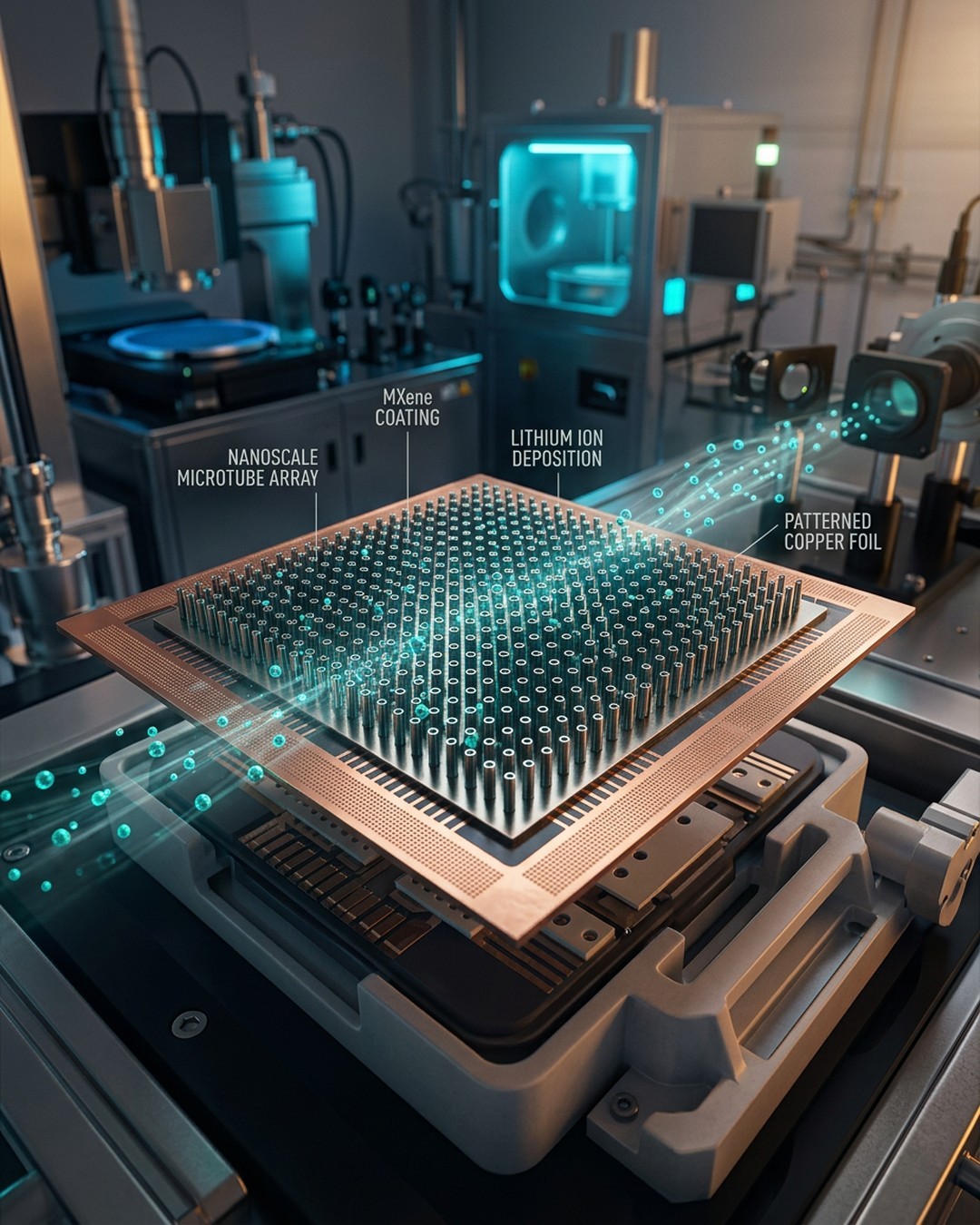
Researchers from the Korea Advanced Institute of Science and Technology (KAIST) announced on September 22, 2026, that they have developed a novel anode-free battery technology by borrowing semiconductor manufacturing techniques. By eliminating materials like graphite and utilizing an ultrathin MXene coating alongside microscopic tubes created via secondary sputtering lithography (SSL), the team significantly extended EV battery life while preventing dendrite formation and minimizing added weight. The primary scientific breakthrough addresses the historical challenge where high-energy anode-free lithium metal batteries suffer from sharp, branching spikes called dendrites and unstable protective layers during repeated charging cycles. Led by Professor Jinwoo Lee and Professor Hee-Tae Jung, the research team demonstrated that ultrafine fabrication methods can create uniform deposition sites and stable lithium fluoride rich protective barriers without altering bulk electrolyte formulations or adding excessive lithium. The strategic implementation relies on coating copper foil with roughly 10 nanometers of MXene to act as a reactive primer that builds a protective barrier during operation, coupled with an array of microscopic tubes measuring 300 nanometers in diameter and 150 nanometers in height. This structure expands the available surface area to approximately four times that of flat copper foil, allowing lithium ions to spread out evenly rather than concentrating in isolated spots. These advancements offer profound practical value for the electric vehicle industry by accelerating the commercialization of lightweight, high-energy-density batteries. The methodology successfully eliminates the weight and bulk penalties associated with conventional protective films or excess lithium additions, thereby supporting the broader industrial goal of manufacturing smaller, lighter, and safer electric vehicles.

Points clés

01

🔹 KAIST Breakthrough in Anode-Free Batteries

【📌 Key Finding】Researchers at KAIST announced a semiconductor-inspired manufacturing method for anode-free EV batteries on September 22, 2026. 【🔸 Impact Factors】Eliminates graphite and heavy materials to save weight and space while extending battery lifespan. 【⭐ Data Support】Led by Professor Jinwoo Lee and Professor Hee-Tae Jung in collaboration with Kyungpook National University and the National NanoFab Center.

02

🔸 MXene Coating as a Reactive Primer

【📌 Key Finding】The research team coated copper foil with roughly 10 nanometers of MXene, a two-dimensional material. 【🔸 Impact Factors】Acts as a primer to gather components and encourage a lithium fluoride rich protective layer to form inside LiPF6-based electrolytes during battery operation. 【⭐ Data Support】Successfully reduces unwanted reactions between lithium and the electrolyte while suppressing dendrite growth without adding excess bulk.

03

⭐ Nanoscale Microtubes via Secondary Sputtering Lithography

【📌 Key Finding】Utilized secondary sputtering lithography (SSL) from the semiconductor industry to pattern the copper substrate. 【🔸 Impact Factors】Created an array of microscopic tubes measuring 300 nanometers in diameter and 150 nanometers in height. 【⭐ Data Support】Increased the available electrode surface area to roughly four times that of flat copper foil, allowing lithium to deposit uniformly.

04

📊 Prevention of Dendrite Growth and Weight Penalties

【📌 Key Finding】Traditional methods used thick protective films or excess lithium that eroded size and weight advantages. 【🔸 Impact Factors】The new nanoscale architecture gives lithium more room to spread during charging, suppressing damaging dendritic spikes. 【⭐ Data Support】Confirmed via advanced analytical techniques including X-ray photoelectron spectroscopy (XPS) and transmission electron microscopy (TEM).

05

💡 Commercialization and Industrial Implications

【📌 Key Finding】The technology is published in Advanced Functional Materials on September 1, 2026, under the title Anion-Interactive Anode Interfaces for Stable Anode-Free Lithium Metal Batteries. 【🔸 Impact Factors】Accelerates the commercialization of high-energy anode-free batteries for electric vehicles. 【⭐ Data Support】Supported by the National Research Foundation of Korea and the Global Semiconductor Advanced Fab Utilization Project.

Voulez-vous créer votre propre mindmap ?

Connectez-vous à Neumap AI et commencez à créer vos propres mindmaps !

Commencer