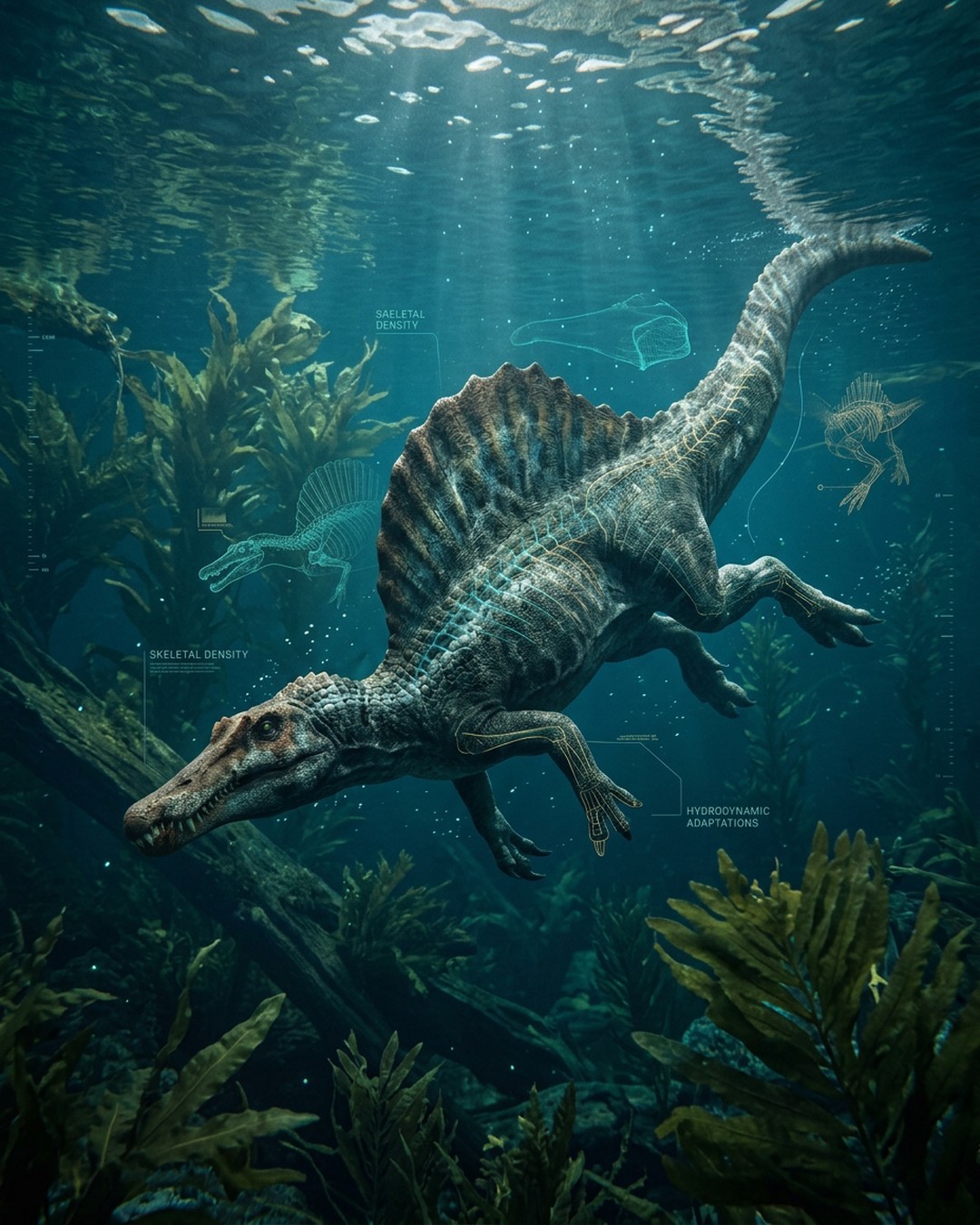
Spinosaurus Aquatic Lifestyle Study

scitechdaily paleontology dinosaurs evolution machine-learning yale-university

Résumé

Image de couverture du mindmap
Image de Couverture Générée par IA

A recent paleontological study published in Current Biology on November 20, 2025, reveals that the giant predatory dinosaur Spinosaurus likely spent the vast majority of its life submerged in water. Conducted by researchers at Yale University including lead author Caleb Gordon and senior author Bhart-Anjan Bhullar, the study analyzed more than 11,000 measurements, CT scans, and historical statistical techniques to reconstruct the lifestyles of extinct vertebrates. The authors emphasize a novel machine-learning methodology trained on modern living species to accurately predict aquatic habits and soft-tissue adaptations from fossil limb proportions. By avoiding subjective interpretations of fragmentary remains, the research successfully resolved long-standing debates regarding whether Spinosaurus was a fully aquatic hunter or merely a shorebound forager. The investigation establishes that Spinosaurus possessed highly aquatic adaptations, contrasting with smaller marine reptiles like mesosaurs from the Paleozoic Era which maintained semi-terrestrial lifestyles. This comprehensive approach demonstrates how convergent evolution drives separate lineages to develop similar swimming traits under matching environmental pressures. Scientists suggest this objective skeletal analysis framework can be extended to other major evolutionary transitions, such as bipedalism in human ancestors and avian flight. The findings eliminate traditional guesswork in paleontology, allowing researchers to rely strictly on verifiable anatomical data and modern biological analogues.

Points clés

01

🔹 Spinosaurus Aquatic Lifestyle Findings

【📌 Key Finding】New research published in Current Biology indicates that Spinosaurus spent the vast majority of its time submerged underwater rather than foraging along the shore. 【🔸 Impact Factors】This resolves a long-standing debate in paleontology regarding whether the dinosaur behaved more like a swimming predator or a shorebound heron. 【⭐ Data Support】Lead author Caleb Gordon and colleagues utilized machine-learning models trained on modern species to predict aquatic habits with extreme accuracy based on fossil limb proportions.

02

🔸 Innovative Machine Learning Methodology

【📌 Research Technique】Researchers analyzed over 11,000 measurements, photographs, and CT scans from global museum collections, including the Yale Peabody Museum. 【🔸 Analytical Tool】The team resurrected a World War II statistical technique originally designed to spot enemy planes on radar to estimate limb modifications for swimming. 【⭐ Accuracy】Forelimb proportions successfully predicted soft-tissue flippers and aquatic habits with more than 90% accuracy, removing subjective interpretation from fossil analysis.

03

⭐ Comparison with Paleozoic Marine Reptiles

【📌 Mesosaurs Re-evaluated】Mesosaurs, small marine reptiles living 290 to 274 million years ago, were previously thought to be fully aquatic due to live birth habits. 【🔸 Skeletal Evidence】Limb proportion analysis revealed they actually maintained a semi-terrestrial lifestyle akin to modern alligators or platypuses. 【⭐ Broader Pattern】All Paleozoic marine reptiles regularly returned to land, living at most an amphibious lifestyle rather than becoming completely aquatic.

04

📊 Convergent Evolution and Future Applications

【📌 Evolutionary Patterns】Aquatic species independently developed similar traits like flippers through convergent evolution in response to comparable environmental pressures. 【🔸 Scientific Implications】The method provides a rigorous framework to study other major transitions, including human bipedal walking and bird flight origins. 【⭐ Objective Science】Senior author Bhart-Anjan Bhullar highlights that the method allows skeletal data to speak for themselves rather than relying on isolated preferred features.

05

💡 Study Authors and Institutional Funding

【📌 Key Personnel】The research was led by Caleb Gordon alongside co-authors Lisa S. Freisem, Christopher T. Griffin, Jacques A. Gauthier, and Bhart-Anjan S. Bhullar at Yale University. 【🔸 Publication Date】The study was published on November 20, 2025, in the journal Current Biology under DOI 10.1016/j.cub.2025.10.068. 【⭐ Financial Support】Funding was provided by the Yale Institute for Biospheric Studies, the IUCN Crocodile Specialist Group, and the National Science Foundation.

Voulez-vous créer votre propre mindmap ?

Connectez-vous à Neumap AI et commencez à créer vos propres mindmaps !

Commencer