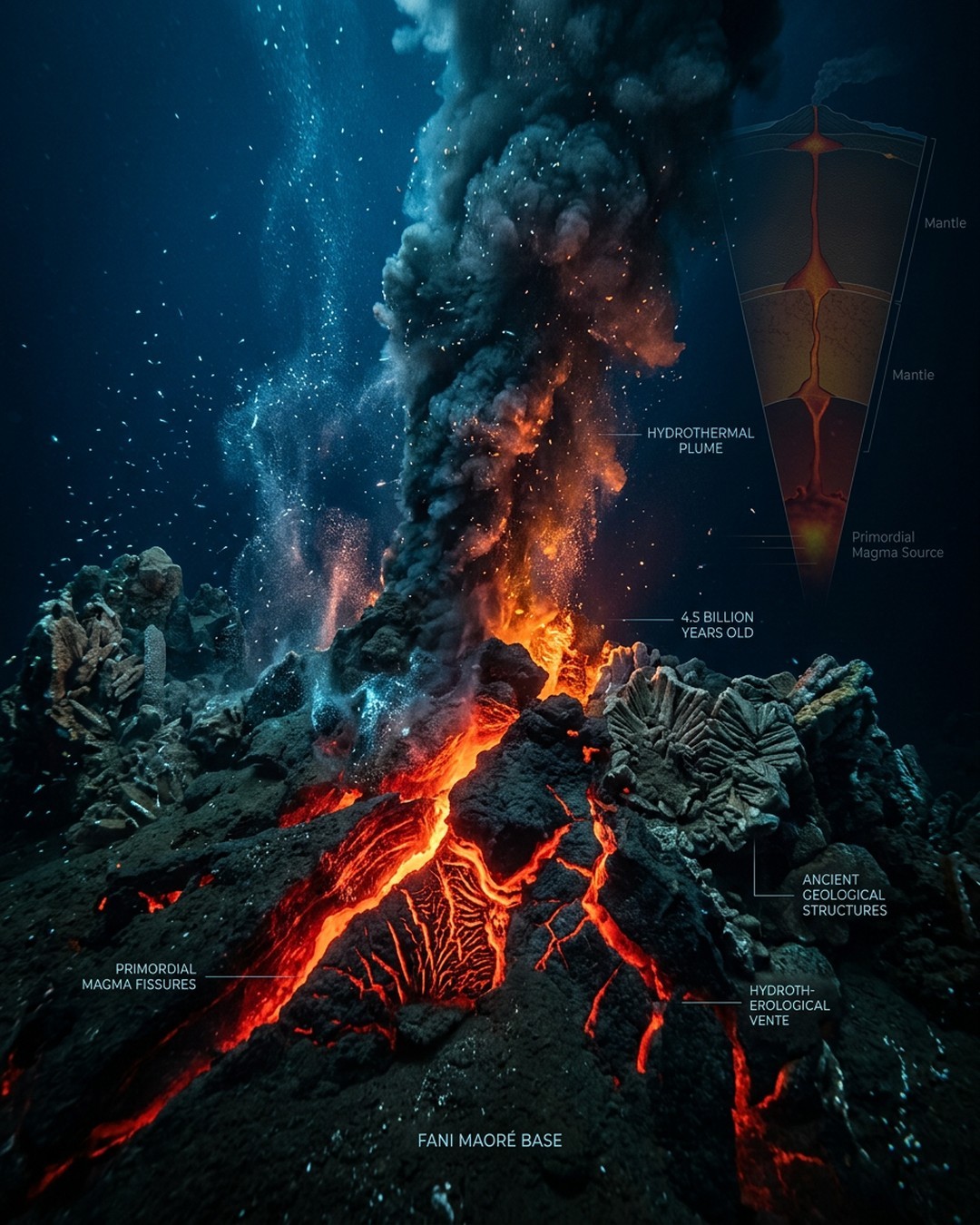
Primordial Magma Traces in Fani Maoré Volcano

Geology EarthScience Volcanology PrimordialMagma NeodymiumIsotopes FaniMaoré

Résumé

Image de couverture du mindmap
Image de Couverture Générée par IA

The discovery of the Fani Maoré underwater volcano off the coast of Mayotte has provided scientists with the first direct evidence of primordial material dating back 4.5 billion years. By analyzing volcanic rock samples using ultra-precise neodymium isotope measurements, researchers identified chemical signatures linked to Earth's original magma ocean, challenging long-held assumptions about the thorough mixing of the Earth's mantle over geological time. The research team, led by Catherine Chauvel and Claudine Israel, posits that pockets of ancient mantle, rich in the mineral bridgmanite, have remained isolated from the mantle's convective churning for billions of years. This discovery suggests that the Earth's mantle is more chemically heterogeneous than previously believed, offering a rare window into the Hadean eon when the planet was covered in a global magma ocean. This breakthrough relies on the detection of a higher ratio of neodymium-142 to neodymium-144 in Fani Maoré lava compared to nearby volcanic systems. The successful application of this high-precision analytical technique marks a significant advancement in earth science, enabling researchers to reconstruct the crystallization processes that occurred during the cooling of the young Earth. These findings provide a foundational shift in understanding planetary evolution, suggesting that primordial materials are accessible for sampling. Future research will likely focus on mapping these ancient mantle reservoirs to better understand the solidification history of the early Earth and the preservation of its earliest chemical records.

Points clés

01

🔹 Discovery of Primordial Magma Traces

Researchers identified chemical traces of Earth's primordial magma ocean in the Fani Maoré underwater volcano, located east of Mayotte. This volcano, discovered following an earthquake swarm in May 2018, erupted material that contains evidence of the planet's state during its first 100 million years, specifically the Hadean eon.

02

🔸 Analytical Breakthrough in Isotope Measurement

The study utilized a newly developed ultra-precise technique to measure neodymium isotopes (neodymium-142 and neodymium-144). The Fani Maoré lava exhibited a higher ratio of these isotopes, which serves as a chemical fingerprint for ancient mantle material that has remained isolated from billions of years of convective mixing.

03

⭐ Implications for Mantle Heterogeneity

The findings challenge the geological consensus that the Earth's mantle has been thoroughly mixed over 4 billion years. The presence of bridgmanite-rich pockets suggests that the mantle retains chemical heterogeneity from the initial crystallization of the global magma ocean, providing a direct record of early planetary cooling.

04

📊 Geological Context and Impact

The eruption of Fani Maoré was significant enough to cause the island of Mayotte to sink by approximately 20 centimetres due to magma drainage. This event allowed scientists to sample deep-seated material that acts as a time capsule, offering insights into the period following the collision with a Mars-sized object that formed the moon.

05

💡 Expert Consensus and Future Research

Leading geologists, including Tim Johnson and Bernard Bourdon, have characterized this study as a major achievement in earth science. The ability to sample material from the Earth's early history is compared to accessing the planet's core, opening new pathways for reconstructing the solidification history of the early Earth.

Voulez-vous créer votre propre mindmap ?

Connectez-vous à Neumap AI et commencez à créer vos propres mindmaps !

Commencer