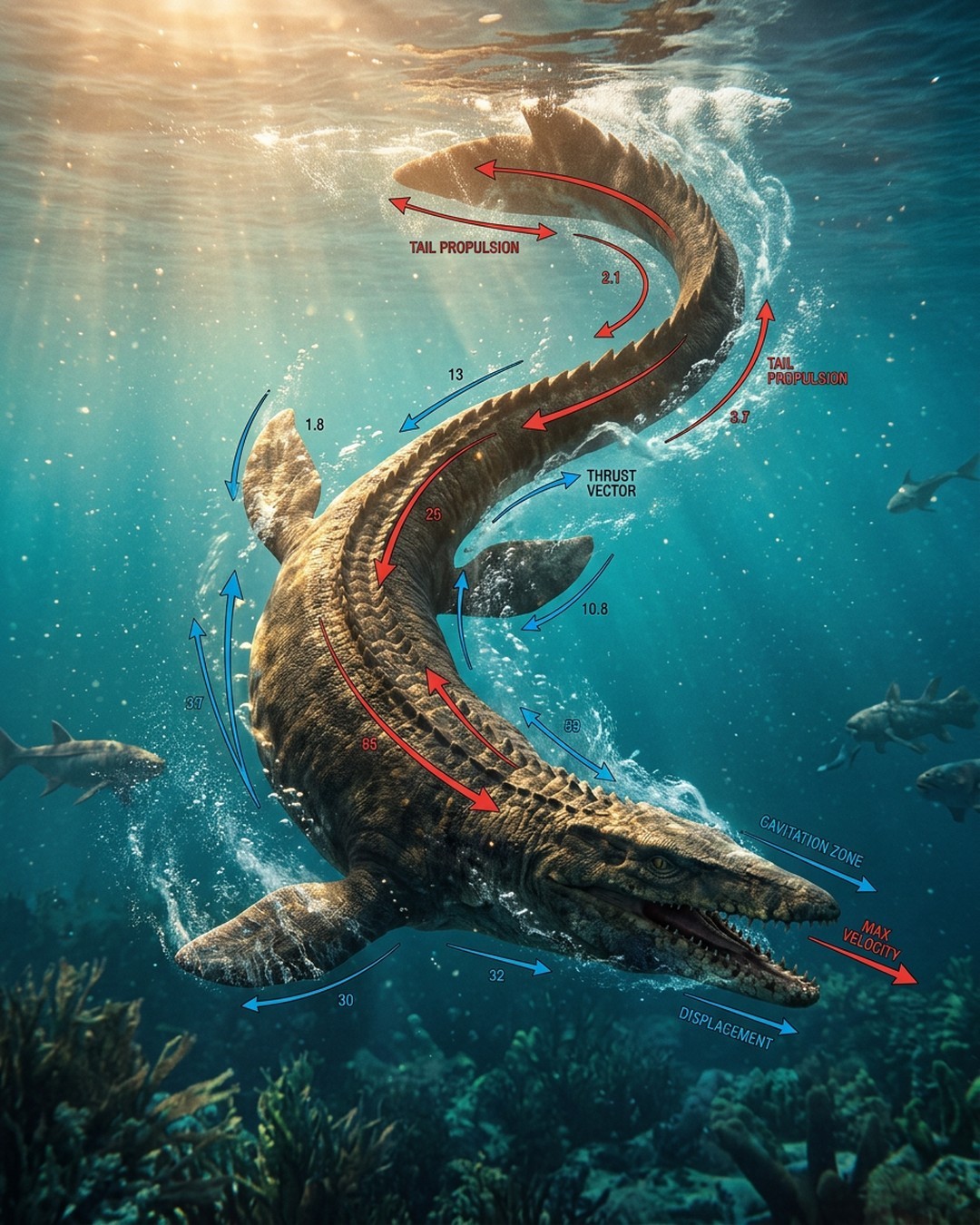
Mosasaur Burst Swimming Performance and Hunting Strategies

scitechdaily paleontology marine-biology mosasaur rutgers-university

Résumé

Image de couverture du mindmap
Image de Couverture Générée par IA

New research led by Rutgers University assistant professor Kiersten Formoso and published in Current Biology on October 7, 2026, reveals that ancient giant marine reptiles known as mosasaur species like Tylosaurus could accelerate from 0 to 15 miles per hour in a single powerful slam-start swipe of the tail. The study investigates how these prehistoric ocean predators moved and hunted by reconstructing fossil skeletons and applying physics to calculate burst swimming performance, contrasting sudden ambush tactics with sustained open-water swimming. The research demonstrates that anatomical variations in tail length and flexibility determined hunting strategies, giving species like Platecarpus and Tylosaurus an advantage in shallow-sea ambushes while adapting Mosasaurus and Plotosaurus for continuous pursuit. These computational modeling tools are now being made publicly available for scientists to analyze extinct aquatic animals, providing fundamental numerical benchmarks for understanding ancient marine ecosystem dynamics.

Points clés

01

🔹 Mosasaur Burst Speed and Slam-Start Mechanics

【📌 Key Finding】Exceptionally large Tylosaurus individuals could accelerate from 0 to 15 miles per hour in a single powerful sweep of the tail. 【🔸 Impact Factors】This calculation represents a brief burst of acceleration during a slam-start maneuver rather than sustained swimming. 【⭐ Data Support】Researchers bent the tail to one side and forcefully swept it through the water, propelling the body forward similarly to a swimmer launching from a pool wall.

02

🔸 Anatomical Differences Dictating Hunting Strategies

【📌 Key Finding】Differences in tail anatomy gave certain mosasaurs advantages in sudden attacks while equipping others for open-water pursuit. 【🔸 Impact Factors】Platecarpus and Tylosaurus were ideally suited to ambushing prey in shallow seas due to long, flexible tail sections. 【⭐ Data Support】Mosasaurus and Plotosaurus featured tails built for sustained, tuna-like swimming rather than rapid lunges.

03

⭐ Research Methodology and Modeling Approach

【📌 Key Finding】Scientists reconstructed four mosasaur species from fossil skeletons and applied physics to calculate potential acceleration. 【🔸 Impact Factors】Missing soft-tissue musculature was estimated using anatomical evidence from living lizards including Komodo dragons. 【⭐ Data Support】The team tested assumptions regarding muscle strength, tail flexibility, and water resistance to evaluate acceleration metrics.

04

📊 Integration with Broader Paleontological Evidence

【📌 Key Finding】Proposed hunting strategies align with independent fossil indicators including tooth wear, bite force estimates, and chemical analyses. 【🔸 Impact Factors】The research examined colossal specimens such as a Mosasaurus reconstructed from a New Jersey fossil housed at the New Jersey State Museum. 【⭐ Data Support】Published in Current Biology on October 7, 2026, the study offers foundational numerical estimates for dinosaur-era marine reptiles.

05

💡 Open Access Tools and Evolutionary Insights

【📌 Key Finding】Lead researcher Kiersten Formoso and her team are making their biomechanical modeling tools publicly available. 【🔸 Impact Factors】Scientists can apply these physical principles to investigate extinct swimming animals lacking close living counterparts. 【⭐ Data Support】Co-authors include Nicholas Hebdon, Frank E. Fish, Robert L. Cieri, and Michael B. Habib, with funding from the U.S. National Science Foundation.

Voulez-vous créer votre propre mindmap ?

Connectez-vous à Neumap AI et commencez à créer vos propres mindmaps !

Commencer