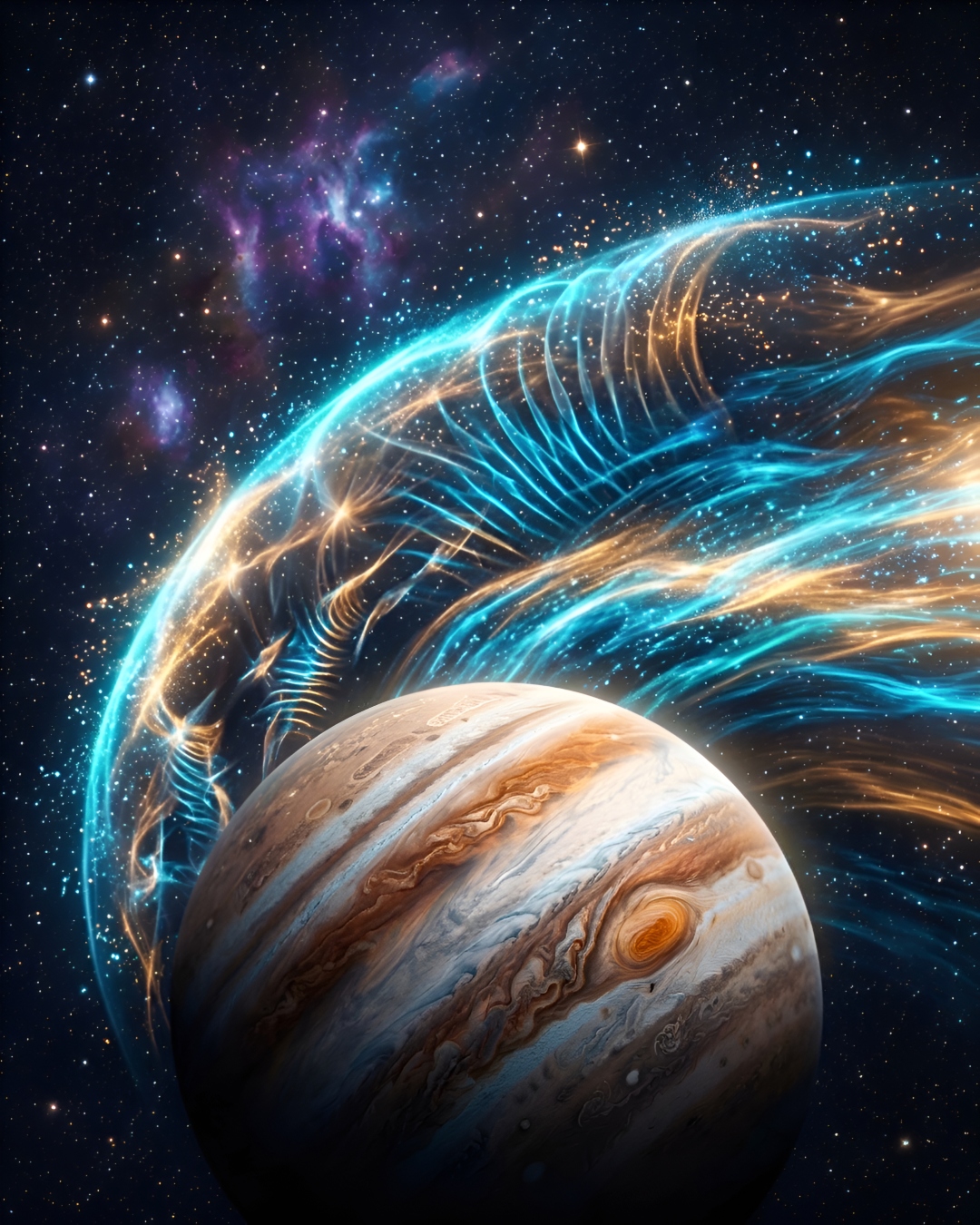
Jupiter Bow Shock and Solar Wind Dynamics

scitechdaily space jupiter juno astrophysics

Résumé

Image de couverture du mindmap
Image de Couverture Générée par IA

NASA's Juno spacecraft has captured detailed measurements of Jupiter's bow shock, revealing that the gas giant manages the high-energy solar wind much differently and more complexly than Earth. Reported by a University of Iowa-led team in September 2026, the findings show that Jupiter uses a richer spectrum of plasma waves and smaller precursor structures called shocklets to heat and slow incoming particles. The researchers, including corresponding author Jayasri Joseph and co-author Bill Kurth, emphasize that Jupiter's immense magnetosphere creates extreme conditions. Unlike Earth, which relies on a single large bow shock and a dominant wave frequency, Jupiter employs plasma waves spread across multiple frequencies, known as harmonics, to transfer energy to a broader range of solar wind particles. The study highlights the presence of smaller shocklets located before Jupiter's primary bow shock, which interact with and decelerate incoming particles in stages. This multi-step process contrasts with Earth's simpler interaction and demonstrates how a planetary environment can handle powerful solar wind impacts through intricate plasma dynamics. Beyond planetary science, these observations provide scientists with a nearby natural laboratory to study extreme cosmic shock physics. Researchers can use Jupiter's bow shock data to understand how energy conversion works in high-energy environments like supernova remnants, offering valuable insights into particle acceleration and space plasma behavior.

Points clés

01

🔹 Juno Spacecraft Observations of Jupiter Bow Shock

NASA's Juno spacecraft captured the most detailed measurements yet of Jupiter's bow shock, the boundary where the solar wind crashes into the planet's magnetosphere, revealing a much more complex interaction than previously understood (S0019). The findings were published in Nature Communications on July 31, 2026, based on data collected in December 2024 by the University of Iowa-built Waves instrument (S0031, S0032).

02

🔸 Complex Harmonic Plasma Waves at Jupiter

Unlike Earth's bow shock which relies mainly on one dominant frequency, Jupiter's bow shock contains plasma waves spread across multiple frequencies described as harmonics (S0024). This richer spectrum of waves allows Jupiter to heat and slow down a wider range of incoming solar wind particles effectively (S0025).

03

⭐ Role of Smaller Shocklets Before the Main Boundary

Juno detected a series of smaller regions called shocklets that begin processing the solar wind before it reaches Jupiter's primary bow shock, slowing incoming particles in stages (S0026). Earth does not require these extra steps because its solar wind impact is significantly less powerful compared to the gas giant (S0027).

04

📊 Natural Laboratory for Extreme Cosmic Shocks

Because powerful shocks occur around high-energy astrophysical objects such as supernova remnants, Jupiter's bow shock offers a nearby natural laboratory for exploring how nature converts flow energy into heat and energetic particles (S0030). While Jupiter cannot fully replicate supernova conditions, it allows direct measurement of relevant plasma processes (S0029).

05

💡 University of Iowa Research Team and Instrumentation

The study was led by University of Iowa postdoctoral researcher Jayasri Joseph and co-authored by research scientist Bill Kurth, who has been involved with the Juno mission since its 2011 launch (S0025, S0027). The research relies on data collected by Juno's Waves instrument, designed and built by University of Iowa physicists to measure radio and plasma waves around the planet (S0032).

Voulez-vous créer votre propre mindmap ?

Connectez-vous à Neumap AI et commencez à créer vos propres mindmaps !

Commencer