Stanford Study on Rapid Coral Bleaching Recovery

stanford-university coral-reefs marine-biology climate-change science-advances

Résumé

Image de couverture du mindmap
Image de Couverture Générée par IA

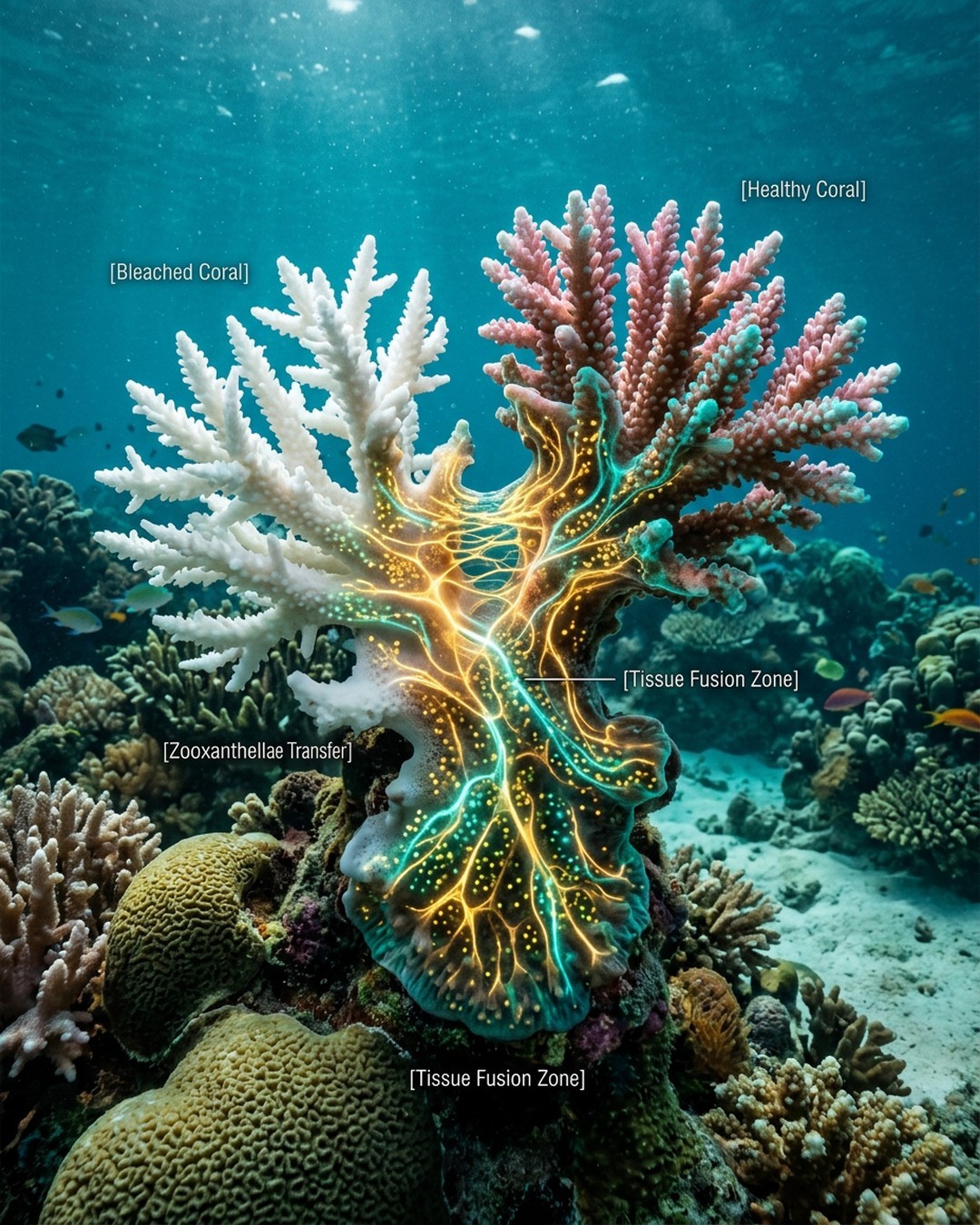
Stanford researchers have discovered that dying, bleached corals can fully recover within seven weeks through brief contact with healthy genetic clones. Published on October 14, 2026, in Science Advances, the study reveals that microscopic tissue fusion allows vital, energy-supplying algae to flow from healthy partners to bleached corals within three days. This rapid transfer triggers the algae inside the bleached coral to double every four days, achieving a recovery rate roughly ten times faster than observed in wild corals. Lead author Danny Collins and senior researchers Steve Palumbi and Fiorenza Micheli emphasize that while this specific method requires genetically identical clones and continuous physical touch, it fundamentally challenges the assumption that bleached corals are a lost cause. The research demonstrates that even brief contact lasting just one week, or as little as five days, provides enough beneficial symbionts for a bleached coral to complete its recovery independently. The core biological mechanism relies on tissue compatibility where microscopic channels align, creating an open pathway for rapid nutrient and symbiont exchange. Once introduced, the algae flood into the bleached tissue and multiply at unprecedented speeds, effectively kickstarting the coral restoration process before terminal mortality sets in from starvation and harmful algae invasion. The research team is actively investigating alternative delivery mechanisms, such as pre-collecting and batch-delivering beneficial algae to bleached corals without requiring direct contact with matching clones. This breakthrough offers critical hope for accelerating reef restoration and helping marine ecosystems survive increasingly severe and frequent marine heat waves driven by climate change.

Points clés

01

🔹 Coral Bleaching Crisis and Recovery Challenge

【📌 Key Finding】Warm water marine heat waves cause corals to expel colorful symbiotic algae, leading to starvation and ghostly white bleaching that leaves them vulnerable to harmful algal invasion. 【🔸 Impact Factors】Bleached corals lose essential energy sources for growth, and natural recovery in the wild typically takes months or years, often resulting in high mortality rates. 【⭐ Data Support】Published on October 14, 2026, in Science Advances by researchers at the Stanford Doerr School of Sustainability.

02

🔸 Breakthrough Discovery in Laboratory Testing

【📌 Key Finding】Bleached corals fully recovered within seven weeks after brief contact with healthy genetic clones in controlled laboratory experiments. 【🔸 Impact Factors】This represents the fastest documented recovery to date for bleached corals, shifting the scientific perspective that bleached corals are inevitably lost causes. 【⭐ Data Support】Lead author Danny Collins paired 10 coral fragments, observing full recovery in touching pairs while separated pairs died.

03

⭐ Biological Mechanism of Symbiont Transfer

【📌 Key Finding】Genetically identical corals recognize each other and fuse tissues when brought into physical contact, aligning microscopic channels. 【🔸 Impact Factors】Beneficial algae and vital nutrients flow from healthy fragments into bleached partners within three days of initial contact. 【⭐ Data Support】Algae inside bleached fragments doubled every four days during the second week, multiplying roughly ten times faster than wild coral rates.

04

📊 Duration and Independence of Recovery

【📌 Key Finding】Continuous contact is not strictly required for full recovery once the initial transfer of beneficial algae occurs. 【🔸 Impact Factors】Experiments testing varying separation intervals proved that just one week, and sometimes as little as five days, of contact is sufficient. 【⭐ Data Support】Corals separated after five to seven days finished recovering independently over seven weeks, matching the timeline of continuously touching pairs.

05

💡 Future Applications and Scalability Challenges

【📌 Key Finding】Translating laboratory success to large-scale reef restoration requires overcoming the limitation of needing genetically identical healthy clones. 【🔸 Impact Factors】Researchers are exploring alternative delivery methods, such as collecting symbiont algae from healthy corals prior to heat waves and administering them in large batches. 【⭐ Data Support】Senior researchers Steve Palumbi and Fiorenza Micheli aim to bridge laboratory insights with practical treatments to protect reefs against climate change.

Voulez-vous créer votre propre mindmap ?

Connectez-vous à Neumap AI et commencez à créer vos propres mindmaps !

Commencer