Alternative Molecular Pathway in Transthyretin Amyloid Disease

scitechdaily biochemistry molecular-biology genetics neurology scripps-research-institute

Résumé

Image de couverture du mindmap
Image de Couverture Générée par IA

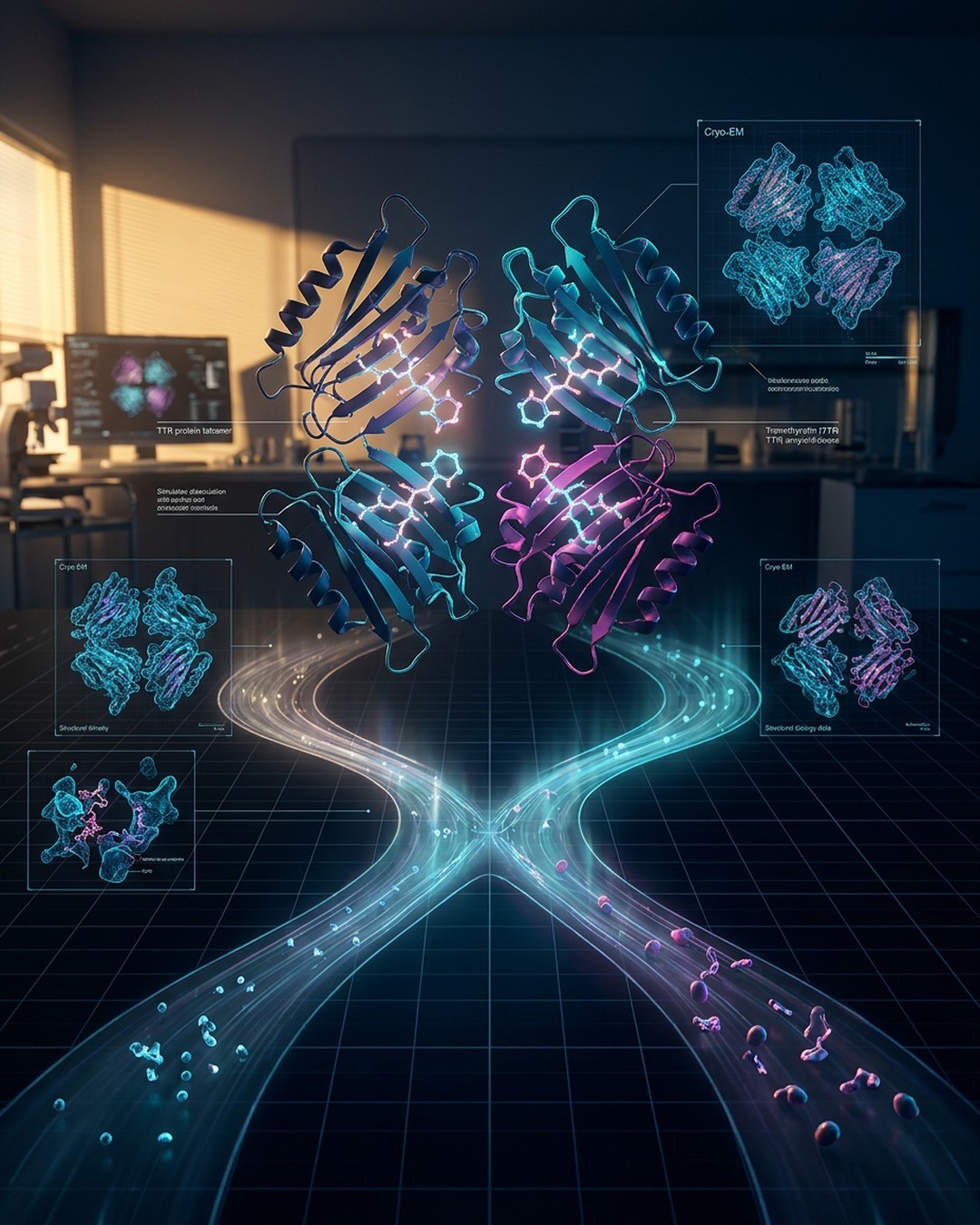
Researchers at Scripps Research have uncovered an alternative molecular pathway for the unfolding of transthyretin (TTR), a protein implicated in the potentially fatal transthyretin amyloid disease (ATTR). Published on September 8, 2026, in the Proceedings of the National Academy of Sciences, the study demonstrates that certain TTR variants can bypass intermediate dimer pairs to unfold directly from tetramers into monomers under acidic conditions. This newly identified pathway raises questions about the effectiveness of existing treatments like tafamidis, which stabilizes the four-unit structure of TTR, especially for patients carrying rare hereditary variants associated with brain amyloid deposits. The authors emphasize that while the alternative route likely evolved for normal cellular protein recycling within acidic compartments like lysosomes, specific disease-associated mutations render this pathway accessible even at physiological blood acidity levels. This mechanistic insight suggests that certain rare genetic variants may lead to TTR aggregation in cerebrospinal fluid, potentially worsening patient outcomes under current standard therapies. Consequently, the findings prompt a reevaluation of drug discovery strategies targeting amyloidosis pathways. The research marks a significant milestone in structural biology as the first demonstration of pathway multiplicity in solution for an oligomeric protein without mechanical pulling. By combining cryogenic electron microscopy, X-ray crystal structures, and unfolding rate measurements across more than 100 TTR variants, the team successfully mapped the energy landscape governing protein denaturation. These insights provide a foundational framework for developing next-generation therapeutics tailored to specific misfolding mechanisms. Medical researchers and clinicians should utilize these findings to investigate whether alternative unfolding contributes to treatment resistance in rare ATTR cases. Further research is necessary to design targeted interventions capable of neutralizing both canonical and alternative pathways, ultimately improving clinical prognoses for patients with inherited amyloidosis disorders.

Points clés

01

🔹 Discovery of Alternative TTR Unfolding Pathway

【📌 Key Finding】Researchers at Scripps Research discovered that the transthyretin (TTR) protein can unfold through a previously unknown direct pathway. 【🔸 Impact Factors】Published on September 8, 2026, in the Proceedings of the National Academy of Sciences, the study reveals that tetramers bypass transient dimer intermediates to dissociate directly into monomers. 【⭐ Data Support】The research team analyzed more than 100 TTR variants using cryogenic electron microscopy and X-ray crystal structures.

02

🔸 Role of Acidic Conditions and Genetic Mutations

【📌 Key Finding】The alternative pathway becomes highly favorable in acidic environments, such as lysosomes which normally handle protein degradation. 【🔸 Impact Factors】Certain rare inherited mutations make this pathway accessible even at normal blood acidity levels. 【⭐ Data Support】Co-author Martin Gruebele noted that while this route evolved for normal protein recycling, specific mutations can trigger harmful side effects and aggregation.

03

⭐ Implications for Existing ATTR Treatments

【📌 Key Finding】Current therapies like tafamidis stabilize the four-unit structure of TTR to slow disassembly and aggregation. 【🔸 Impact Factors】The existence of an alternative unfolding pathway raises uncertainties regarding whether current drugs adequately protect patients with rare hereditary variants. 【⭐ Data Support】Senior author Jeffery Kelly emphasized the urgent need to understand if this pathway causes TTR aggregation in cerebrospinal fluid.

04

📊 Scientific Significance in Protein Denaturation

【📌 Key Finding】Transthyretin is established as the first oligomeric protein to demonstrate pathway multiplicity in solution without mechanical pulling. 【🔸 Impact Factors】This breakthrough bridges a long-standing gap in experimental biology regarding how multi-subunit proteins fold and unfold. 【⭐ Data Support】First author Marcus Jäger confirmed that experimental observation of distinct unfolding pathways in solution had previously been exceptionally challenging.

05

💡 Funding Sources and Collaborative Research

【📌 Key Finding】The study was supported by major institutional grants and international research fellowships. 【🔸 Impact Factors】Funding enables continued exploration of specialized drug targets for amyloidosis pathways. 【⭐ Data Support】Financial backing includes National Institutes of Health grant R01 DK046335 and a postdoctoral fellowship from the German Research Foundation under Project No. 556478029.

Voulez-vous créer votre propre mindmap ?

Connectez-vous à Neumap AI et commencez à créer vos propres mindmaps !

Commencer