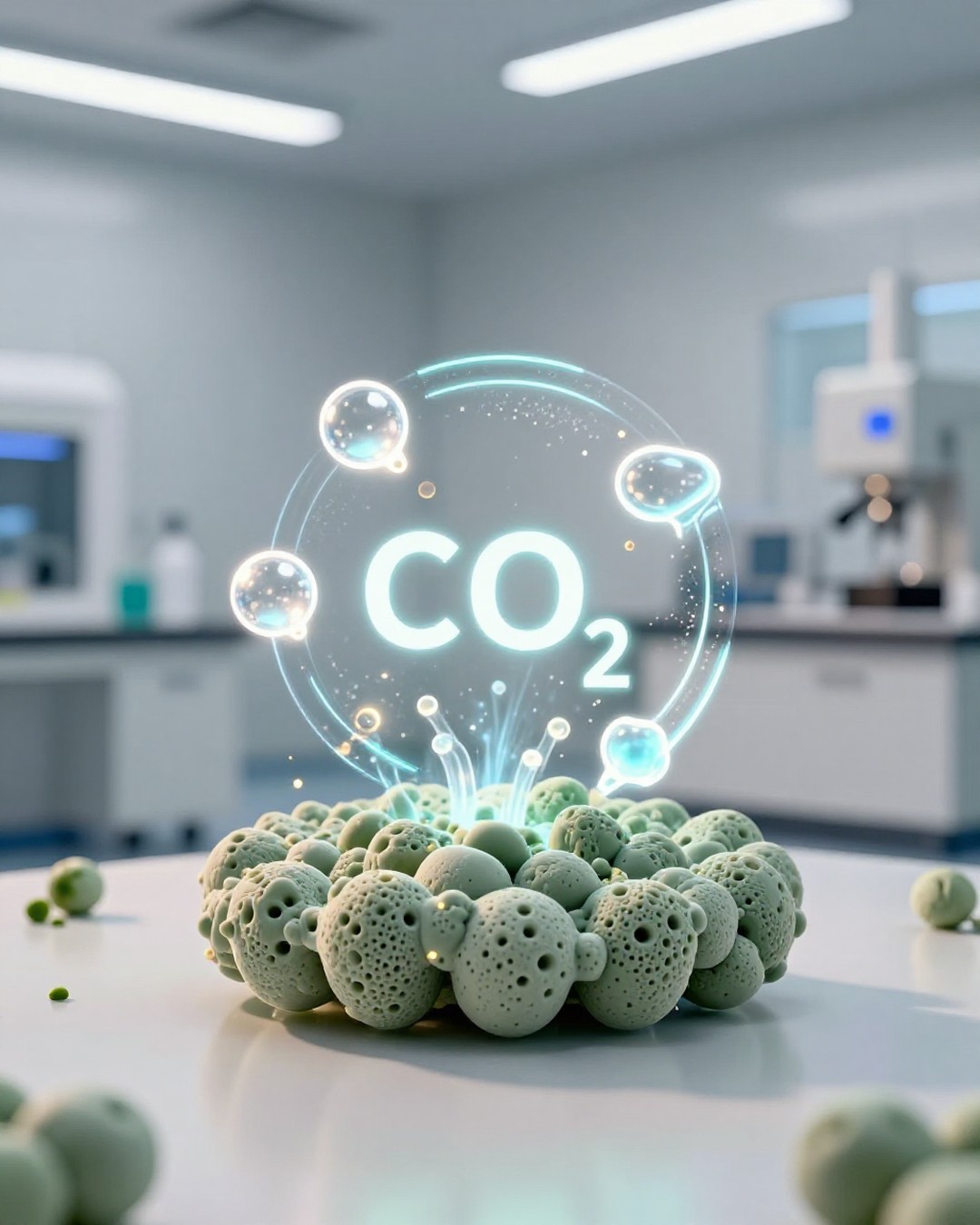
Food Waste-Derived Carbon Capture Technology

ClimateChange CarbonCapture Sustainability ETHZurich Innovation CircularEconomy

Riepilogo

Immagine Copertina Mappa Mentale
Immagine Copertina Generata da AI

Researchers at ETH Zurich have developed a breakthrough direct air capture (DAC) technology that utilizes protein-rich food waste from dairy and tofu production to capture atmospheric carbon dioxide. By assembling extracted proteins into amyloid fibrils and combining them with potassium hydroxide, the team created porous, sponge-like beads capable of absorbing CO2 with 10 to 50 percent higher efficiency than conventional methods. The study, published in PNAS on June 15, 2026, highlights a shift toward sustainable, circular economy practices in climate technology. Unlike traditional DAC systems that require high energy for heat-based carbon release, this new method uses a mild acid-base spray at room temperature, significantly reducing energy consumption and operational costs. The protein beads demonstrate remarkable durability, maintaining performance over 30 cycles of capture and release. Furthermore, the material is non-toxic and biodegradable, allowing for secondary use as agricultural fertilizer or biofuel once its carbon-capture lifespan concludes, effectively minimizing environmental impact. This innovation offers a scalable, low-energy solution for carbon removal, addressing the urgent need for technologies that can help limit global warming to 1.5°C. Future research will focus on industrial-scale implementation to validate the laboratory findings in real-world environments.

Punti Chiave

01

🔹 Breakthrough Carbon Capture Material

Researchers at ETH Zurich developed porous beads using amyloid fibrils extracted from dairy and tofu waste. These beads, loaded with potassium hydroxide, act as a sponge to absorb CO2 from ambient air, converting it into hydrogen carbonate.

02

🔸 Superior Performance Metrics

【📌 Key Finding】The material extracts 97 milligrams of CO2 per gram of beads. 【⭐ Data Support】This capacity exceeds conventional DAC technologies by 10 to 50 percent, with one kilogram of material theoretically capturing 100 grams of CO2 per cycle.

03

⭐ Energy-Efficient Release Mechanism

Unlike traditional heat-intensive DAC systems, this method uses a mild acid and base spray at room temperature to release captured CO2. This process takes approximately 10 minutes and allows for the reuse of the beads, acid, and base.

04

📊 Circular Economy Integration

The beads are non-toxic and biodegradable. After their functional lifespan (several thousand cycles), they can be repurposed as agricultural fertilizer or biofuel, ensuring the technology contributes to a circular economy rather than creating new waste.

05

💡 Scalability and Future Outlook

Led by Raffaele Mezzenga and lead author Zhou Dong, the team is optimistic about industrial scaling. The process is compatible with existing industrial spray techniques, and the use of widely available food waste suggests a lower cost profile compared to current carbon removal solutions.

Vuoi creare la tua mappa mentale?

Accedi a Neumap AI e inizia a creare le tue mappe mentali!

Inizia Ora