125-Million-Year-Old Crocodile Fossil Secrets

scitechdaily paleontology fossils crocodiles evolution spain cretaceous

Riepilogo

Immagine Copertina Mappa Mentale
Immagine Copertina Generata da AI

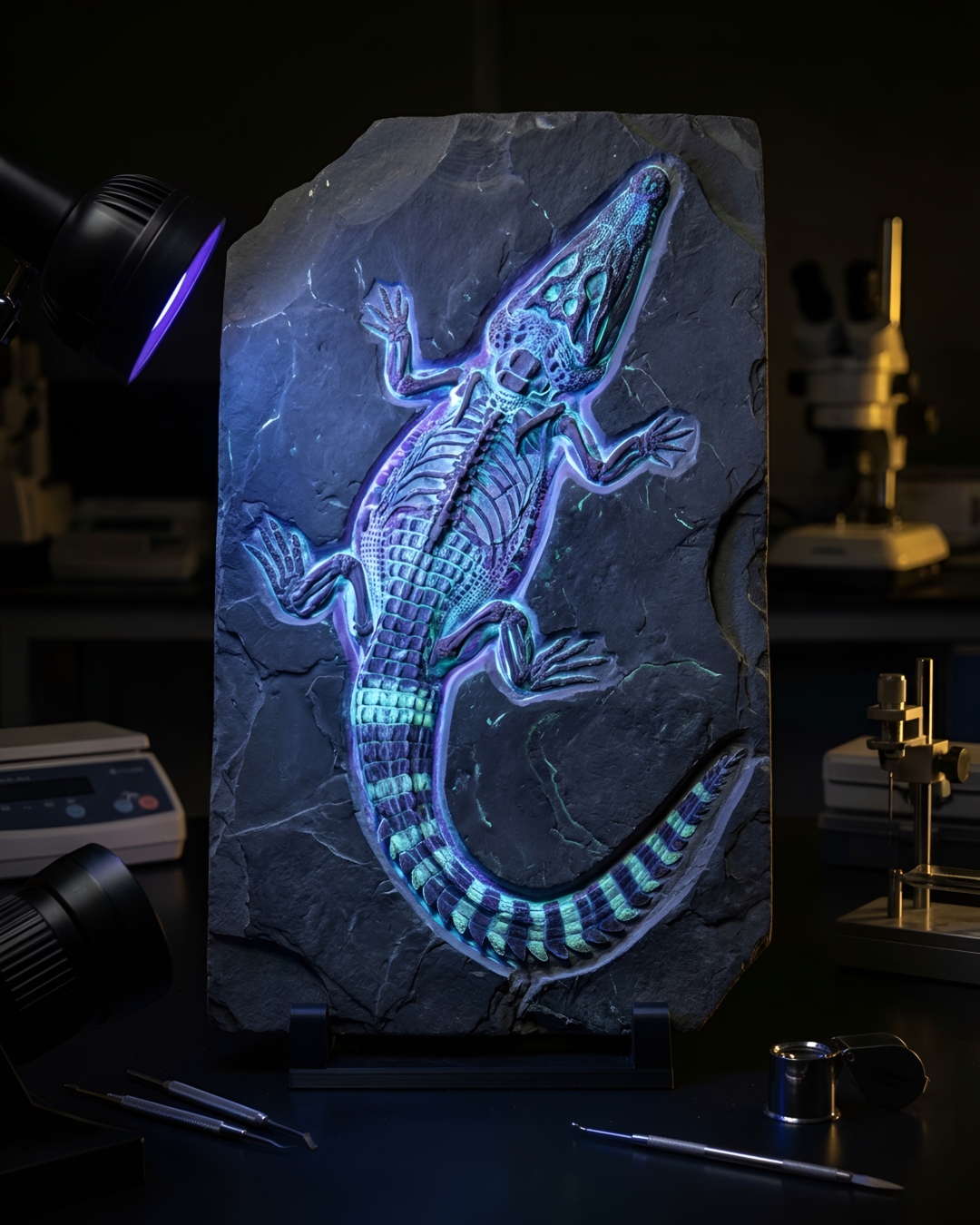
Researchers have uncovered exceptional soft-tissue preservation in a 125-million-year-old Early Cretaceous crocodylomorph fossil named Montsecosuchus depereti, discovered at the Pedrera de Meià site in Catalonia, Spain. Utilizing ultraviolet imaging, paleontologists Oscar Castillo-Visa and Jesús Serrano identified detailed epidermal scales, localized sensory structures, chest cartilage, and potential tail coloration bands. Published on June 13, 2026, in the Zoological Journal of the Linnean Society, the study reveals that this primitive reptile was already well adapted to a semi-aquatic lifestyle with a complex respiratory system. The authors emphasize that advanced ultraviolet photography allows scientists to extract hidden anatomical data from historical museum specimens that standard lighting completely misses. By highlighting fossilized soft tissues that fluoresce differently from surrounding lithographic limestone, the research team successfully mapped scale variation, noting the absence of a modern tail fin and the presence of localized sensory organs akin to those in living crocodilians. The findings establish crucial evolutionary milestones regarding how specialized physiological traits such as pressure-sensing integumentary organs and advanced rib cage ventilation developed over geological time. Furthermore, the detection of alternating light and dark bands on the tail scales represents the oldest known preserved color patterning in any crocodylomorph lineage, pointing toward early disruptive camouflage mechanisms. This discovery highlights the extraordinary scientific value of Konservat-Lagerstätten deposits like Pedrera de Meià for vertebrate paleontology, supporting ongoing efforts to reconstruct ancient ecosystems. Scholars and visitors can examine these exceptional fossils at the Museum of Natural Sciences of Barcelona and the Montsec de Meià Interpretation Center, demonstrating the profound impact of modern imaging technologies on historical paleontological collections.

Punti Chiave

01

🔹 Discovery and Specimen Details

【📌 Fossil Identification】Cataloged as specimen MGB-512 and housing at the Museum of Natural Sciences of Barcelona, the Montsecosuchus depereti holotype measures about 50 centimeters (20 inches) long. 【⭐ Provenance】Unearthed from the Pedrera de Meià site in Catalonia, northeastern Spain, within the UNESCO Orígens Global Geopark. 【📊 Geological Context】Dated to the Early Cretaceous period around 125 million years ago, originating from fine lake sediments of a karst lake near the coast.

02

🔸 Ultraviolet Imaging Breakthroughs

【📌 Technical Method】Paleontologists Oscar Castillo-Visa and Jesús Serrano applied ultraviolet light photography to the fossil specimen. 【⭐ Fluorescence Effect】Fossilized soft tissues fluoresce differently than the surrounding lithographic limestone, exposing details invisible under ordinary lighting. 【💡 Re-examination】Demonstrates how modern non-destructive imaging transforms century-old museum specimens into rich sources of new anatomical data.

03

⭐ Soft Tissue and Skin Structure Analysis

【📌 Epidermal Scales】Provided the first detailed description of Montsecosuchus skin, revealing wide variation in scale size and shape across the body. 【⚖️ Morphological Differences】Confirmed that the animal completely lacked the tall, vertically flattened tail fin characteristic of modern crocodiles. 【🔍 Sensory Organs】Identified probable sensory structures restricted to localized regions around the neck, limbs, and tail sides, suggesting these organs evolved locally before spreading fully in later crocodilians.

04

📊 Respiratory System and Cartilage Preservation

【📌 Chest Anatomy】Ultraviolet imaging exposed preserved cartilage associated with the ventral ribs inside the chest cavity. 【🔗 Functional Implication】Indicates a well-developed respiratory system sharing structural similarities with modern crocodiles. 【⭐ Evolutionary Status】Proves that despite its primitive phylogenetic position, Montsecosuchus possessed complex physiological adaptations suited for a semi-aquatic lifestyle.

05

💡 Oldest Preserved Color Patterning

【📌 Pigmentation Evidence】Ultraviolet light revealed alternating light and dark bands across scales on the fossilized tail. 【🎯 Behavioral Adaptation】Interpreted by researchers as the animal's original color pattern providing disruptive camouflage to break up its body outline. 【⭐ Scientific Significance】Marks the oldest known instance of preserved coloration in any crocodylomorph species, suggesting patterns resembled those of living relatives.

Vuoi creare la tua mappa mentale?

Accedi a Neumap AI e inizia a creare le tue mappe mentali!

Inizia Ora