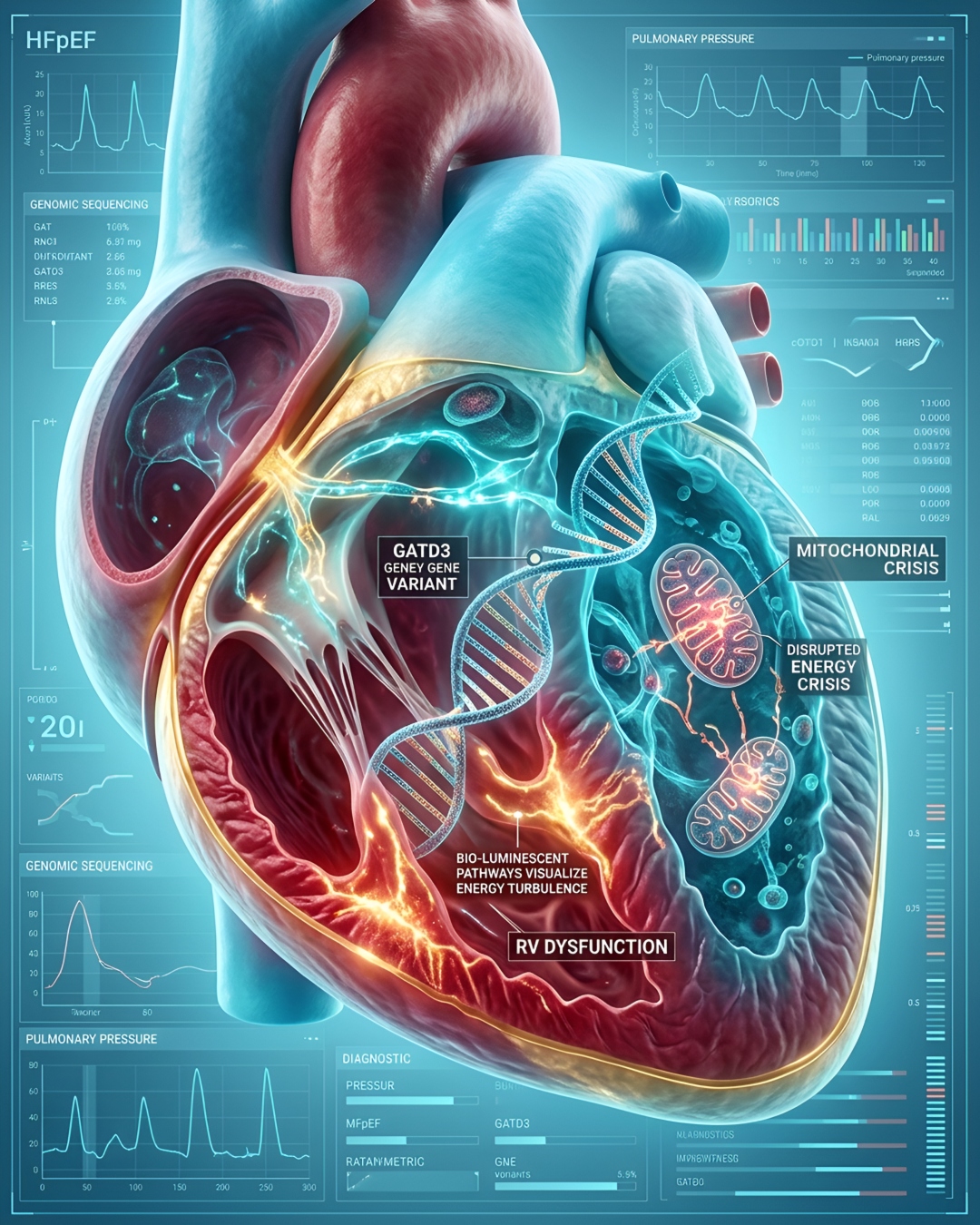
Right Ventricular Dysfunction in Heart Failure with Preserved Ejection Fraction

scitechdaily cardiovascular-disease heart-failure medical-research precision-medicine

Riepilogo

Immagine Copertina Mappa Mentale
Immagine Copertina Generata da AI

A prevalent and challenging form of heart failure known as heart failure with preserved ejection fraction affects approximately 3 million people in the United States, predominantly women and individuals with conditions like hypertension, diabetes, and obesity. Researchers at the University of Wisconsin-Madison and the Morgridge Institute for Research published a study on August 24, 2026, in Circulation: Heart Failure revealing that right ventricular dysfunction serves as a critical prognostic indicator for worse patient outcomes and higher mortality rates. The study demonstrates how left-sided heart stiffening elevates pulmonary vascular pressure, causing severe turbulence and subsequent right ventricular strain, which standard broader treatments like sildenafil or levosimendan have historically failed to alleviate. By utilizing advanced long-read RNA sequencing and cardiac evaluations on 48 patients, the research team identified specific molecular disruptions, notably reduced mitochondrial function and elevated variants in the GATD3 gene linked to cellular energy metabolism. The core discovery emphasizes that patient responses vary significantly due to underlying biological differences, making broad population treatments ineffective. Pinpointing right ventricular performance and energy metabolism markers allows modern cardiology to transition toward precision medicine, matching specific disease pathways with existing targeted pharmacological interventions. Clinical professionals and researchers can utilize these findings to stratify heart failure patients into distinct biological subgroups, designing future precision clinical trials that target mitochondrial and RNA processing abnormalities to dramatically improve quality of life and decrease mortality.

Punti Chiave

01

🔹 Patient Demographics and Disease Scale

Approximately 3 million people in the United States live with heart failure with preserved ejection fraction, a condition characterized by a stiffened heart that fails to fill properly during activity. The condition disproportionately affects women and individuals suffering from aging, hypertension, diabetes, and obesity, yielding a severe annual mortality rate of 15% when complicated by pulmonary hypertension.

02

🔸 Right Ventricular Dysfunction as a Prognostic Indicator

【📌 Key Finding】Right ventricular dysfunction closely tracks with worse clinical outcomes and higher hospitalization and death rates. 【🔸 Impact Factors】Pressure backs up from the left ventricle into the lungs, causing pulmonary hypertension and subsequent right ventricular strain. 【⭐ Data Support】Out of 48 studied patients with pulmonary hypertension and heart failure with preserved ejection fraction, 19 developed right ventricular dysfunction, which predicted patient prognosis more effectively than traditional classification methods.

03

⭐ Failure of Broad Treatment Approaches

Traditional pulmonary hypertension drugs like sildenafil and oral levosimendan have repeatedly failed in clinical trials for this patient population because treating all patients as a single group conceals critical biological differences. Increasing fluid flow through a turbulent pulmonary river with broad vasodilators only causes higher turbulence and flooding upstream in the lungs.

04

📊 Cellular Energy Crisis and Mitochondrial Mechanisms

Tissue biopsies and long-read RNA sequencing revealed that the strongest biological theme driving the disease is disrupted energy metabolism and reduced mitochondrial function. Specifically, a variant of the GATD3 gene associated with mitochondrial function appeared at significantly higher levels in patients whose right ventricles were impaired.

05

💡 Pathway Toward Precision Clinical Trials

Researchers aim to divide heart failure with preserved ejection fraction into biologically meaningful subgroups using a sophisticated analytical pipeline. By identifying specific molecular pathways pushing the right ventricle toward failure, doctors can eventually match patients with already approved targeted drugs in forthcoming human precision clinical trials.

Vuoi creare la tua mappa mentale?

Accedi a Neumap AI e inizia a creare le tue mappe mentali!

Inizia Ora