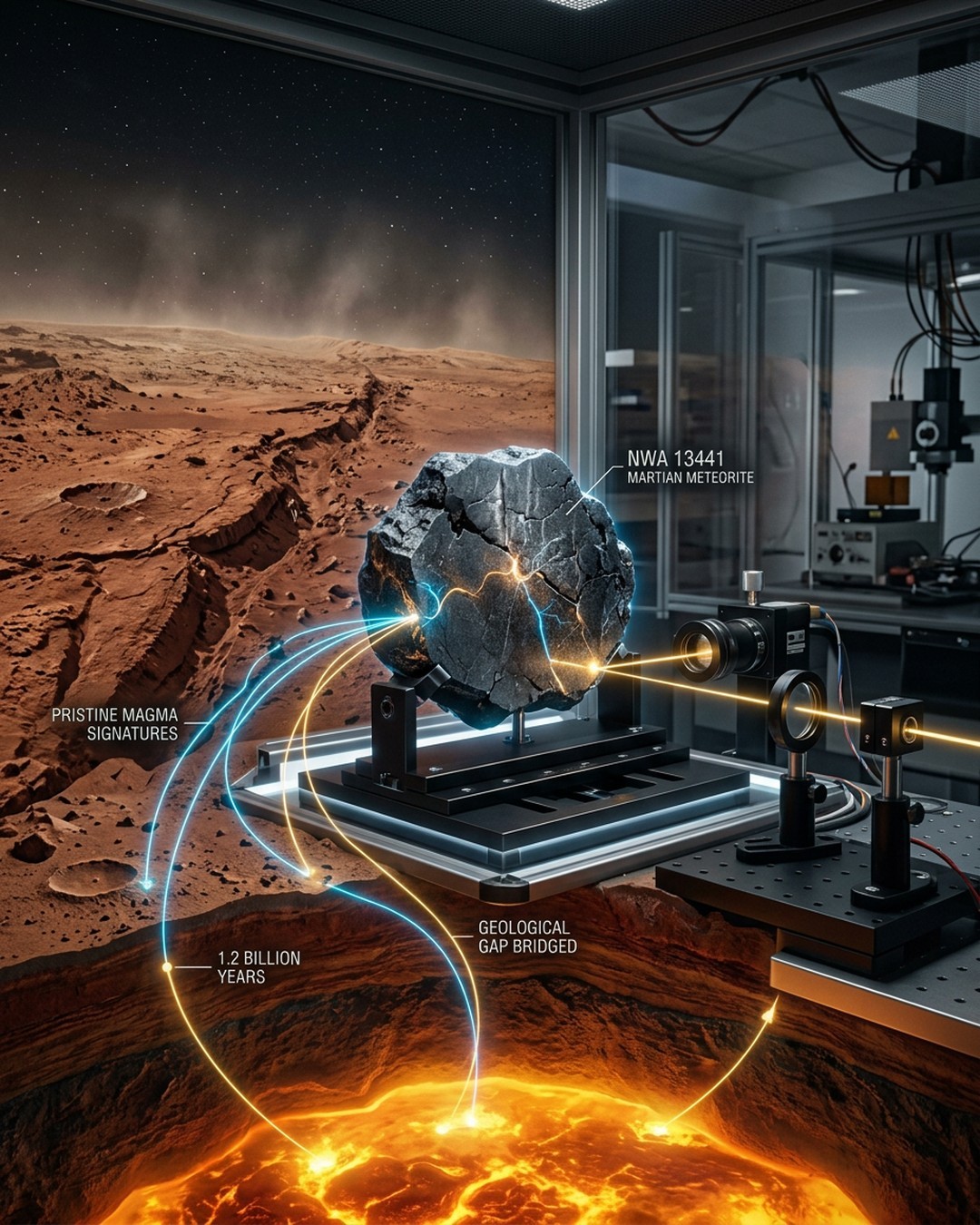
NWA 13441 Martian Meteorite Discovery

boston-college mars meteorites planetary-science geochemistry

Riepilogo

Immagine Copertina Mappa Mentale
Immagine Copertina Generata da AI

Scientists at Boston College have discovered that Northwest Africa (NWA) 13441, a Martian meteorite found in Algeria in 2019, crystallized approximately 1.273 billion years ago. This discovery successfully bridges an approximately 1.8 to 2 billion-year gap in the known record of shergottites, the most common type of Martian igneous meteorites, which previously lacked samples between 600 million and 2.4 billion years old. The researchers determined through high-precision neodymium isotope analysis that the meteorite possesses a chondritic initial composition resembling primordial material from the birth of the solar system about 4.56 billion years ago. This unique chemical signature indicates that the magma originated from a previously unsampled, pristine reservoir deep inside Mars that preserved an ancient chemical memory. Unlike Earth, which constantly destroys and recycles its crust and interior through plate tectonics, Mars formed rapidly and evolved under a stagnant outer shell. This geological difference allowed ancient chemical reservoirs and primordial structures to survive for billions of years, making Martian meteorites invaluable natural time capsules for planetary evolution. Researchers plan to analyze additional isotope systems in NWA 13441 to further clarify its petrogenesis and relationship with other Martian meteorites. These ongoing studies will provide deeper insights into early magmatic and volcanic activity on Mars and help decode the planet's earliest geological history.

Punti Chiave

01

🔹 Discovery of NWA 13441 and Dating

【📌 Key Finding】Researchers at Boston College determined that Northwest Africa (NWA) 13441 crystallized 1.273 billion years ago. 【⭐ Data Support】Discovered in Algeria in 2019, this olivine-rich basalt meteorite was analyzed using high-precision isotope techniques by teams at Boston College, Scripps Institution of Oceanography, and The Open University.

02

🔸 Bridging the Shergottite Age Gap

【📌 Key Finding】Shergottites are the dominant group of Martian igneous meteorites, but nearly all previously dated samples are either younger than 600 million years or older than 2.4 billion years. 【⭐ Data Support】NWA 13441 successfully fills an approximately 1.8 to 2 billion-year gap in the known shergottite record, providing crucial data on Martian volcanism.

03

⭐ Unexpected Chondritic Neodymium Signature

【📌 Key Finding】Neodymium isotope analysis revealed that NWA 13441 has a chondritic initial composition resembling primordial solar system material from 4.56 billion years ago. 【⭐ Data Support】This is the first direct evidence of a broadly chondritic Martian mantle source from this period, indicating the magma tapped a pristine, previously unsampled internal reservoir.

04

📊 Planetary Comparison: Mars vs Earth Geology

【📌 Key Finding】Earth constantly reworks its crust and interior through plate tectonics, erasing its earliest history. 【⭐ Data Support】Mars lacks moving tectonic plates and evolved under a stagnant outer shell, allowing ancient chemical reservoirs and geological structures to survive for billions of years.

05

💡 Origin and Future Research Directions

【📌 Key Finding】NWA 13441 shows signs of intense shock and crystallized near the boundary of Mars' crust and mantle before being ejected into space by a violent impact. 【⭐ Data Support】Led by Professor Ethan Baxter, the laboratory is currently analyzing additional isotope systems to further understand early Mars evolution.

Vuoi creare la tua mappa mentale?

Accedi a Neumap AI e inizia a creare le tue mappe mentali!

Inizia Ora