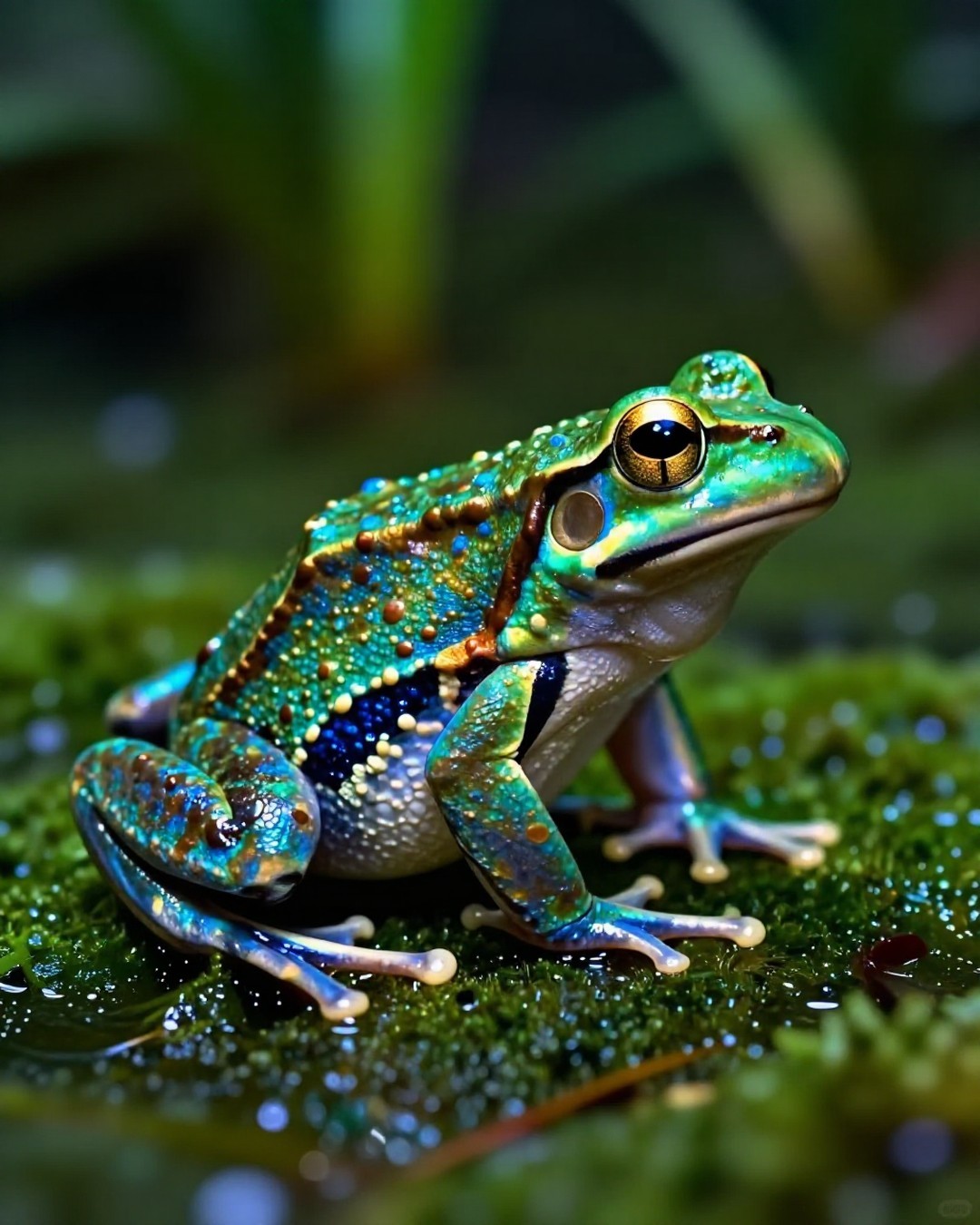
Iridescent Optical Effect in Green and Golden Bell Frogs

Biology Amphibians NewcastleUniversity EvolutionaryBiology OpticalScience

Riepilogo

Immagine Copertina Mappa Mentale
Immagine Copertina Generata da AI

Researchers at the University of Newcastle have identified a rare iridescent optical effect in the inner thigh skin of the green and golden bell frog (Ranoidea aurea). Published on July 14, 2026, in the journal Austral Ecology, the study demonstrates that the frog's skin can shift color from blue to green depending on the viewing angle, a phenomenon rarely documented in amphibians. The lead author, Dr. John Gould, emphasizes that this color-shifting capability is not merely a result of pigment but is driven by the precise, ordered arrangement of microscopic reflective platelets within the skin cells. This structural coloration allows the frog to manipulate light in complex ways, challenging previous assumptions that frog skin color was primarily produced by random light scattering. This discovery suggests that the iridescent blue patches serve as a form of flash coloration, which may startle predators or distract them during the frog's escape. By revealing the hidden complexity of amphibian skin, the research highlights that such optical systems may be more widespread in the animal kingdom than previously understood. For researchers and conservationists, this finding underscores the importance of studying subtle biological traits in well-known species. It provides a new framework for understanding anti-predator defense mechanisms and the evolution of structural coloration in amphibians, encouraging further investigation into similar optical phenomena in other species.

Punti Chiave

01

🔹 Discovery of Iridescence in Ranoidea aurea

【📌 Key Finding】Researchers at the University of Newcastle discovered that the green and golden bell frog (Ranoidea aurea) exhibits rare tissue-wide iridescence on its inner thighs. 【⭐ Data Support】The study, published on July 14, 2026, in Austral Ecology, confirms that the skin shifts from blue to green based on the observer's viewing angle, marking one of the clearest examples of this effect in amphibians.

02

🔸 Mechanism of Structural Coloration

【📌 Key Finding】The color-shifting effect is not produced by pigments but by structural coloration. 【🔸 Impact Factors】Unlike random light scattering, this iridescence requires an ordered arrangement of microscopic reflective platelets within the skin cells. This organization allows the skin to interfere with light wavelengths, creating dynamic color changes that vary with the angle of observation.

03

⭐ Anti-Predator Defense Strategy

【📌 Key Finding】The iridescent blue inner thighs function as a flash coloration mechanism. 【🔸 Impact Factors】The color remains hidden while the frog is at rest but becomes visible during movement, such as jumping or stretching. This sudden burst of color serves to startle predators or divert their attention away from the frog's body, thereby increasing the animal's chances of survival during an escape.

04

📊 Implications for Amphibian Evolution

【📌 Key Finding】The discovery challenges the scientific understanding of how amphibians produce blue coloration. 【🔸 Impact Factors】Previously, it was assumed that blue in frogs was largely due to random light scattering. This study proves that complex, ordered optical systems exist in amphibian skin, suggesting that similar, previously overlooked optical effects may be common across various amphibian species.

05

💡 Research Significance and Future Outlook

【📌 Key Finding】The study highlights the hidden complexity of animal biology in well-known species. 【🔸 Impact Factors】Dr. John Gould and his team suggest that because these effects are often brief or angle-dependent, they have likely gone unnoticed in many other species. This research provides a new foundation for future studies into the evolution and function of structural colors in the animal kingdom.

Vuoi creare la tua mappa mentale?

Accedi a Neumap AI e inizia a creare le tue mappe mentali!

Inizia Ora