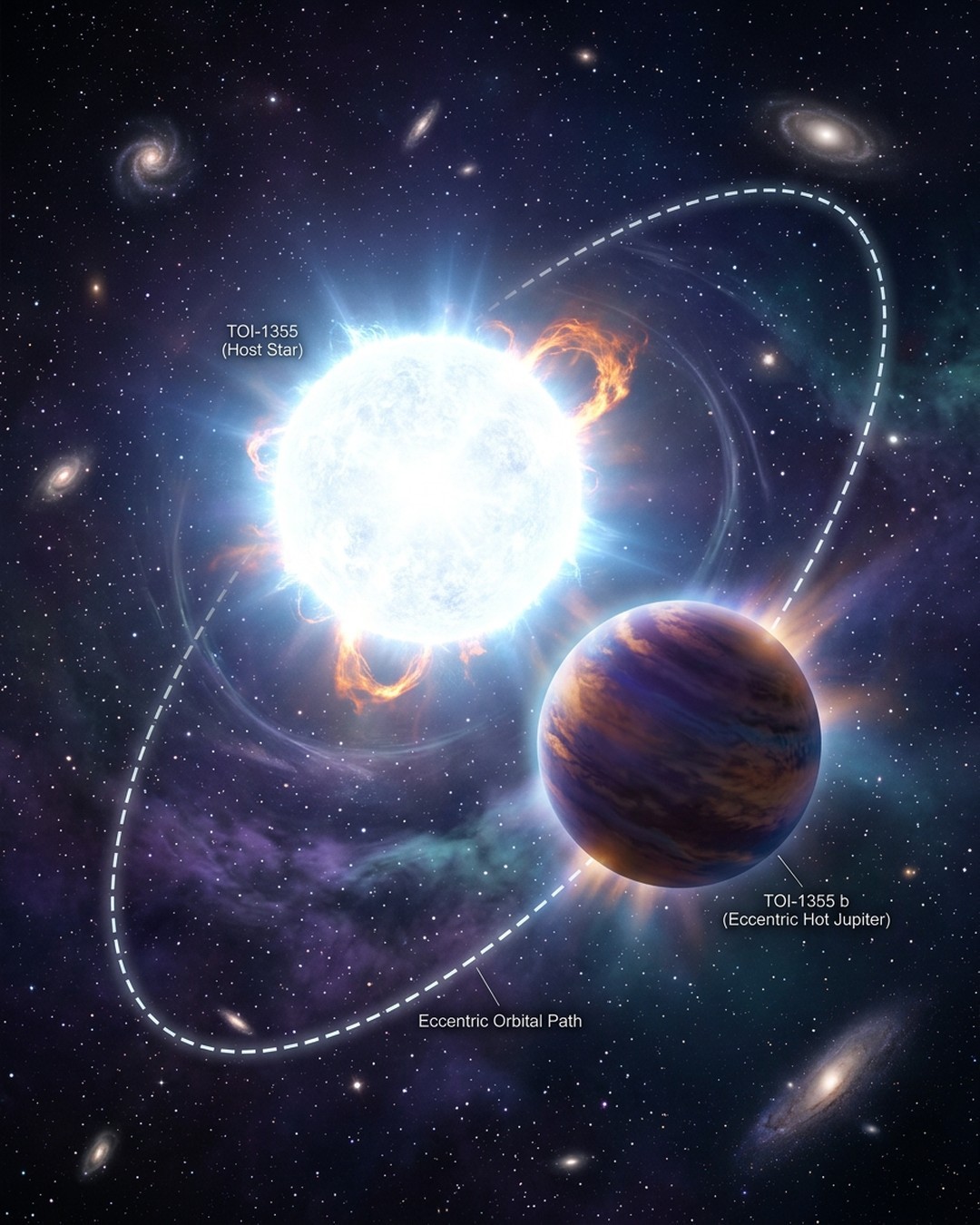
TOI-1355 b: Eccentric Hot Jupiter Orbiting an Extremely Hot Star

astronomy exoplanet university-of-tokyo space-science scitechdaily

Riepilogo

Immagine Copertina Mappa Mentale
Immagine Copertina Generata da AI

Astronomers from the University of Tokyo and international collaborators discovered an unusual exoplanet named TOI-1355 b orbiting a hot star with a surface temperature of approximately 8,400 degrees Celsius or 15,152 degrees Fahrenheit. Published on September 18, 2026, in the Publications of the Astronomical Society of Japan, the study reveals that this giant gas planet completes an orbit every two Earth days while following a highly elliptical path instead of a circular one. The researchers explain that the planet's eccentric trajectory likely originated from past gravitational interactions with other massive celestial bodies before experiencing tidal effects from its host star. This discovery provides critical insights into the orbital migration and evolutionary history of hot Jupiters surrounding unusually hot stars. The analysis relies on data from NASA's Transiting Exoplanet Survey Satellite, which detected brightness drops during transits and secondary eclipses. The anomalous timing of the secondary eclipse first alerted the research team, led by Project Researcher Noriharu Watanabe and Professor Norio Narita, to the planet's elongated orbit. Scientists emphasize that observation opportunities will become severely limited after around 2033 due to the planet's evolving orbital geometry, which will prevent transit viewings from Earth for hundreds of years. The team plans future observations using NASA's James Webb Space Telescope to further investigate the orbital tilt and atmospheric characteristics.

Punti Chiave

01

🔹 Discovery of TOI-1355 b Orbiting an Extremely Hot Star

【📌 Key Finding】Astronomers identified TOI-1355 b, a massive gas giant belonging to the hot Jupiter class, orbiting a star with a surface temperature of approximately 8,400 degrees Celsius or 15,152 degrees Fahrenheit. 【⭐ Data Support】The planet completes one full revolution around its host star in roughly two Earth days while maintaining an unexpected elliptical orbit.

02

🔸 Detection Methods and Anomalous Secondary Eclipses

【📌 Key Finding】NASA's Transiting Exoplanet Survey Satellite detected periodic brightness dips caused by planetary transits. 【⭐ Data Support】Researchers found that the secondary eclipse occurred faster than expected for a circular orbit, revealing that TOI-1355 b travels along an eccentric trajectory.

03

⭐ Turbulent History and Orbital Migration Mechanisms

【📌 Key Finding】The planet's pronounced orbital eccentricity is consistent with a history of gravitational disturbances followed by tidal evolution. 【🔸 Impact Factors】Initial gravitational interactions with other giant planets likely created a highly elliptical path, which gradually shrunk over time due to the host star's tidal effects.

04

📊 Observational Challenges and Future Research Plans

【📌 Key Finding】After around 2033, TOI-1355 b will leave its transit geometry from Earth's perspective, making it impossible to observe transits and eclipses for hundreds of years. 【💡 Future Actions】Researchers are preparing observation proposals involving NASA's James Webb Space Telescope to study the planet's orbital tilt relative to its star's rotation.

05

🏛️ Research Leadership and Publication Details

【📌 Key Finding】The study was led by Project Researcher Noriharu Watanabe and Professor Norio Narita from the University of Tokyo's Graduate School of Arts and Sciences. 【⭐ Data Support】The findings were published on September 18, 2026, in the Publications of the Astronomical Society of Japan under the DOI 10.1093/pasj/psag103.

Vuoi creare la tua mappa mentale?

Accedi a Neumap AI e inizia a creare le tue mappe mentali!

Inizia Ora