NHS AI Scribes Patient Safety Risks

HealthwatchEngland ArtificialIntelligence PatientSafety NHS MedicalTechnology

Riepilogo

Immagine Copertina Mappa Mentale
Immagine Copertina Generata da AI

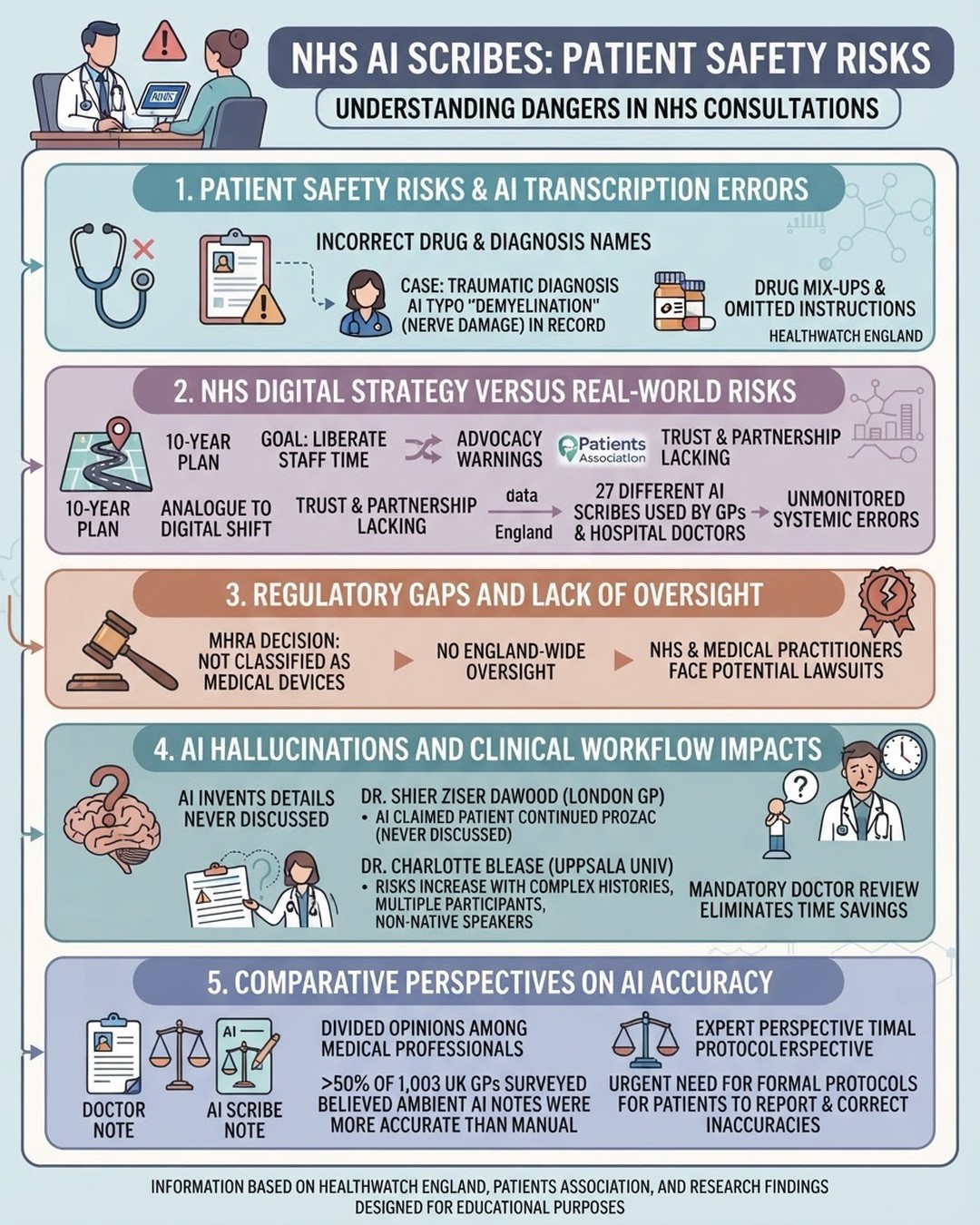
AI scribes used in NHS consultations are posing patient safety risks by incorrectly transcribing names of drugs, illnesses, and medical diagnoses. Healthwatch England highlighted cases including a patient mistakenly given a traumatic diagnosis of demyelination due to an AI error and transcription mix-ups involving prescription drugs. The government's 10-year health plan heavily relies on AI scribes to reduce bureaucratic burdens and modernize services, but critics warn that the technology causes dangerous hallucinations and errors. Furthermore, the Medicines and Healthcare products Regulatory Agency has chosen not to classify AI scribes as medical devices, leaving a critical lack of national oversight. Medical professionals and patient advocacy groups emphasize that trust and robust communication are currently missing, noting that patients frequently have to catch and correct these AI mistakes themselves. Additionally, the necessity for doctors to meticulously review transcripts diminishes expected time-saving benefits while increasing legal liability risks for the NHS. Experts urge immediate clarity on reporting mechanisms for AI errors and recommend enhanced partnership with patients to safeguard medical records. Without stringent regulatory oversight and improved accuracy, the rapid rollout of ambient voice technology risks compromising the integrity of patient care across England.

Punti Chiave

01

🔹 Patient Safety Risks and AI Transcription Errors

【📌 Key Finding】AI scribes listening to doctor-patient consultations are generating dangerous inaccuracies in medical records. 【🔸 Impact Factors】A female NHS health professional was traumatized when an AI tool incorrectly diagnosed her with demyelination, a serious nerve damage linked to multiple sclerosis, which was later identified as a null result typo. 【⭐ Data Support】Healthwatch England documented multiple errors where AI confused prescribed drugs with similarly named medications and omitted vital hospital consultant instructions for repeat prescriptions.

02

🔸 NHS Digital Strategy versus Real-World Risks

【📌 Key Finding】The government's 10-year health plan for the NHS in England promotes AI scribes to shift from an analogue to a digital service and reduce administrative burdens. 【🔸 Impact Factors】Despite leadership goals to liberate staff time, patient advocacy groups like the Patients Association warn that trust and genuine partnership with patients are currently lacking. 【⭐ Data Support】GPs and hospital doctors across England are already utilizing 27 different AI scribes, heightening the exposure to unmonitored systemic errors.

03

⭐ Regulatory Gaps and Lack of Oversight

【📌 Key Finding】The Medicines and Healthcare products Regulatory Agency decided not to classify AI scribes as medical devices. 【🔸 Impact Factors】This classification decision means there is no England-wide oversight to ensure the safety and effectiveness of these tools. 【⭐ Data Support】Ministers have received direct warnings that both the NHS and individual medical practitioners could face lawsuits over mistakes generated by unmonitored artificial intelligence.

04

📊 AI Hallucinations and Clinical Workflow Impacts

【📌 Key Finding】AI scribes frequently suffer from hallucinations, referencing details never discussed during consultations. 【🔸 Impact Factors】London GP Dr Shier Ziser Dawood noted an instance where an AI scribe claimed a patient was told to continue taking Prozac even though the drug was never prescribed or discussed. 【⭐ Data Support】Research by Dr Charlotte Blease from Uppsala University revealed that error risks increase with multiple participants, complex medical histories, and non-native English speakers, while mandatory doctor review eliminates intended time savings and threatens to increase daily patient loads.

05

💡 Comparative Perspectives on AI Accuracy

【📌 Key Finding】Opinions among medical professionals regarding AI accuracy remain divided despite documented failures. 【🔸 Impact Factors】More than half of the 1,003 UK GPs surveyed last year believed ambient AI records were more accurate than their own manual notes. 【⭐ Data Support】Experts emphasize that while human doctors also make mistakes, the specific error profile of AI tools requires urgent establishment of formal protocols allowing patients to report and correct inaccuracies.

Vuoi creare la tua mappa mentale?

Accedi a Neumap AI e inizia a creare le tue mappe mentali!

Inizia Ora